Overview
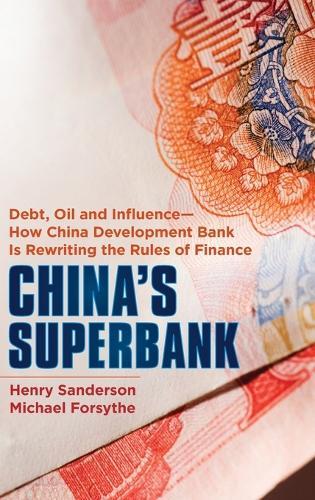
Inside the engine-room of China's economic growth—the China Development Bank Anyone wanting a primer on the secret of China's economic success need look no further than China Development Bank (CDB)—which has displaced the World Bank as the world's biggest development bank, lending billions to countries around the globe to further Chinese policy goals. In China’s Superbank, Bloomberg authors Michael Forsythe and Henry Sanderson outline how the bank is at the center of China's domestic economic growth and how it is helping to expand China's influence in strategically important overseas markets. 100 percent owned by the Chinese government, the CDB holds the key to understanding the inner workings of China's state-led economic development model, and its most glaring flaws. The bank is at the center of the country's efforts to build a world-class network of highways, railroads, and power grids, pioneering a lending scheme to local governments that threatens to spawn trillions of yuan in bad loans. It is doling out credit lines by the billions to Chinese solar and wind power makers, threatening to bury global competitors with a flood of cheap products. Another $45 billion in credit has been given to the country's two biggest telecom equipment makers who are using the money to win contracts around the globe, helping fulfill the goal of China's leaders for its leading companies to ""go global."" Bringing the story of China Development Bank to life by crisscrossing China to investigate the quality of its loans, China’s Superbank travels the globe, from Africa, where its China-Africa fund is displacing Western lenders in a battle for influence, to the oil fields of Venezuela. Offers a fascinating insight into the China Development Bank (CDB), the driver of China's rapid economic development Travels the globe to show how the CDB is helping Chinese businesses ""go global"" Written by two respected reporters at Bloomberg News As China's influence continues to grow around the world, many people are asking how far it will extend. China’s Superbank addresses these vital questions, looking at the institution at the heart of this growth.
Full Product Details
Author: Henry Sanderson ,
Michael Forsythe
Publisher: John Wiley & Sons Inc
Imprint: John Wiley & Sons Inc
Dimensions:
Width: 16.30cm
, Height: 2.10cm
, Length: 23.60cm
Weight: 0.558kg
ISBN: 9781118176368
ISBN 10: 1118176367
Pages: 250
Publication Date: 04 January 2013
Audience:
Professional and scholarly
,
Professional & Vocational
Format: Hardback
Publisher's Status: Active
Availability: Out of stock

The supplier is temporarily out of stock of this item. It will be ordered for you on backorder and shipped when it becomes available.
Reviews
Despite CDB s central role in developing China s economy and bankrolling the international expansion of Chinese companies, China s biggest policy lender rarely makes an appearance in most English-language chronicles of the country s economic rise. All the more reason then to praise a superbly researched new book, written by two Beijing-based reporters for Bloomberg, in which CDB finally makes a star turn. Lifting the veil on one of global finance s least understood institutions, the book is essential reading for anyone seeking insight into the workings of Chinese state capitalism. -- China Economic Quarterly, March 2013 Reviewer: Erica Downs of the Brookings Institution China's economy sometimes seems the work of miracles: three decades of economic growth, with GDP compounding at an annual rate of around 10%; the world's highest levels of savings and investment; vast trade surpluses, which feed the largest foreign-exchange reserves in history. The financial system has played a key role in delivering these economic feats, and no single institution within it has been more important than China Development Bank. Understand CDB, Henry Sanderson and Michael Forsythe write in China's Superbank, and you understand the core of China's state capitalism. -- Wall Street Journal review, Feb 27, 2013 The book is another useful insight into the workings of the Chinese state apparatus to come out of the Bloomberg bureau in Beijing in July it printed an expose about the family finances of Xi Jinping, and its website has been blocked since. One of the most striking aspects of the CDB story is how the bank managed to balance being a state-owned company with maintaining sufficient independence to function as a commercial business. -- Irish Times Calls for reform in China tend to come in two kinds one, the most common in Chinese social media and popular discussion, calls for a crackdown on endemic forms of local tyranny, such as land seizures, black prisons, and bribery. The other, found among liberals within the Party and expatriate businessmen, talks about rolling back the growing dominance of the state and state-owned companies over the Chinese economy, opening more markets to competition and ending the practices that allow state-owned (or state-blessed) companies to command cheap access to capital, natural resources, and land. So far, Xi Jinping's term looks promising for advocates of the first but the book [China's Superbank: Debt, Oil and Influence How China Development Bank is Rewriting the Rules of Finance] makes a case that land seizures are at the very foundations of China's model of state capitalism. -- The Diplomat
The book is another useful insight into the workings of the Chinese state apparatus to come out of the Bloomberg bureau in Beijing -- in July it printed an expose about the family finances of Xi Jinping, and its website has been blocked since. One of the most striking aspects of the CDB story is how the bank managed to balance being a state-owned company with maintaining sufficient independence to function as a commercial business. -- Irish Times Calls for reform in China tend to come in two kinds -- one, the most common in Chinese social media and popular discussion, calls for a crackdown on endemic forms of local tyranny, such as land seizures, black prisons, and bribery. The other, found among liberals within the Party and expatriate businessmen, talks about rolling back the growing dominance of the state and state-owned companies over the Chinese economy, opening more markets to competition and ending the practices that allow state-owned (or state-blessed) companies to command cheap access to capital, natural resources, and land. So far, Xi Jinping's term looks promising for advocates of the first but the book [China's Superbank: Debt, Oil and Influence -- How China Development Bank is Rewriting the Rules of Finance] makes a case that land seizures are at the very foundations of China's model of state capitalism. -- The Diplomat
Compelling read -- The Wall Street Journal The book is another useful insight into the workings of the Chinese state apparatus to come out of the Bloomberg bureau in Beijing -- in July it printed an expose about the family finances of Xi Jinping, and its website has been blocked since. One of the most striking aspects of the CDB story is how the bank managed to balance being a state-owned company with maintaining sufficient independence to function as a commercial business. -- Irish Times Calls for reform in China tend to come in two kinds -- one, the most common in Chinese social media and popular discussion, calls for a crackdown on endemic forms of local tyranny, such as land seizures, black prisons, and bribery. The other, found among liberals within the Party and expatriate businessmen, talks about rolling back the growing dominance of the state and state-owned companies over the Chinese economy, opening more markets to competition and ending the practices that allow state-owned (or state-blessed) companies to command cheap access to capital, natural resources, and land. So far, Xi Jinping's term looks promising for advocates of the first but the book [China's Superbank: Debt, Oil and Influence -- How China Development Bank is Rewriting the Rules of Finance] makes a case that land seizures are at the very foundations of China's model of state capitalism. -- The Diplomat
Author Information
HENRY SANDERSON has been a reporter for Bloomberg News since April 2010. Prior to that, he was a reporter for the Associated Press in Beijing and Dow Jones in New York. While at Bloomberg, Sanderson has covered corporate finance, focusing on China's banks, the bond market, and the emergence of the yuan as an international currency. He is a graduate of the University of Leeds (with a BA in Chinese and English literature) and Columbia University (with a Master's in East Asian Studies). MICHAEL FORSYTHE has been a reporter and editor for Bloomberg News since 2000. Prior to that, he was an officer in the U.S. Navy for seven years, serving on ships in the U.S. 7th Fleet. The highlight of his career in Washington was overseeing Bloomberg's coverage of the historic 2008 presidential election. Since returning to Beijing in 2009, Forsythe has focused on policy and politics, with particular emphasis on the international impact of ""China Inc."" He is a graduate of Georgetown University (with a BA in International Economics) and Harvard University (with a Master's in East Asian Regional Studies).