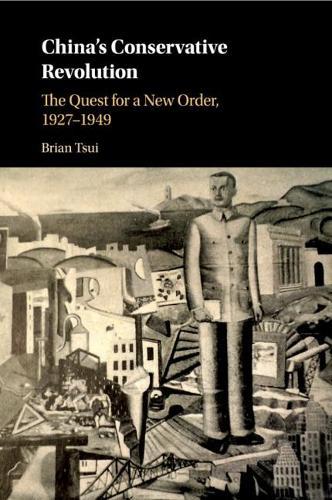
Full Product Details
Author: Brian Tsui (Hong Kong Polytechnic University)
Publisher: Cambridge University Press
Imprint: Cambridge University Press
Dimensions:
Width: 23.00cm
, Height: 1.50cm
, Length: 15.00cm
Weight: 0.450kg
ISBN: 9781316647226
ISBN 10: 1316647226
Pages: 304
Publication Date: 28 November 2019
Audience:
Professional and scholarly
,
Professional & Vocational
Format: Paperback
Publisher's Status: Active
Availability: Manufactured on demand

We will order this item for you from a manufactured on demand supplier.
Reviews
'In this incisive volume, Tsui conclusively demonstrates that the Nationalists' quest for 'capitalism without capitalism' - or fascism - was the central feature of the ideology and organization of the politics of conservatism in China's Republican period. This study is a meticulous work of history; it is also indispensable for our contemporary moment.' Rebecca E. Karl, New York University 'In this study of the 1930s, Brian Tsui reshapes our understanding of the radicalization of Chinese politics and culture. He situates China's 'conservative revolution' in the context of global history, showing how the Nationalists valorized the nation in a language of fascist modernity while forging bonds with anticolonial movements across Asia. If the conservative revolution failed in its own incoherent terms, it nonetheless left permanent marks.' Peter Zarrow, University of Connecticut 'As intellectual biography, Tsui brings to life Dai Jitao, Chen Lifu, Zhu Guangqian, Tan Yunshan, Fu Sinian, Jiang Dingfu, Li Shizeng and Pan Gongzhan as architects of the conservative revolution. ... Tsui has written a deeply researched and highly original re-interpretation of political thought during the Chiang Kai-shek era.' Stephen R. Mackinnon, The China Quarterly 'In his book, Brian Tsui expands discussion of nationalism and aesthetics at the core of the conservative revolution, moving from the United Front into the wartime period.' Jeremy Tai, Modern Chinese Literature and Culture 'Brian Tsui's outstanding new book is a welcome piece of scholarship that takes scholars back to the legacy of 1927 ... Understanding China's mid-twentieth century revolution in these terms gives Tsui's book a startling freshness. Its contemporary relevance is just one element of its quality; in the depths of its research and complexity and seriousness of its historical insights, it is a deeply significant work.' Rana Mitter, Journal of Chinese Studies 'In this incisive volume, Tsui conclusively demonstrates that the Nationalists' quest for 'capitalism without capitalism' - or fascism - was the central feature of the ideology and organization of the politics of conservatism in China's Republican period. This study is a meticulous work of history; it is also indispensable for our contemporary moment.' Rebecca E. Karl, New York University 'In this study of the 1930s, Brian Tsui reshapes our understanding of the radicalization of Chinese politics and culture. He situates China's 'conservative revolution' in the context of global history, showing how the Nationalists valorized the nation in a language of fascist modernity while forging bonds with anticolonial movements across Asia. If the conservative revolution failed in its own incoherent terms, it nonetheless left permanent marks.' Peter Zarrow, University of Connecticut 'As intellectual biography, Tsui brings to life Dai Jitao, Chen Lifu, Zhu Guangqian, Tan Yunshan, Fu Sinian, Jiang Dingfu, Li Shizeng and Pan Gongzhan as architects of the conservative revolution. ... Tsui has written a deeply researched and highly original re-interpretation of political thought during the Chiang Kai-shek era.' Stephen R. Mackinnon, The China Quarterly 'In his book, Brian Tsui expands discussion of nationalism and aesthetics at the core of the conservative revolution, moving from the United Front into the wartime period.' Jeremy Tai, Modern Chinese Literature and Culture 'Brian Tsui's outstanding new book is a welcome piece of scholarship that takes scholars back to the legacy of 1927 ... Understanding China's mid-twentieth century revolution in these terms gives Tsui's book a startling freshness. Its contemporary relevance is just one element of its quality; in the depths of its research and complexity and seriousness of its historical insights, it is a deeply significant work.' Rana Mitter, Journal of Chinese Studies
Author Information
Brian Tsui is Assistant Professor at the Hong Kong Polytechnic University. His works on Guomindang ideology, China-India relations and the Cold War have appeared in journals such as Modern China, Twentieth-Century China and positions: asia critique.