Overview
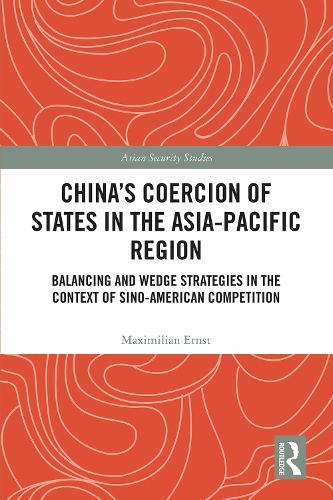
This book explains why China chooses to coerce Asia-Pacific regional states, despite the risk of such actions creating a backlash and complicating its strategic calculus. China’s coercion of neighboring states, often a variation of heavy informal economic sanctions combined with diplomatic pressure and gray-zone coercive measures, has been increasingly observable in the past decade. It has become an important tool in China’s foreign policy toolbox and is frequently used by Beijing to shape the security-political environment of the Asia-Pacific. The book begins with an appreciation of China’s complicated geopolitical exposition and an understanding that such coercion creates backlash, since the target state will likely be alienated and pushed into closer security cooperation with the United States, China’s main geopolitical rival. Through two in-depth case studies of Chinese coercion, targeting the Philippines and South Korea, respectively, the book demonstrates that, first, the reason China coerces is that the secondary state engages in actions that fundamentally threaten China’s security interests, and, second, it will coerce these states only if other policy options geared to change the secondary state’s course of action have not worked. Employing balance-of-power theory, and particularly wedge strategies, the book solves a pertinent research question and improves our knowledge of contemporary security politics in the Asia-Pacific. This book will be of interest to students, scholars and practitioners of Asia-Pacific security, Chinese foreign policy, and international relations.
Full Product Details
Author: Maximilian Ernst
Publisher: Taylor & Francis Ltd
Imprint: Routledge
Weight: 0.600kg
ISBN: 9781032812335
ISBN 10: 1032812338
Pages: 272
Publication Date: 11 February 2025
Audience:
College/higher education
,
Professional and scholarly
,
Tertiary & Higher Education
,
Professional & Vocational
Format: Hardback
Publisher's Status: Active
Availability: In Print

This item will be ordered in for you from one of our suppliers. Upon receipt, we will promptly dispatch it out to you. For in store availability, please contact us.
Reviews
""Why and how does China coerce other states, with a high risk of backlash? Ernst answers this important question with empirically rich case studies of China’s recent coercive policies toward South Korea and the Philippines. Policymakers and scholars alike will find valuable insights in this book."" Tongfi Kim, Professor in Asian Geopolitics and Korea Chair Senior Researcher, Brussels School of Governence, Belgium
Author Information
Maximilian Ernst is Associate Researcher at the Centre for Security, Diplomacy and Strategy (CSDS) at the Brussels School of Governance, Belgium.