Overview
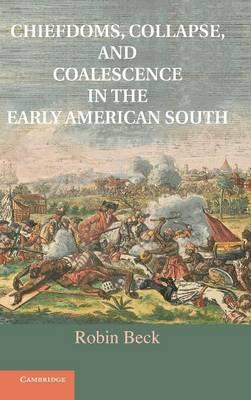
This book provides a new conceptual framework for understanding how the Indian nations of the early American South emerged from the ruins of a precolonial, Mississippian world. A broad regional synthesis that ranges over much of the Eastern Woodlands, its focus is on the Indians of the Carolina Piedmont - the Catawbas and their neighbors - from 1400 to 1725. Using an 'eventful' approach to social change, Robin Beck argues that the collapse of the Mississippian world was fundamentally a transformation of political economy, from one built on maize to one of guns, slaves and hides. The story takes us from first encounters through the rise of the Indian slave trade and the scourge of disease to the wars that shook the American South in the early 1700s. Yet the book's focus remains on the Catawbas, drawing on their experiences in a violent, unstable landscape to develop a comparative perspective on structural continuity and change.
Full Product Details
Author: Robin Beck ( Assistant Professor of Anthropology, University of Michigan, Ann Arbor) ,
Charles M. Hudson (University of Georgia)
Publisher: Cambridge University Press
Imprint: Cambridge University Press
Dimensions:
Width: 15.20cm
, Height: 1.90cm
, Length: 22.90cm
Weight: 0.600kg
ISBN: 9781107022133
ISBN 10: 1107022134
Pages: 322
Publication Date: 24 June 2013
Audience:
Professional and scholarly
,
Professional & Vocational
Format: Hardback
Publisher's Status: Active
Availability: Manufactured on demand

We will order this item for you from a manufactured on demand supplier.
Reviews
'Beck not only opens up the Mississippian world of the sixteenth century but also the various historical forces that worked to transform that world during the seventeenth and early eighteenth centuries. He writes with clarity, confidence, and authority and, without losing any of the power of the evidence or theory, he is careful to explain professional archaeological concepts for non-specialists. It is as fine a piece of scholarship as any I have ever seen.' Robbie Ethridge, University of Mississippi 'This is a tour de force on the subject of culture contact that should be widely read by both archaeologists and historians. Beck's argument is theoretically sophisticated and at the same time clearly presented.' David G. Anderson, University of Tennessee '... a must-read for teachers and scholars of the Native South.' Journal of American Studies 'This volume makes significant contributions to Southeastern archaeology and will be of great interest to anyone working with late prehistoric or colonial era indigenous communities.' Southeastern Archaeology
'Beck not only opens up the Mississippian world of the sixteenth century but also the various historical forces that worked to transform that world during the seventeenth and early eighteenth centuries. He writes with clarity, confidence, and authority and, without losing any of the power of the evidence or theory, he is careful to explain professional archaeological concepts for non-specialists. It is as fine a piece of scholarship as any I have ever seen.' Robbie Ethridge, University of Mississippi 'This is a tour de force on the subject of culture contact that should be widely read by both archaeologists and historians. Beck's argument is theoretically sophisticated and at the same time clearly presented.' David G. Anderson, University of Tennessee '... a must-read for teachers and scholars of the Native South.' Journal of American Studies 'This volume makes significant contributions to Southeastern archaeology and will be of great interest to anyone working with late prehistoric or colonial era indigenous communities.' Southeastern Archaeology 'Robin Beck's study traces the origin of the Catawba Indians from precontact Appalachian Mississippian chiefdoms through their emergence as a nation in the eighteenth-century Southeast ... a compelling argument that combines the best aspects of anthropological and historical methodology grounded in a thorough discussion of its theoretical implications ... This book is sure to open new avenues of inquiry not only for North American case studies but also for similar sociopolitical geneses elsewhere.' George Edward Milne, The Journal of American History
'Beck not only opens up the Mississippian world of the sixteenth century but also the various historical forces that worked to transform that world during the seventeenth and early eighteenth centuries. He writes with clarity, confidence, and authority and, without losing any of the power of the evidence or theory, he is careful to explain professional archaeological concepts for non-specialists. It is as fine a piece of scholarship as any I have ever seen.' Robbie Ethridge, University of Mississippi 'This is a tour de force on the subject of culture contact that should be widely read by both archaeologists and historians. Beck's argument is theoretically sophisticated and at the same time clearly presented.' David G. Anderson, University of Tennessee
Author Information
Robin Beck is an assistant professor in the Department of Anthropology and assistant curator of Eastern North American Archaeology at the Museum of Anthropology, University of Michigan, Ann Arbor. His research interests include the archaeology and ethnohistory of complex societies in eastern North America and the Andes of Bolivia and Peru, early colonial encounters in what is now the southern United States, and the broader issues related to social organization and change. He received his Ph.D. in Anthropology from Northwestern University in 2004. For his dissertation work, he excavated a Middle Formative (800–400 BC) ritual platform at the site of Alto Pukara, located in Bolivia's Lake Titicaca Basin at an altitude of 3800 m. His research at Alto Pukara used Lévi-Strauss' concept of the social house to understand transformations in public space during the Formative Period. Since 2001, concurrent with his Andean work, he has co-directed the Exploring Joara Project, which focuses on the archaeology and early colonial history of Native American societies in the North Carolina Piedmont. Robin and his colleagues have directed NSF-supported research along the Catawba River at the Berry site, location of the native town of Joara and the Spanish garrison Fort San Juan, built by the Juan Pardo expedition in 1567. Manned by thirty soldiers for eighteen months, this fort is the earliest European settlement in the interior of what is now the United States. Its excavation is shedding new light on the process and practice of colonialism near the very beginning of the colonial era.