Overview
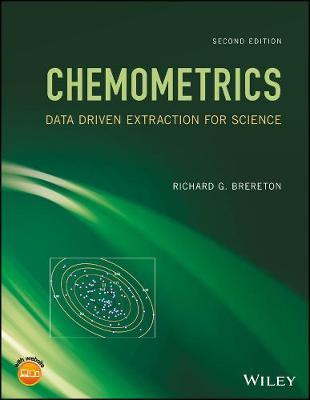
A new, full-color, completely updated edition of the key practical guide to chemometrics This new edition of this practical guide on chemometrics, emphasizes the principles and applications behind the main ideas in the field using numerical and graphical examples, which can then be applied to a wide variety of problems in chemistry, biology, chemical engineering, and allied disciplines. Presented in full color, it features expansion of the principal component analysis, classification, multivariate evolutionary signal and statistical distributions sections, and new case studies in metabolomics, as well as extensive updates throughout. Aimed at the large number of users of chemometrics, it includes extensive worked problems and chapters explaining how to analyze datasets, in addition to updated descriptions of how to apply Excel and Matlab for chemometrics. Chemometrics: Data Driven Extraction for Science, Second Edition offers chapters covering: experimental design, signal processing, pattern recognition, calibration, and evolutionary data. The pattern recognition chapter from the first edition is divided into two separate ones: Principal Component Analysis/Cluster Analysis, and Classification. It also includes new descriptions of Alternating Least Squares (ALS) and Iterative Target Transformation Factor Analysis (ITTFA). Updated descriptions of wavelets and Bayesian methods are included. Includes updated chapters of the classic chemometric methods (e.g. experimental design, signal processing, etc.) Introduces metabolomics-type examples alongside those from analytical chemistry Features problems at the end of each chapter to illustrate the broad applicability of the methods in different fields Supplemented with data sets and solutions to the problems on a dedicated website, www.booksupport.wiley.com Chemometrics: Data Driven Extraction for Science, Second Edition is recommended for post-graduate students of chemometrics as well as applied scientists (e.g. chemists, biochemists, engineers, statisticians) working in all areas of data analysis.
Full Product Details
Author: Richard G. Brereton (University of Bristol, UK)
Publisher: John Wiley & Sons Inc
Imprint: John Wiley & Sons Inc
Edition: 2nd edition
Dimensions:
Width: 21.60cm
, Height: 2.80cm
, Length: 27.70cm
Weight: 1.293kg
ISBN: 9781118904664
ISBN 10: 1118904664
Pages: 464
Publication Date: 30 March 2018
Audience:
Professional and scholarly
,
Professional & Vocational
Format: Paperback
Publisher's Status: Active
Availability: Out of stock

The supplier is temporarily out of stock of this item. It will be ordered for you on backorder and shipped when it becomes available.
Reviews
"""... fills a gap in the chemometrics literature landscape. With its unique approach of learning-by-doing it is best suited for practitioners, which do not want to dig too deep into the theory and are not interested in a full coverage of methods. Nevertheless, the most important and usual applied chemometrics methods are introduced... The example data sets of the book are also worth exploring by itself, because they are well chosen and nicely structured."" —Thomas Bocklitz, Analytical and Bioanalytical Chemistry (2019)"
...fills a gap in the chemometrics literature landscape. With its unique approach of learning-by-doing it is best suited for practitioners, which do not want to dig too deep into the theory and are not interested in a full coverage of methods. Nevertheless, the most important and usual applied chemometrics methods are introduced...The example data sets of the book are also worth exploring by itself, because they are well chosen and nicely structured. Thomas Bocklitz, Analytical and Bioanalytical Chemistry (2019) fills a gap in the chemometrics literature landscape. With its unique approach of learning-by-doing it is best suited for practitioners, which do not want to dig too deep into the theory and are not interested in a full coverage of methods. Nevertheless, the most important and usual applied chemometrics methods are introduced by Brereton (2018). The example data sets of the book are also worth exploring by itself, because they are well chosen and nicely structured.
Author Information
RICHARD G. BRERETON is Director of Brereton Consultancy and Emeritus Professor at the University of Bristol, UK. He is Fellow of the Royal Society of Chemistry, Royal Statistical Society and Royal Society of Medicine. He has applied chemometrics in a wide variety of areas including pharmaceuticals, materials, metabolomics, heritage studies and forensics, and has published over 400 articles, including writing/editing eight books.