|
|
|||
|
||||
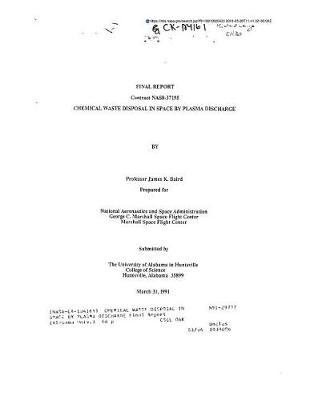
OverviewAn inductively coupled plasma discharge apparatus operating at 13.56 MHz and with electrical power up to 2.5 kW was constructed. The efficiency of this device to destroy various gases expected to be carried aboard the Space Station was tested. By expressing the efficiency of the device in terms of G-value (the number of molecules decomposed per 100 eV of energy absorbed), the results are compared with known efficiencies of ionizing radiation to destroy these same gases. In the case of ammonia, it was found that in the inductively coupled device, the destruction efficiency, G(-NH3) varied from 6.0 to 32.0 molecules/100 eV, depending on conditions. It was also found that capacitatively coupled discharges were less efficient in destroying NH2 than the inductively coupled discharge. In the case NH2 destruction, it was found that the G(-NH3) was a qualitative guide to the efficiencies of plasmas. The plasma device was also used to destroy nitrous oxide and methane. It is shown how the G-value for the destruction of any gas can be computed theoretically from a knowledge of the electron velocity distribution, the various electron molecule scattering cross sections, and the rate constants for the reactions of secondary species. Baird, James K. Unspecified Center... Full Product DetailsAuthor: National Aeronaut Administration (Nasa)Publisher: Createspace Independent Publishing Platform Imprint: Createspace Independent Publishing Platform Dimensions: Width: 21.60cm , Height: 0.40cm , Length: 27.90cm Weight: 0.186kg ISBN: 9781722300616ISBN 10: 1722300612 Pages: 70 Publication Date: 06 July 2018 Audience: General/trade , General Format: Paperback Publisher's Status: Active Availability: Available To Order We have confirmation that this item is in stock with the supplier. It will be ordered in for you and dispatched immediately. Table of ContentsReviewsAuthor InformationTab Content 6Author Website:Countries AvailableAll regions |
||||