Overview
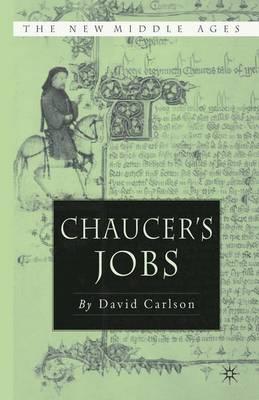
Geoffrey Chaucer was not a writer, primarily, but a privileged official place-holder. Prone to violence, including rape, assault, and extortion, the poet was employed first at domestic personal service and subsequently at police-work of various sorts, protecting the established order during a period of massive social upset. Chaucer's Jobs shows that the servile and disciplinary nature of the daily work Chaucer did was repeated in his poetry, which by turns flatters his aristocratic betters and deals out discipline to malcontent others. Carlson contends that it was this social-political quality of Chaucer's writings, not artistic merit, that made him the 'Father of English Poetry'.
Full Product Details
Author: D. Carlson
Publisher: Palgrave Macmillan
Imprint: Palgrave Macmillan
Edition: 2004 ed.
Dimensions:
Width: 14.00cm
, Height: 1.00cm
, Length: 21.60cm
Weight: 0.237kg
ISBN: 9780230602434
ISBN 10: 0230602436
Pages: 168
Publication Date: 14 June 2008
Audience:
Professional and scholarly
,
Professional & Vocational
Format: Paperback
Publisher's Status: Active
Availability: In Print

This item will be ordered in for you from one of our suppliers. Upon receipt, we will promptly dispatch it out to you. For in store availability, please contact us.
Reviews
In this imaginative book, David Carlson invites us to read Chaucer's poetry through his professional careers. As servant to the aristocracy, official for the court, Member of Parliament, Clerk of the King's Works, tax-gatherer, justice of the peace, and so on, Chaucer was, in Carlson's words, everything from a 'lackey' to an 'official of the repressive apparatus of the state.' Chaucer's poetry, Carlson argues, did the same kind of work as the poet did throughout his life: it flattered patrons and disciplined political unrest. Chaucer's Jobs reveals how Chaucer became the 'father' of English poetry, not so much because he was a great poet, but because his poetry served to affirm the dominant social interests of his age. Carlson has written a book that will provoke us to see a social Chaucer in new and productive ways, and it will also provoke debates about the poet's place in both his historical period and our modern classrooms. --Seth Lerer, Avalon Foundation Professor in the Humani
In this imaginative book, David Carlson invites us to read Chaucer's poetry through his professional careers. As servant to the aristocracy, official for the court, Member of Parliament, Clerk of the King's Works, tax-gatherer, justice of the peace, and so on, Chaucer was, in Carlson's words, everything from a 'lackey' to an 'official of the repressive apparatus of the state.' Chaucer's poetry, Carlson argues, did the same kind of work as the poet did throughout his life: it flattered patrons and disciplined political unrest. Chaucer's Jobs reveals how Chaucer became the 'father' of English poetry, not so much because he was a great poet, but because his poetry served to affirm the dominant social interests of his age. Carlson has written a book that will provoke us to see a social Chaucer in new and productive ways, and it will also provoke debates about the poet's place in both his historical period and our modern classrooms. - Seth Lerer, Avalon Foundation Professor in the Humanities and Professor of English and Comparative Literature, Stanford University
"""In this imaginative book, David Carlson invites us to read Chaucer's poetry through his professional careers. As servant to the aristocracy, official for the court, Member of Parliament, Clerk of the King's Works, tax-gatherer, justice of the peace, and so on, Chaucer was, in Carlson's words, everything from a 'lackey' to an 'official of the repressive apparatus of the state.' Chaucer's poetry, Carlson argues, did the same kind of work as the poet did throughout his life: it flattered patrons and disciplined political unrest. Chaucer's Jobs reveals how Chaucer became the 'father' of English poetry, not so much because he was a great poet, but because his poetry served to affirm the dominant social interests of his age. Carlson has written a book that will provoke us to see a social Chaucer in new and productive ways, and it will also provoke debates about the poet's place in both his historical period and our modern classrooms."" - Seth Lerer, Avalon Foundation Professor in the Humanities and Professor of English and Comparative Literature, Stanford University"
Author Information
DAVID R. CARLSON is Professor of English and Adjunct Professor of Classical Studies at the University of Ottawa, Canada. He is the author of English Humanist Books: Writers and Patrons, Manuscript and Print, 1475-1525 and has published various monographs and papers on topics in early English and European literary history.