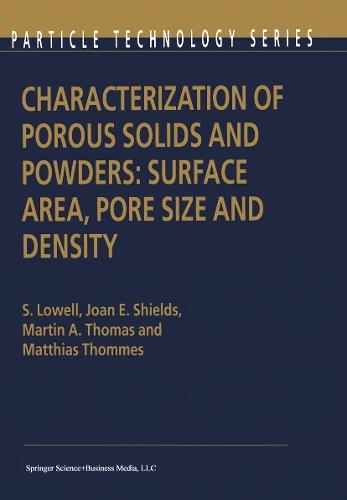
Characterization of Porous Solids and Powders: Surface Area, Pore Size and Density

Author:   S. Lowell ,  Joan E. Shields ,  Martin A. Thomas ,  Matthias Thommes
Publisher:   Springer
Edition:   Softcover reprint of the original 1st ed. 2004
Volume:   16
ISBN:  

9789048166336


Pages:   350
Publication Date:   28 October 2010
Format:   Paperback
Availability:   Out of stock   Availability explained
The supplier is temporarily out of stock of this item. It will be ordered for you on backorder and shipped when it becomes available.

Our Price $551.76 Quantity:  
Add to Cart

Share |

Characterization of Porous Solids and Powders: Surface Area, Pore Size and Density


Overview

Full Product Details

Author:   S. Lowell ,  Joan E. Shields ,  Martin A. Thomas ,  Matthias Thommes
Publisher:   Springer
Imprint:   Springer
Edition:   Softcover reprint of the original 1st ed. 2004
Volume:   16
Dimensions:   Width: 16.00cm , Height: 1.90cm , Length: 24.00cm
Weight:   0.637kg
ISBN:  

9789048166336


ISBN 10:   9048166330
Pages:   350
Publication Date:   28 October 2010
Audience:   Professional and scholarly ,  Professional & Vocational
Format:   Paperback
Publisher's Status:   Active
Availability:   Out of stock   Availability explained
The supplier is temporarily out of stock of this item. It will be ordered for you on backorder and shipped when it becomes available.

Table of Contents

1 Theoretical.- 1 Introduction.- 1.1 Real Surfaces.- 1.2 Factors Affecting Surface area.- 1.3 Surface Area from Particle Size Distributions.- 1.4 References.- 2 Gas Adsorption.- 2.1 Introduction.- 2.2 Physical and Chemical Adsorption.- 2.3 Physical Adsorption Forces.- 2.4 Physical Adsorption on a Planar Surface.- 2.5 References.- 3 Adsorption Isotherms.- 3.1 Pore Size and Adsorption Potential.- 3.2 Classification of Adsorption Isotherms.- 3.3 References.- 4 Adsorption Mechanism.- 4.1 Langmuir and BET Theories (Kinetic Isotherms).- 4.1.1 The Langmuir Isotherm.- 4.1.2 The Brunauer, Emmett, and Teller (BET) Theory.- 4.2 The Frenkel-Halsey-Hill (FHH) Theory of Multilayer Adsorption.- 4.3 Adsorption in Microporous Materials.- 4.3.1 Introduction.- 4.3.2 Aspects of Classical, Thermodynamic Theories for Adsorption in Micropores: Extension of Polanyi’s Theory.- 4.3.3 Aspects of Modern, Microscopic Theories for Adsorption in Micropores: Density Functional Theory and Molecular Simulation.- 4.3.3.1 Density Functional Theory (DFT).- 4.3.3.2 Computer Simulation Studies: Monte Carlo Simulation and Molecular Dynamics.- 4.3.3.3 NLDFT and Monte Carlo Simulation for Pore Size Analysis.- 4.4 Adsorption in Mesopores.- 4.4.1 Introduction.- 4.4.2 Multilayer Adsorption, Pore Condensation and Hysteresis.- 4.4.3 Pore Condensation: Macroscopic, Thermodynamic Approaches.- 4.4.3.1 Classical Kelvin Equation.- 4.4.3.2 Modified Kelvin Equation.- 4.4.4 Adsorption Hysteresis.- 4.4.4.1 Classification of Hysteresis Loops.- 4.4.4.2 Origin of Hysteresis.- 4.4.5 Effects of Temperature and Pore Size: Experiments and Predictions of Modern, Microscopic Theories.- 4.5 References.- 5 Surface Area from the Langmuir and BET Theories.- 5.1 Specific Surface Area from the Langmuir Equation.- 5.2 Specific Surface Area from the BET Equation.- 5.2.1. BET-Plot and Calculation of the Specific Surface Area.- 5.2.2 The Meaning of Monolayer Coverage.- 5.2.3 The BET Constant and Site Occupancy.- 5.2.4 The Single Point BET Method.- 5.2.5 Comparison of the Single Point and Multipoint Methods.- 5.2.6 Applicability of the BET Theory.- 5.2.7 Importance of the Cross-Sectional Area.- 5.2.8 Nitrogen as the Standard Adsorptive for Surface Area Measurements.- 5.2.9 Low Surface Area Analysis.- 5.3 References.- 6 Other Surface Area Methods.- 6.1 Introduction.- 6.2 Gas Adsorption: Harkins and Jura Relative Method.- 6.3 Immersion Calorimetry: Harkins and Jura Absolute Method.- 6.4 Permeametry.- 6.5 References.- 7 Evaluation of the Fractal Dimension by Gas Adsorption.- 7.1 Introduction.- 7.2 Method of Molecular Tiling.- 7.3 The Frenkel-Halsey-Hill Method.- 7.4 The Thermodynamic Method.- 7.5 Comments About Fractal Dimensions Obtained from Gas Adsorption.- 7.6 References.- 8 Mesopore Analysis.- 8.1 Introduction.- 8.2 Methods based on the Kelvin equation.- 8.3 Modelless Pore Size Analysis.- 8.4 Total Pore Volume and Average Pore Size.- 8.5 Classical, Macroscopic Thermodynamic Methods versus Modern, Microscopic Models for Pore Size Analysis.- 8.6 Mesopore Analysis and Hysteresis.- 8.6.1 Use of Adsorption or Desorption Branch for Pore Size Calculation?.- 8.6.2 Lower Limit of the Hysteresis Loop- Tensile Strength Hypothesis.- 8.7 Adsorptives other than Nitrogen for Mesopore Analysis.- 8.8 References.- 9 Micropore Analysis.- 9.1 Introduction.- 9.2 Micropore Analysis by Isotherm Comparison.- 9.2.1 Concept of V-t curves.- 9.2.2 The t- Method.- 9.2.3 The ?s method.- 9.3 The Micropore Analysis (MP) Method).- 9.4 Total Micropore Volume and Surface Area.- 9.5 The Dubinin-Radushkevich (DR) Method.- 9.6 The Horvath-Kawazoe (HK) Approach and Related Methods.- 9.7 Application of NLDFT: Combined Micro/Mesopore Analysis With a Single Method.- 9.8 Adsorptives other than Nitrogen for Super- and Ultramicroporosimetry.- 9.9 References.- 10 Mercury Porosimetry: Non-Wetting Liquid Penetration.- 10.1 Introduction.- 10.2 Young-Laplace Equation.- 10.3 Contact Angles and Wetting.- 10.4 Capillarity.- 10.5 The Washburn Equation.- 10.6 Intrusion — Extrusion Curves.- 10.7 Common Features of Porosimetry Curves.- 10.8 Hysteresis, Entrapment and Contact Angle.- 10.9 Contact Angle Changes.- 10.10 Porosimetric Work.- 10.12 Theory of Porosimetry Hysteresis.- 10.13 Pore Potential.- 10.14 Other Hysteresis Theories (Throat-Pore Ratio Network Model).- 10.15 Equivalency of Mercury Porosimetry and Gas Sorption.- 10.16 References.- 11 Pore Size and Surface Characteristics of Porous Solids by Mercury Porosimetry.- 11.1 Application of The Washburn Equation.- 11.2 Pore Size and Pore Size Distribution from Mercury Porosimetry.- 11.2.1 Linear Pore Volume Distribution.- 11.2.2 Logarithmic Pore Volume Distribution.- 11.2.3 Pore Number Distributions.- 11.2.4 Pore Length Distribution.- 11.2.5 Pore Population (Number Distribution).- 11.2.6 Surface Area and Surface Area Distribution from Intrusion Curves.- 11.2.7 Pore Area Distributions.- 11.3 Pore Shape from Hysteresis.- 11.4 Fractal Dimension.- 11.5 Permeability.- 11.6 Tortuosity.- 11.7 Particle Size Distribution.- 11.7.1 Mayer & Stowe Approach.- 11.7.2 Smith & Stermer Approach.- 11.8 Comparison of Porosimetry and Gas Sorption.- 11.9 Solid Compressibility.- 11.10 References.- 12 Chemisorption: Site Specific Gas Adsorption.- 12.1 Chemical Adsorption.- 12.2 Quantitative Measurements.- 12.3 Stoichiometry.- 12.4 Monolayer Coverage.- 12.4.1 Extrapolation.- 12.4.2 Irreversible Isotherm and Bracketing.- 12.4.3 Langmuir Theory.- 12.4.4 Temperature Dependent Models.- 12.4.5 Temkin Method.- 12.4.6 Freundlich Method.- 12.4.7 Isotherm Subtraction — Accessing Spillover.- 12.4.8 Surface Titration.- 12.5 Active Metal Area.- 12.6 Dispersion.- 12.7 Crystallite (Nanoparticle) Size.- 12.8 Heats of Adsorption and Activation Energy.- 12.8.1 Differential Heats of Adsorption.- 12.8.2 Integral Heat of Adsorption.- 12.8.3 Activation Energy.- 12.9 References.- 2 Experimental.- 13 Physical Adsorption Measurements — Preliminaries.- 13.1 Experimental Techniques for Physical Adsorption Measurements.- 13.2 Reference Standards.- 13.3 Representative Samples.- 13.4 Sample Conditioning: Outgassing of the Adsorbent.- 13.5 Elutriation and Its Prevention.- 13.6 References.- 14 Vacuum Volumetric Measurements (Manometry).- 14.1 Basics of Volumetric Adsorption Measurement.- 14.2 Deviations from Ideality.- 14.3 Void Volume Determination.- 14.4 Coolant Level and Temperature Control.- 14.5 Saturation Vapor Pressure, P0 and Temperature of the Sample Cell.- 14.6 Sample Cells.- 14.7 Low Surface Area.- 14.8 Micro- and Mesopore Analysis.- 14.8.1 Experimental Requirements.- 14.8.2 Micropore Analysis and Void Volume Determination.- 14.8.3 Thermal Transpiration Correction.- 14.8.4 Adsorptives other than Nitrogen for Micro- and Mesopore Analysis — Experimental Aspects.- 14.9 Automated Instrumentation.- 14.9.1 Multistation Sorption Analyzer.- 14.9.2 The NOVA Concept.- 14.10 References.- 15 Dynamic Flow Method.- 15.1 Nelson and Eggertsen Continuous Flow Method.- 15.2 Carrier Gas (Helium) and Detector Sensitivity.- 15.3. Design Parameters for Continuous Flow Apparatus.- 15.4 Signals and Signal Calibration.- 15.5 Adsorption and Desorption Isotherms by Continuous Flow.- 15.6 Low Surface Areas Measurement.- 15.7 Data Reduction — Continuous Flow Method.- 15.8 Single Point Method.- 15.9 References.- 16 Volumetric Chemisorption: Catalyst Characterization by Static Methods.- 16.1 Applications.- 16.2 Sample Requirements.- 16.3 General Description of Equipment.- 16.4 Measuring System.- 16.4.1 Pressure Measurement.- 16.4.2 Valves.- 16.4.3 Vacuum.- 16.4.4 Sample Cell.- 16.4.5 Heating System.- 16.4.6 Gases and Chemical Compatibilities.- 16.5 Pretreatment.- 16.5.1 Heating.- 16.5.2 Atmosphere.- 16.6 Isotherms.- 16.6.1 Reactive Gas.- 16.6.2 The Combined Isotherm.- 16.6.3 The Weak Isotherm.- 16.6.4 The Strong Isotherm.- 16.6.5 Multiple Isotherms.- 16.7 References.- 17 Dynamic Chemisorption: Catalyst Characterization By Flow Techniques.- 17.1 Applications.- 17.2 Sample Requirements.- 17.3 General Description of Equipment.- 17.3.1 Flow Path.- 17.3.2 Sample Cell.- 17.3.3 Gases.- 17.3.4 Heating.- 17.3.5 Pulse Injection.- 17.3.6 Detector.- 17.4 Pretreatment.- 17.5 Pulse Titration.- 17.6 Additional Requirements for Temperature Programmed Methods.- 17.6.1 Programmed Heating.- 17.6.2 Sample Temperature.- 17.7 Temperature Programmed Reduction.- 17.8 Temperature Programmed Oxidation.- 17.9 Temperature Programmed Desorption.- 17.9.1 Some Specific Applications.- 17.8.1.1 Acid/Base.- 17.8.1.2 Oxidizers.- 17.8.1.3 Reducers.- 17.10 Mass Spectrometry.- 17.11 Metal Parameters.- 17.11 References.- 18 Mercury Porosimetry: Intra and Inter- Particle Characterization.- 18.1 Applications.- 18.2 Working with Mercury.- 18.3 Experimental Requirements.- 18.4 Sample Cell.- 18.5 Volume Measurement.- 18.6 Contact Angle.- 18.6.1 Dynamic Contact Angle.- 18.6.2 Static Contact Angle.- 18.7 A Modern Porosimeter.- 18.8 Low Pressure Measurements.- 18.8.1 Sample Cell Evacuation.- 18.8.2 Filling with Mercury.- 18.8.3 Low Pressure Intrusion-Extrusion.- 18.9 High Pressure Measurements.- 18.10 Scanning Method.- 18.11 Stepwise Method.- 18.12 Mercury Entrapment.- 18.13 Working with Powders.- 18.14 Inter/Intra Particle Porosity.- 18.15 Isostatic Crush Strength.- 18.16 References.- 19 Density Measurement.- 19.1 Introduction.- 19.2 True Density.- 19.3 Apparent Density.- 19.4 Open-Closed Porosity.- 19.5 Bulk Density.- 19.6 Tap Density.- 19.7 Envelope or Geometric Density.- 19.8 Effective Density.- 19.9 Density by Mercury Porosimetry.- 19.10 Standard Methods.- 19.11 References.

Reviews

An updated version of the classical textbook (Powder Surface Area and Porosity, 3rd ed., 1991) by the first two authors the book now includes recent developments in the areas of density functional theory, molecular simulations, pore network theories, and it has an expanded section on heterogeneous catalysts!.. An interesting aspect is the book's clear division between theoretical aspects (Part 1) and experimental aspects (Part 2) of the various techniques!.. The book also demonstrates a good balance between how deep a theoretical concept is being discussed and how many real-world examples are presented. Summing up: Recommended. Lower-division undergraduates through professionals; two-year technical program students. H. Giesche, Alfred University, in CHOICE, May 2005, Vol. 42 No.09


An updated version of the classical textbook (Powder Surface Area and Porosity, 3rd ed., 1991) by the first two authors the book now includes recent developments in the areas of density functional theory, molecular simulations, pore network theories, and it has an expanded section on heterogeneous catalysts..... An interesting aspect is the book's clear division between theoretical aspects (Part 1) and experimental aspects (Part 2) of the various techniques..... The book also demonstrates a good balance between how deep a theoretical concept is being discussed and how many real-world examples are presented. Summing up: Recommended. Lower-division undergraduates through professionals; two-year technical program students. H. Giesche, Alfred University, in CHOICE, May 2005, Vol. 42 No.09


An updated version of the classical textbook (Powder Surface Area and Porosity, 3rd ed., 1991) by the first two authors ""the book now includes recent developments in the areas of density functional theory, molecular simulations, pore network theories, and it has an expanded section on heterogeneous catalysts….. An interesting aspect is the book’s clear division between theoretical aspects (Part 1) and experimental aspects (Part 2) of the various techniques….. The book also demonstrates a good balance between how deep a theoretical concept is being discussed and how many real-world examples are presented. Summing up: Recommended. Lower-division undergraduates through professionals; two-year technical program students."" H. Giesche, Alfred University, in CHOICE, May 2005, Vol. 42 No.09


Summarizing, the book demonstrates a good balance between experimental and advanced theoretical concepts. Sufficient details and practical examples are given throughout the text to establish a better understanding of available methods and background for students and professionals alike, with many references for follow-up study. The book appears to be an extremely useful handbook that should provide the necessary tools for students and researchers, in both industry and academia, to tackle and solve problems associated with the state-of-the art characterization of porous solids and powders. Mohamed Eddaoudi, UniVersity of South Florida


An updated version of the classical textbook (Powder Surface Area and Porosity, 3rd ed., 1991) by the first two authors the book now includes recent developments in the areas of density functional theory, molecular simulations, pore network theories, and it has an expanded section on heterogeneous catalysts..... An interesting aspect is the book's clear division between theoretical aspects (Part 1) and experimental aspects (Part 2) of the various techniques..... The book also demonstrates a good balance between how deep a theoretical concept is being discussed and how many real-world examples are presented. Summing up: Recommended. Lower-division undergraduates through professionals; two-year technical program students. H. Giesche, Alfred University, in CHOICE, May 2005, Vol. 42 No.09


Author Information

Tab Content 6

Author Website:  

Countries Available

All regions
Latest Reading Guide

NOV RG 20252


Shopping Cart
Your cart is empty
Shopping cart
Mailing List