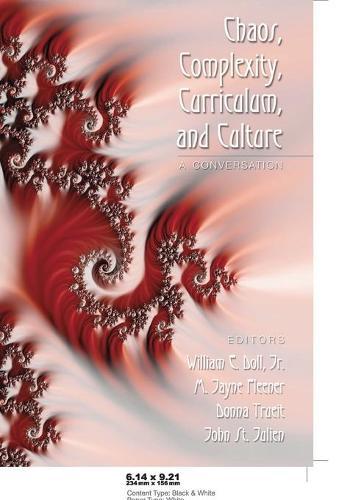
Full Product Details
Author: William E. Doll ,
M. Jayne Fleener ,
Donna Trueit ,
John St. Julien
Publisher: Peter Lang Publishing Inc
Imprint: Peter Lang Publishing Inc
Edition: 2nd Revised edition
Volume: 6
Weight: 0.470kg
ISBN: 9780820467801
ISBN 10: 0820467804
Pages: 329
Publication Date: 24 August 2006
Audience:
Professional and scholarly
,
Professional & Vocational
Format: Paperback
Publisher's Status: Active
Availability: In Print

This item will be ordered in for you from one of our suppliers. Upon receipt, we will promptly dispatch it out to you. For in store availability, please contact us.
Reviews
« 'Chaos, Complexity, Curriculum, and Culture: A Conversation' is a Landmark text in the history of educational ideas. It has a simple focus: the new science that established the technical rationality of modernism, and that survives, variously, in the Tyler rationale for curriculum development, in the paradigm of the audit society adopted in public management, and in the high-stakes quality-assurance rituals of public schooling. Yet this volume also engages because it has a recursive dimension. It also takes new science as its emblem. The contributors suggest that it is defensible to realise the Enlightenment project of liberty, equality and fraternity in other ways. They show us a way, not with a guarantee of success but by engaging us iteratively in their conversation.
'Chaos, Complexity, Curriculum, and Culture: A Conversation' is a landmark text in the history of educational ideas. It has a simple focus: the new science that established the technical rationality of modernism, and that survives, variously, in the Tyler rationale for curriculum development, in the paradigm of the audit society adopted in public management, and in the high-stakes quality-assurance rituals of public schooling. Yet this volume also engages because it has a recursive dimension. It also takes new science as its emblem. The contributors suggest that it is defensible to realise the Enlightenment project of liberty, equality and fraternity in other ways. They show us a way, not with a guarantee of success but by engaging us iteratively in their conversation. (David Hamilton, Umea University, Sweden) 'Chaos, Complexity, Curriculum, and Culture: A Conversation' is a must read for anyone concerned about education and learning. It is extremely well written, intertwining history, pedagogy and scholarship. Although there are many ways to define complex systems, the contributors understand and embrace 'systems thinking' and nonlinear concepts in a series of 'conversations' resulting in a fascinating and truly landmark work. It encourages the reader to think differently about learning and educational methods. Most impressive about these iterative 'conversations' is that they discuss the importance of understanding the evolvability and fluidity of educational methods. It demonstrates the emergence of new ways of thinking about education and learning as a complex cycle of social and dynamic, versus static and rigid, processes. This book should be required reading for all students interested in entering the field of education and is a must for all college and university libraries. (Ellen Goldberg, Santa Fe Institute Research Professor and Consortium Director)
Author Information
The Editors: William Doll is the V. F. and J. R. Eagles Professor of Curriculum at Louisiana State University. There he co-directs the Curriculum Theory Project and directs the Holmes Elementary Education Program. His books are A Post-Modern Perspective on Curriculum (1993), Curriculum Visions (with Noel Gough, Lang, 2002) and Internationalization of Curriculum (with Donna Trueit, Hongyu Wang, and William Pinar, Lang, 2003). Developing chaotic and complex curricula within a postmodern frame has been a project of him for years. M. Jayne Fleener is Dean of the College of Education and the E. B. (Ted) Robert Professor of Curriculum at Louisiana State University. Her teaching and research have been in the areas of philosophy, computer science, mathematics, mathematics education, and curriculum theory. Her current research focus is on chaos and complexity sciences as applied to educational contexts. She has over forty national and international publications including the book Curriculum Dynamics: Recreating Heart (Lang, 2002). The chapter included in this book includes a problematization of New Science as it relates to postmodern inquiry. Donna Trueit is a doctoral candidate at Louisiana State University, studying curriculum and instruction. Her current project is conceiving curriculum as a poietic space for creating selves, drawing on principles of complexity theory, Gregory Bateson, and Charles S. Peirce. An integral part of this project regards the process, analysis and representation of postmodern inquiry. With others, she edited The Internationalization of Curriculum (Trueit, Doll, Wang, and Pinar) (Lang, 2002), and contributed Speaking of Ghosts to Curriculum Visions (Doll and Gough) (Lang, 2002). John St. Julien lives and works in Lafayette, Louisiana where he consults with school districts and businesses on education and technology issues. His academic interests include learning theories, social studies instruction, computer-based instructional design, and complexity theories. He is engaged in designing after-school programs and computer-aided learning models based on the principles animating social connectionist learning and objectstructured social play. The chapter included in this book focuses on developing an analytic and logic suitable for a complex age that he hopes will prove especially useful in educational contexts.