Overview
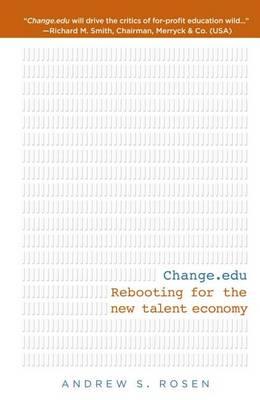
It's no wonder American higher education is facing a crisis. While low-income students can't find a spot in their local community colleges for lack of funding, public four-year universities are spending staggering sums on luxurious residence halls, ever-bigger football stadiums, and obscure research institutes. We have cosseted our most advantaged students even as we deny access to the working adults who urgently need higher education to advance their careers and our economy. In Change.edu: Rebooting for the new talent economy Andrew S. Rosen clearly and entertainingly details how far the American higher education system has strayed from the goals of access, quality, affordability, and accountability that should characterize our system, and offers a prescription to restore American educational pre-eminence. To change, our system will have to end its reflexive opposition to anything new and different. Rosen describes how each new wave of innovation and expansion of educational access- starting with the founding of Harvard in 1636, and continuing with the advent of land-grant colleges in the 19th century, community colleges in the 20th century and private sector colleges over the last two decades-has been met with misunderstanding and ridicule. When colleges like the University of California, Cornell and Purdue were founded, they were scorned as ""pretenders to the title of university"" - language that tracks later criticisms of community colleges and most recently for-profit colleges. Avoiding that condescension is just one of the reasons colleges have come under the sway of ""Harvard Envy"" - schools that were founded to expand access feel an inexorable tug to become more prestigious and exclusive. Even worse, the competition for the best students has led universities to turn themselves into full-fledged resorts; they've built climbing walls, French bistros and 20-person hot-tubs to entice students to their campuses. How can America address an incentive system in higher education that is mismatched to the challenges of the years ahead? In Change.edu, Rosen outlines ""seven certainties"" of education in the coming 25 years, and presents an imperative for how our system must prepare for the coming changes. He proposes a new ""playbook"" for dealing with the change ahead, one that will enable American higher education to regain its global primacy and be a catalyst for economic growth in the 21st century.
Full Product Details
Author: Andrew S. Rosen
Publisher: Kaplan AEC Education
Imprint: Kaplan Trade
Dimensions:
Width: 13.30cm
, Height: 1.90cm
, Length: 20.30cm
Weight: 0.313kg
ISBN: 9781609788995
ISBN 10: 1609788990
Pages: 208
Publication Date: 01 January 2013
Audience:
Professional and scholarly
,
Professional & Vocational
Format: Paperback
Publisher's Status: Active
Availability: Available To Order

We have confirmation that this item is in stock with the supplier. It will be ordered in for you and dispatched immediately.
Reviews
Change.edu: Time to Reboot Learning <p>One would expect a book by the CEO of a for-profit university to mount a vigorous defense of the much-maligned for-profit higher education sector. But what one might not expect is that the same book would do so in a thoughtful, well-researched manner that discusses not just the place of for-profit universities in education, but also offers a compelling narrative on the state of American higher education across the board--from its elite institutions to its community colleges--and addresses the far larger challenges the country's colleges and universities must tackle for America to maintain--or even regain--its competitive edge. <p>Yet that's exactly what Andy Rosen, CEO of Kaplan, Inc., accomplishes in Change.edu: Rebooting for the new talent economy, which whirls through the history of higher education in the United States and into its uncertain future in a refreshingly enjoyable and brief but comprehensive 200 pages. <p>Framed against the backdrop of America's need to educate more of its citizens far better, Change.edu is divided into four broad themes. The first is a discussion of Harvard Envy and Club College, which explains why colleges strive to become bigger and better along dimensions that often don't line up with improving student learning and causes greater investment in the educational haves as opposed to the educational have nots. Next, Rosen explores how community colleges are meant to help the educational have nots but have a broken funding model that limits their reach. Rosen then examines the complementary role the for-profit colleges play and concludes with a discussion of how learning should guide government policy for colleges and universities of all stripes in the future. <p>At times Rosen is intensely critical of many colleges' and universities' excesses and limitations. To illustrate the points, he documents everything from a sadly amusing competition to house the t
Kirkus Reviews October 15, 2011<p> An enjoyable look back at the history of higher education in America and the startling new ways it might develop in the future. <p> The author and CEO of test-prep powerhouse Kaplan is willing to doff his mortarboard to the Ivy League--but only because Rosen is absolutely convinced that one day, often maligned private-sector institutions like his will rule the day. Incredibly, his argument never comes off as self-serving; the author's thorough exploration of Harvard Envy and the rise of resort campuses is both fascinating and enlightening. He cites spiraling costs, dwindling budgets and improved technology as some of the many reasons behind this inevitable changeover. If America is going to compete with the global brain trust, the author argues, it will have to be done from behind a computer screen. The prestige that Ivy League schools command is largely due to their exclusivity, a fact that runs counter to the growing need to expose increasing numbers of people to higher education. Thus, somewhere in America, there is a college campus contemplating the highest rock-climbing wall in an effort to woo new students. That's just about as ridiculous as online distance learning--what might be thought of as the successor to old correspondence courses --becoming as viable as Yale or Duke. But both are happening. The U.S., writes Rosen, has no other choice but to look to virtual for-profit learning outlets like Kaplan and the University of Phoenix to boost the number of college graduates. <p> Presently, this may be the subject of snide editorials and contemptuous hearings, but Rosen envisions a day when for-profit learning centers step up and fill the education gap much in the same way land grant and community colleges did in years past. The alternative, he fears, spells trouble for American supremacy in education.
Author Information
Andrew S. Rosen is chairman and CEO of Kaplan, Inc., one of the world's largest and most diverse education organizations. Throughout his career, Rosen has pioneered new approaches to education with a focus on student achievement and success. He is an outspoken advocate for adult learners, and a frequent speaker on the challenges facing higher education in a knowledge economy. Mr. Rosen holds an A.B. degree from Duke University and a J.D. from Yale Law School.