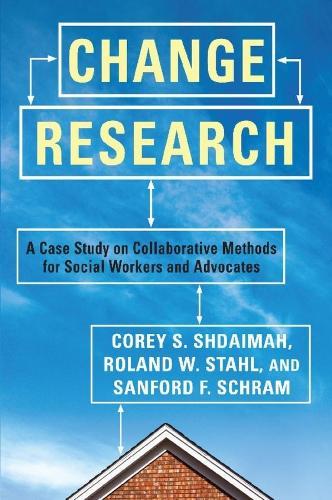
Full Product Details
Author: Corey Shdaimah (Assistant Professor, University of Maryland, Baltimore) ,
Roland Stahl, , Ph.D. (Assistant Professor) ,
Sanford Schram (Visiting Professor, Bryn Mawr College)
Publisher: Columbia University Press
Imprint: Columbia University Press
Dimensions:
Width: 15.20cm
, Height: 1.50cm
, Length: 22.90cm
Weight: 0.312kg
ISBN: 9780231151795
ISBN 10: 0231151799
Pages: 232
Publication Date: 13 September 2011
Audience:
College/higher education
,
Professional and scholarly
,
Postgraduate, Research & Scholarly
,
Professional & Vocational
Format: Paperback
Publisher's Status: Active
Availability: Out of stock

The supplier is temporarily out of stock of this item. It will be ordered for you on backorder and shipped when it becomes available.
Language: English
Reviews
This is a one-of-a-kind book. The authors do not just talk about collaboration, they tell the story of the nitty-gritty process of trying--successfully--to work with community advocates. A wonderful book about how it all worked and could and should work at the ground level. -- John Tropman, author of Successful Community Organization and Leadership: A Skills Guide for Volunteers and Professionals Instead of perpetuating the dichotomy between 'evidence-based' and 'change-oriented' research, the authors argue compellingly that social justice goals must inform all aspects of the research process and that value-based research has equal validity with conventional academic research. In doing so, they reestablish the connection between social science and social action central to the history of social work. -- Michael Reisch, University of Maryland, School of Social Work Change Research demonstrates the power of participatory action research for identifying creative alternatives to neoliberal housing policy. The authors reveal the limits of traditional policy research and share insights gained from negotiating the challenges and rewards of participatory approaches. Accessible, practical, and written by activist researchers who are passionate about the value of research for social change, this book offers important lessons for social workers, policy makers, advocates, and social scientists interested in using their skills to advance social justice. -- Nancy A. Naples, University of Connecticut Erudite, accessible, eloquent, and cutting-edge informative, this book beautifully blends the normative and empirical, all in the service of social work's traditional focus on marginalized, underserved, and generally voiceless persons and the institutions and policies that purportedly serve them. -- Roberta R. Iversen, author of Jobs Aren't Enough: Toward a New Economic Mobility for Low-Income Families
<p>Erudite, accessible, eloquent, and cutting-edge informative, this book beautifully blends the normative and empirical, all in the service of social work's traditional focus on marginalized, underserved, and generally voiceless persons and the institutions and policies that purportedly serve them.--Roberta R. Iversen, author of Jobs Aren't Enough: Toward a New Economic Mobility for Low-Income Families
This is a one-of-a-kind book. The authors do not just talk about collaboration, they tell the story of the nitty-gritty process of trying-successfully-to work with community advocates. A wonderful book about how it all worked and could and should work at the ground level. -- John Tropman, author of <i>Successful Community Organization and Leadership: A Skills Guide for Volunteers and Professionals</i> Instead of perpetuating the dichotomy between 'evidence-based' and 'change-oriented' research, the authors argue compellingly that social justice goals must inform all aspects of the research process and that value-based research has equal validity with conventional academic research. In doing so, they reestablish the connection between social science and social action central to the history of social work. -- Michael Reisch, University of Maryland, School of Social Work Change Research demonstrates the power of participatory action research for identifying creative alternatives to neoliberal housing policy. The authors reveal the limits of traditional policy research and share insights gained from negotiating the challenges and rewards of participatory approaches. Accessible, practical, and written by activist researchers who are passionate about the value of research for social change, this book offers important lessons for social workers, policy makers, advocates, and social scientists interested in using their skills to advance social justice. -- Nancy A. Naples, University of Connecticut Erudite, accessible, eloquent, and cutting-edge informative, this book beautifully blends the normative and empirical, all in the service of social work's traditional focus on marginalized, underserved, and generally voiceless persons and the institutions and policies that purportedly serve them. -- Roberta R. Iversen, author of <i>Jobs Aren't Enough: Toward a New Economic Mobility for Low-Income Families</i>
This is a one-of-a-kind book. The authors do not just talk about collaboration, they tell the story of the nitty-gritty process of trying -- successfully -- to work with community advocates. A wonderful book about how it all worked and could and should work at the ground level. -- John Tropman, author of Successful Community Organization and Leadership: A Skills Guide for Volunteers and Professionals Instead of perpetuating the dichotomy between 'evidence-based' and 'change-oriented' research, the authors argue compellingly that social justice goals must inform all aspects of the research process and that value-based research has equal validity with conventional academic research. In doing so, they reestablish the connection between social science and social action central to the history of social work. -- Michael Reisch, University of Maryland, School of Social Work Change Research demonstrates the power of participatory action research for identifying creative alternatives to neoliberal housing policy. The authors reveal the limits of traditional policy research and share insights gained from negotiating the challenges and rewards of participatory approaches. Accessible, practical, and written by activist researchers who are passionate about the value of research for social change, this book offers important lessons for social workers, policy makers, advocates, and social scientists interested in using their skills to advance social justice. -- Nancy A. Naples, University of Connecticut Erudite, accessible, eloquent, and cutting-edge informative, this book beautifully blends the normative and empirical, all in the service of social work's traditional focus on marginalized, underserved, and generally voiceless persons and the institutions and policies that purportedly serve them. -- Roberta R. Iversen, author of Jobs Aren't Enough: Toward a New Economic Mobility for Low-Income Families
Author Information
Corey Shdaimah is assistant professor at the University of Maryland School of Social Work. Roland Stahl is assistant professor at the Lucerne University of Applied Sciences and Arts School of Social Work. Sanford F. Schram teaches social theory and social policy at the Graduate School of Social Work and Social Research, Bryn Mawr College, and is an affiliate to the National Poverty Center at the University of Michigan-Ann Arbor.