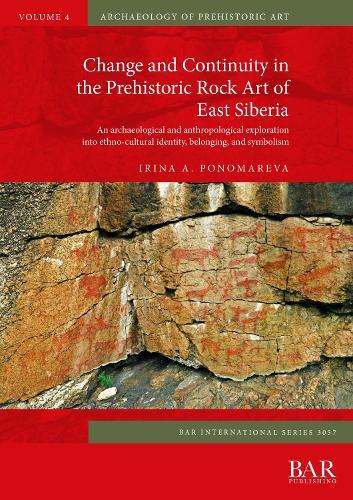
Change and Continuity in the Prehistoric Rock Art of East Siberia: An archaeological and anthropological exploration into ethno-cultural identity, belonging, and symbolism

Author:   Irina A. Ponomareva
Publisher:   BAR Publishing
ISBN:  

9781407358765


Pages:   222
Publication Date:   30 November 2021
Format:   Paperback
Availability:   Available To Order   Availability explained
We have confirmation that this item is in stock with the supplier. It will be ordered in for you and dispatched immediately.

Our Price $137.14 Quantity:  
Add to Cart

Share |

Change and Continuity in the Prehistoric Rock Art of East Siberia: An archaeological and anthropological exploration into ethno-cultural identity, belonging, and symbolism


Overview

This book covers an extensive region of East Siberia, considering prehistoric ethno-cultural and social processes through the development of rock art styles and traditions. It addresses the questions of why rock art is created, why specific styles and traditions emerge and why changes in rock art occur. These questions are explored through anthropological perspectives on ethnicity, identity, and symbolism. A reader will find a comprehensive overview of the developments of rock art research in Siberia as well as detailed accounts of the regional archaeology in the Bronze/Iron ages, the Neolithic, and partially the Late Paleolithic. Importantly, this study is primarily fieldwork-based, presenting information on 108 rock art sites in Yakutia and Trans-Baikal. It is a major contribution to Siberian and global rock art research and suggests new directions for future rock art research.

Full Product Details

Author:   Irina A. Ponomareva
Publisher:   BAR Publishing
Imprint:   BAR Publishing
Weight:   0.885kg
ISBN:  

9781407358765


ISBN 10:   1407358766
Pages:   222
Publication Date:   30 November 2021
Audience:   Professional and scholarly ,  Professional & Vocational
Format:   Paperback
Publisher's Status:   Active
Availability:   Available To Order   Availability explained
We have confirmation that this item is in stock with the supplier. It will be ordered in for you and dispatched immediately.

Table of Contents

List of Figures List of Tables Abstract 1. Introduction 1.1. Research questions, methodology and relevance of study 1.2. Background and setting 1.3. Chronology and dates 1.4. Book structure 2. In Search of Rock Art Sites. Fieldwork, Results, Materials 2.1. Fieldwork 2.1.1. Fieldwork goals 2.1.2. Fieldwork overview 2.1.3. Rock art recording 2.2. Initial data handling 2.2.1. Data processing 2.2.2. Primary data analysis 2.3. Results of rock art surveys in 2017 2.3.1. Yakutia 2.3.2. Zabaykalsky Krai 2.3.3. Buryatia 2.4. Conclusion 3. In Search of Rock Art In Siberia. History 3.1. Russian Empire period 3.2. Soviet/Russian period 3.2.1. The 1920s-1930s 3.2.2. The 1940s-1970s 3.2.3. The 1970s-1980s 3.2.4. The 1990s-2000s 3.3. Conclusion 4. In Search of Ethnic Groups and Ethnicity in Rock Art. Developments and Perspectives 4.1. Origin of the term and early categorisations of people entities 4.2. Soviet/Russian concepts 4.3 American and British concepts of ethnicity 4.4. Further relevant ideas and viewpoints about ethnicity 4.5. Style and identity in rock art studies 4.6. A new working definition of style 4.7. Conclusion 5. Ethno-cultural Continuity in the Rock Art of East Siberia: In Search of the Earliest Images 5.1. Debates on the Paleolithic rock art of Siberia: a review 5.2. Trans-Baikal rock art province 5.2.1. Discoveries and new perspectives 5.2.2. Shaman-Gora rock art site 5.2.3. The 'Byrka' style 5.3. The Lower Amur Basin: the longest petroglyphic tradition 5.3.1. Motifs 5.3.2. Chronology 5.3.3. 'Structuring structures' in the Lower Amur petroglyphic tradition 5.4. Conclusion. Change is where continuity begins 6. Neolithic Rock Art and Negotiation of Ethno-Cultural Identities 6.1 East Siberia in the Neolithic Age 6.1.1. Cis-Baikal 6.1.2. Yakutia 6.1.3. Trans-Baikal 6.1.4. Summary 6.2. Neolithic rock art of East Siberia: a review 6.2.1. Cis-Baikal 6.2.2. Yakutia 6.2.3. Trans-Baikal 6.3. Angara rock art style and the emergence of ethno-cultural identity 6.3.1. The Angara rock art style in time and space 6.3.2. The emergence of ethno-cultural identity 6.4. Conclusion 7. Bronze Age Rock Art of East Siberia. Unravelling Manifold Identities 7.1. East Siberia in the Bronze-Iron Ages 7.1.1. Eneolithic and Early Bronze Ages 7.1.2. Late Bronze - Iron Ages 7.1.3. Summary 7.2. The diversity of Bronze age rock art: an introduction 7.2.1. Taiga Early Bronze Age rock art 7.2.2. Steppe Bronze Age rock art of East Siberia 7.3. Painted rock art tradition of Trans-Baikal 7.3.1. Motifs, typology, and spatial distribution 7.3.2. Selenga rock art tradition in time and space 7.4. Kyakhta group: preliminary approach 7.5. Early nomadic rock art of Trans-Baikal. Manifold identities unravelled 7.6. Conclusion 8. Conclusion 8.1. Summary 8.2. Key contribution to the field 8.3. Future directions and perspectives References

Reviews

'Siberian rock art is still underrepresented in international scholarship and Ponomareva's book will be a significant contribution to developing knowledge and interest in the rock art of this part of the world.' Professor Andrzej Rozwadowski, Adam Mickiewicz University, Poznan 'This work is incredibly ambitious: it covers a huge geographic area, yet provides a huge amount of detail on the current state of research for both rock art and archaeology in eastern Siberia. Non-Russian speakers will immediately find it invaluable for the sheer scale of the research overview, while those interested in the region's rock art will benefit from the publication of the 108 rock art sites (both re-recorded and newly identified).' Dr Rebecca O'Sullivan, University of Bonn


Author Information

Irina A. Ponomareva has a degree in archaeology from Saint-Petersburg State University, Russia, and holds a PhD from Griffith University, Australia. Her research interests include rock art and archaeology of Central and North Asia, ethnography of Siberian peoples, cultural anthropology, and Australian Aboriginal archaeology. She is currently a Resident Adjunct at Griffith University also working as an archaeologist with Aboriginal communities in QLD, Australia.

Tab Content 6

Author Website:  

Countries Available

All regions
Latest Reading Guide

April RG 26_2


Shopping Cart
Your cart is empty
Shopping cart
Mailing List