Overview
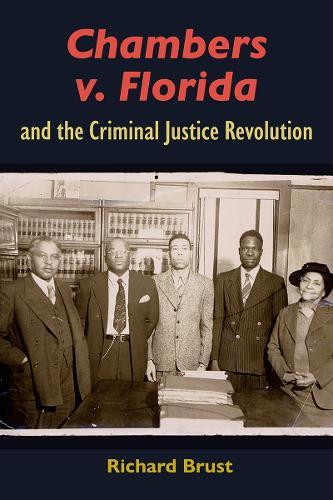
The history and enduring legacy of a breakthrough case in criminal justice reform In 1940, the United States Supreme Court decided in Chambers v. Florida to ban confessions obtained through mental or physical coercion in criminal trials. This landmark ruling laid the groundwork for many later protections for those in the custody of law enforcement. This book shows how the case contributed to what is now known as the “criminal procedure revolution,” a series of Supreme Court rulings that found protections in the Bill of Rights applied not only to defendants in federal cases but also to those in state legal systems. The trial that sparked this chain of events resulted from the robbing and murder of a white fish market owner in Pompano, Florida, in 1933. Local law enforcement officers extracted confessions from four Black migrant workers after a week of torture and abuse. Simuel McGill, a Black lawyer based in Jacksonville, mounted appeals, kept the accused men safe from lynchings, and eventually took the case to the nation’s highest court, where Justice Hugo Black, among other parts of the ruling, compared justice systems in the Jim Crow South to those of totalitarian nations in 1930s Europe. This book fully explores the case, often overlooked by historians, and its ripple effects—such as the “Miranda rights” formalized in 1966, including the “right to remain silent.” Chambers v. Florida and the Criminal Justice Revolution demonstrates the influence of African American lawyers in early criminal and civil rights cases, as well as the growing public awareness of abuses of power by white sheriffs and law enforcement authorities during this time. It highlights the ever-present need to safeguard protections for minority and impoverished individuals accused of crimes, reminding readers that with perseverance and vigilance, justice can prevail. A volume in the series Government and Politics in the South, edited by Sharon D. Wright Austin and Angela K. Lewis-Maddox
Full Product Details
Author: Richard Brust
Publisher: University Press of Florida
Imprint: University Press of Florida
Dimensions:
Width: 15.20cm
, Height: 1.40cm
, Length: 22.90cm
ISBN: 9780813081021
ISBN 10: 0813081025
Pages: 204
Publication Date: 20 May 2025
Audience:
Professional and scholarly
,
College/higher education
,
Professional & Vocational
,
Postgraduate, Research & Scholarly
Format: Paperback
Publisher's Status: Active
Availability: Out of stock

The supplier is temporarily out of stock of this item. It will be ordered for you on backorder and shipped when it becomes available.
Reviews
CONTENTS List of Figures ix Introduction 1 Part I. Race and Crime: Lawlessness and Racism in the 1930s 1. Pompano in the 1930s 17 2. The Sheriff and Arbitrary Power 28 3. Jailhouse Violence and the Confession 35 4. Prohibition and Lawlessness 42 5. A Trial in the South 52 6. Jacksonville and the African American Lawyer 59 7. Appeals and Lynching 74 Part II. Law and Justice: The Supreme Court Ruling and Its Aftermath 8. Justice Black 95 9. The Due Process Debate 101 10. Southern Fascism 109 11. Decision and Response 119 12. The Criminal Justice Revolution 125 13. A New Generation of Lawyers 135 14. The Decline of Sheriff Clark 145 Epilogue 153 Acknowledgments 159 Notes 161 Bibliography 201 Index 215
Author Information
Richard Brust is an award-winning journalist and legal historian who has worked as an editor and writer at metropolitan newspapers and legal affairs publications.