Overview
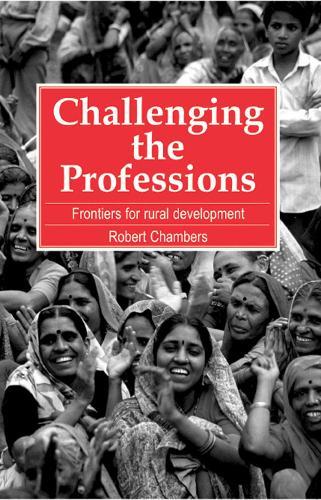
Questioning the dominant approaches taken by many professionals concerned with rural development the theme of this book is that 'we' - the professionals - are much of the problem. New frontiers could be opened by reversing many ideas and practices.
Full Product Details
Author: Professor Robert Chambers (Fellow, Institute of Development Studies (IDS))
Publisher: Practical Action Publishing
Imprint: Practical Action Publishing
Dimensions:
Width: 15.00cm
, Height: 0.90cm
, Length: 22.80cm
Weight: 0.240kg
ISBN: 9781853391941
ISBN 10: 1853391948
Pages: 160
Publication Date: 15 December 1993
Audience:
College/higher education
,
Professional and scholarly
,
Undergraduate
,
Postgraduate, Research & Scholarly
Format: Paperback
Publisher's Status: Active
Availability: In Print 
This item will be ordered in for you from one of our suppliers. Upon receipt, we will promptly dispatch it out to you. For in store availability, please contact us.
Table of Contents
Part 1 Normal professionalism, new paradigms and development: the setting; development professions and paradigms; normal professionalism; conservatism; defences; weaknesses; polar paradigms - first and last; the new development paradigm. Part 2 Managing rural development - procedure, principles and choices: principles, modes of thought - empirical not perfectionist, systems thinking, administrative capacity as a scarce resource, optimizing, not maximizing, optimal ignorance, opportunity-versus problem-orientation, sophistication in simplicity; precepts in procedural design - introduce joint programming and joint target-setting, make meetings few and functional, make reports short and functional, subsume or abolish old procedures, start with a pilot experimental approach, involve participating staff in discussion procedures; choices. Part 3 Project selection for poverty-focused rural development - simple is optimal: rural poverty - problems and opportunities; problems in project selection - the needs of donors, the big project trap, project appraisal in practice, complexity, dependence and delay, the neglect of administrative capacity; solutions - simple is optimal - decentralization; simple procedures - decision matrices, poverty group ranking, checklists, listing costs and benefits, unit costs and cost-effectiveness; life-style, learning and judgement. Part 4 Health, agriculture, and rural poverty - why seasons matters: the argument - professional and personal biases, biases of access and contact, dry season bias, statistical biases; practical implications - research, health services, rural planning and action; postscript. Part 5 Farmer-first - a practical paradigm for the Third Agriculture: the great challenge of the 1990s; normal professionalism, transfer-of-technology and the third agriculture; farmer first - the complementary paradigm - analysis, search, choice, experimentation, evaluation and extension; challenges for the future - inventiveness, parsimony, spread, embedding. Part 6 Normal professionalism and the early project process - problems and solutions: definitions and scope; normal professionalism; professions and the early project process; bureaucratic and political pressures; project process pathology - irreversibility of commitment, the anti-poor bias in methodology, the ""home economics"" of cost-benefit analysis, additive procedures; large projects - prevention often better than cure; the new paradigm and the new professionalism; practical implications - calibre, commitment and continuity of field staff, restraint in funding, rapid appraisal; learning projects. (Part contents)
Reviews
Author Information
Professor Robert Chambers is a research associate of the Institute of Development Studies, Sussex, UK, which has been his base since 1969 with periods in other countries. His educational background is in natural sciences, history and public administration. His main administrative and research experience in development has been in East Africa and South Asia. He is widely recognized as one of the main driving forces behind the great surge of interest in the use of Participatory Rural Appraisal around the world. He has been a Fellow at the Institute of Development Studies since 1972 and is an author, co editor and contributor of many books.
Tab Content 6
Author Website:
Countries Available
All regions
|