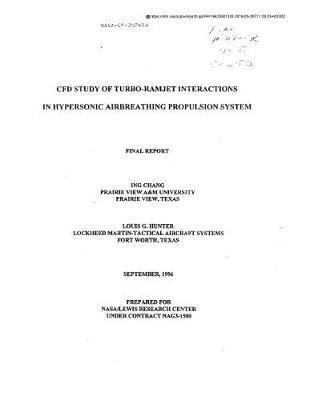
Cfd Study of Turbo-Ramjet Interactions in Hypersonic Airbreathing Propulsion System

Author:   National Aeronaut Administration (Nasa)
Publisher:   Createspace Independent Publishing Platform
ISBN:  

9781722297718


Pages:   70
Publication Date:   06 July 2018
Format:   Paperback
Availability:   Available To Order   Availability explained
We have confirmation that this item is in stock with the supplier. It will be ordered in for you and dispatched immediately.

Our Price $65.97 Quantity:  
Add to Cart

Share |

Cfd Study of Turbo-Ramjet Interactions in Hypersonic Airbreathing Propulsion System


Overview

Advanced airbreathing propulsion systems used in Mach 4-6 mission scenarios, usually involve turbo-ramjet configurations. As the engines transition from turbojet to ramjet, there is an operational envelope where both engines operate simultaneously. In the first phase of our study, an over/under nozzle configuration was analyzed. The two plumes from the turbojet and ramjet interact at the end of a common 2-D cowl, where they both reach an approximate Mach 3.0 condition and then jointly expand to Mach 3.6 at the common nozzle exit plane. For the problem analyzed, the turbojet engine operates at a higher nozzle pressure ratio than the ramjet, causes the turbojet plume overpowers the ramjet plume, deflecting it approximately 12 degrees downward and in turn the turbojet plume is deflected 6 degrees upward. In the process, shocks were formed at the deflections and a shear layer formed at the confluence of the two jets. This particular case was experimentally tested and the data were used to compare with a computational fluid dynamics (CFD) study using the PARC2D code. The CFD results were in good agreement with both static pressure distributions on the cowl separator and on nozzle walls. The thrust coefficients were also in reasonable agreement. In addition, inviscid relationships were developed around the confluence point, where the two exhaust jets meet, and these results compared favorably with the CFD results. In the second phase of our study, a 3-D CFD solution was generated to compare with the 2-D solution. The major difference between the 2-D and 3-D solutions was the interaction of the shock waves, generated by the plume interactions, on the sidewall. When a shock wave interacts with a sidewall and sidewall boundary layer, it is called a glancing shock sidewall interaction. These interactions entrain boundary layer flow down the shockline into a vortical flow pattern. The 3-D plots show the streamlines being entrained down the shockline. The pressure of the flow a...

Full Product Details

Author:   National Aeronaut Administration (Nasa)
Publisher:   Createspace Independent Publishing Platform
Imprint:   Createspace Independent Publishing Platform
Dimensions:   Width: 21.60cm , Height: 0.40cm , Length: 27.90cm
Weight:   0.186kg
ISBN:  

9781722297718


ISBN 10:   1722297719
Pages:   70
Publication Date:   06 July 2018
Audience:   General/trade ,  General
Format:   Paperback
Publisher's Status:   Active
Availability:   Available To Order   Availability explained
We have confirmation that this item is in stock with the supplier. It will be ordered in for you and dispatched immediately.

Table of Contents

Reviews

Author Information

Tab Content 6

Author Website:  

Countries Available

All regions
Latest Reading Guide

April RG 26_2


Shopping Cart
Your cart is empty
Shopping cart
Mailing List