Overview
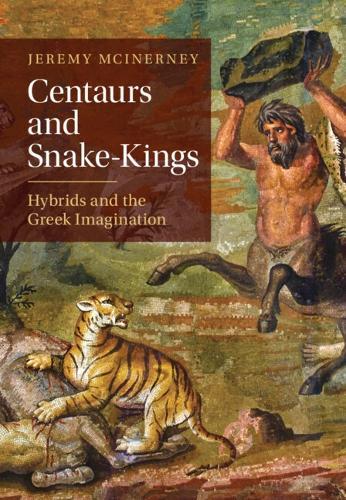
Griffins, centaurs and gorgons: the Greek imagination teems with wondrous, yet often monstrous, hybrids. Jeremy McInerney discusses how these composite creatures arise from the entanglement of humans and animals. Overlaying such enmeshment is the rich cultural exchange experienced by Greeks across the Mediterranean. Hybrids, the author reveals, capture the anxiety of cross-cultural encounter, where similarity and incongruity were conjoined. Hybridity likewise expresses instability of identity. The ancient sea, that most changeable ancient domain, was viewed as home to monsters like Skylla; while on land the centaur might be hypersexual yet also hypercivilized, like Cheiron. Medusa may be destructive, yet also alluring. Wherever conventional values or behaviours are challenged, there the hybrid gives that threat a face. This absorbing work unveils a mercurial world of shifting categories that offer an alternative to conventional certainties. Transforming disorder into images of wonder, Greek hybrids – McInerney suggests – finally suggest other ways of being human.
Full Product Details
Author: Jeremy McInerney (University of Pennsylvania)
Publisher: Cambridge University Press
Imprint: Cambridge University Press
Dimensions:
Width: 17.90cm
, Height: 2.20cm
, Length: 25.00cm
Weight: 0.860kg
ISBN: 9781009459105
ISBN 10: 1009459104
Pages: 368
Publication Date: 25 July 2024
Audience:
General/trade
,
General
Format: Hardback
Publisher's Status: Active
Availability: Manufactured on demand

We will order this item for you from a manufactured on demand supplier.
Reviews
'This welcome contribution to theorizing hybridity offers a thoughtful and sustained reflection on a key dimension of human interaction with the natural and imagined environment, furnishing a fascinating window onto aspects of the ancient Greek experience with the known and unknown. It should also attract interest for comparative studies of hybrids and hybridity in cultural spheres both related to and altogether removed from the ancient Mediterranean world.' Ann C. Gunter, Northwestern University 'In this splendid book which deploys scholarship of truly impressive depth and breadth, Jeremy McInerney demonstrates that the notion of hybridity has just as much to offer to the student of ancient Greece as it does to the analyst of our own radically different culture. The argument overflows with theoretical insights inspired by anthropology, and makes productive use of comparative material from, especially, the Near East, Egypt and Australasia (including Norman Lindsay's sublime The Magic Pudding). But it is Greece that takes the limelight. McInerney investigates a fascinating menagerie of imaginary animal/human boundary-crossers, creatures who are, as he puts it, 'strange, yet at the same time disquietingly familiar'. A must-read for any serious student of the Greek imaginaire.' Richard G. A. Buxton, University of Bristol
'This welcome contribution to theorizing hybridity offers a thoughtful and sustained reflection on a key dimension of human interaction with the natural and imagined environment, furnishing a fascinating window onto aspects of the ancient Greek experience with the known and unknown. It should also attract interest for comparative studies of hybrids and hybridity in cultural spheres both related to and altogether removed from the ancient Mediterranean world.' Ann C. Gunter, Northwestern University 'In this splendid book which deploys scholarship of truly impressive depth and breadth, Jeremy McInerney demonstrates that the notion of hybridity has just as much to offer to the student of ancient Greece as it does to the analyst of our own radically different culture. The argument overflows with theoretical insights inspired by anthropology, and makes productive use of comparative material from, especially, the Near East, Egypt and Australasia (including Norman Lindsay's sublime The Magic Pudding). But it is Greece that takes the limelight. McInerney investigates a fascinating menagerie of imaginary animal/human boundary-crossers, creatures who are, as he puts it, 'strange, yet at the same time disquietingly familiar'. A must-read for any serious student of the Greek imaginaire.' Richard G. A. Buxton, University of Bristol 'The Greeks, says the classics professor Jeremy McInerney, were fascinated by hybrids. From centaurs and griffins to gorgons and Medusa, composite creatures had a hold on their imagination, not least because they were an expression of dual personality traits: dangerous and alluring, sexualised and civilised. Through them, McInerney argues, disorder became wonder.' New Statesman 'A brilliant study, which left this reader both deeply informed and pleasurably disorientated.' Emma Greensmith, Times Literary Supplement
Author Information
Jeremy McInerney is Professor of Classical Studies at the University of Pennsylvania. He is the author of The Folds of Parnassos (1999), The Cattle of the Sun (2010) and Greece in the Ancient World (2018) and the editor of A Companion to Ethnicity in the Ancient Mediterranean (2014).