Overview
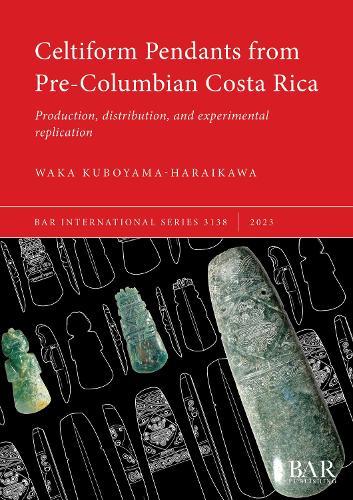
This volume elucidates the lapidary technologies and social organisation of pre-Columbian Costa Rica (500 BCE - 900 CE) by analysing the manufacturing and social role of lapidary ornaments, known as celtiform pendants. These pendants are characterised by skilfully decorated carvings on celtiform semiprecious rocks and minerals, such as jadeite. A human or animal face is carved on the poll of the axe, and these sophisticated images require large amounts of time and effort to create, hence they are interpreted as status symbols and prestigious objects. They represent a thousand years of tradition of the manufacture of high-status ornaments and were used by elite members of Indigenous Costa Rican societies. Although ancient Costa Rican society was formed by different social-cultural groups, to some extent societal integration was achieved by a widely shared material culture: celtiform pendants. In addition to stylistic evaluations of these objects in specific sites and features, the text examines their manufacture via experimental archaeology and traceology.
Full Product Details
Author: Waka Kuboyama-Haraikawa
Publisher: BAR Publishing
Imprint: BAR Publishing
ISBN: 9781407314969
ISBN 10: 1407314963
Pages: 168
Publication Date: 31 August 2023
Audience:
Professional and scholarly
,
Professional & Vocational
Format: Paperback
Publisher's Status: Active
Availability: Available To Order 
We have confirmation that this item is in stock with the supplier. It will be ordered in for you and dispatched immediately.
Table of Contents
Introduction Celtiform pendants: Subject matter of the discussion Celt (axe) production and jade lapidary arts around the world Approaches to technology Outline of the book Research questions 1. Overview of Costa Rican Archaeology 1.1. The regional characteristics of the Isthmo-Colombian Area and Costa Rica 1.1.1. Geographical-environmental division of pre-Columbian Costa Rica 1.2. The development of Costa Rican archaeology: From antiquarianism to scientific research 1.3. The emergence of early human society in Costa Rica 1.3.1. Early Hunter-gatherer society/Paleoindian period (13,000-7000 BCE) 1.3.2. Late Hunter-gatherer society/Archaic period (7000-2000 BCE) 1.3.3. Early Agricultural society/Formative period (2000-300 BCE) 1.3.4. Early Chiefdom society (300 BCE-300 CE) 1.3.5. Late Chiefdom society (300-800 CE/800-1502 CE) 1.3.6. Spanish Colonisation (1502-1821) 1.4. The emergence of the jadeworking tradition in Costa Rica 2. Morphological Aspects of Celtiform Pendants and Lapidary Cultures in Middle America 2.1. Characteristics of celtiform pendants 2.2. Raw material: Jadeite, 'social jade', and other volcanic stones 2.3. Previous studies on stylistic classification 2.4. New stylistic classification of celtiform pendants 2.4.1. Size 2.4.2. Shape of profile 2.4.3. Dorsal form 2.4.4. Perforation 2.4.5. Motifs on the poll 2.5. Lapidary cultures across Middle America 2.5.1. The Olmecs (Mexico) 2.5.2. Maya (Guatemala/Honduras) 2.5.3. Mezcala (Mexico) 2.5.4. Insular-Caribbean (Greater and Lesser Antilles) 3. Material Culture, Technology, and Human Behaviour 3.1. Material culture in archaeology 3.2. Archaeological approach to ancient technologies 3.3. Behavioural archaeology and the life history of technology 3.4. Designing an artefact 3.5. The selection of raw material and production 3.6. Communication, technology transfer, and educational/learning systems 3.7. Imitation, skeuomorphism, bricolage, and scale 3.8. Economic and social issues of craftspeople 4. Methodologies: Material Analyses and Experimental Archaeology 4.1. Analysing material culture and ancient technologies 4.2. Microscopes, RTI, and silicon resin casting 4.3. The theory of chaîne opératoire 4.4. Experimental archaeology 5. Lapidary Technologies and Fragmentation 5.1. Necessary skills and key technologies 5.1.1. Raw material extraction and forming standardised blanks 5.1.2. Grinding and polishing 5.1.3. Perforation 5.1.4. Carving images 5.1.5. Highlighting the incised lines 5.2. Carving technology of celtiform pendants 5.2.1. Reconsideration of Chenault's work 5.2.2. New proposal for carving procedures of celtiform pendants 5.3. Fragmentation 5.3.1. Fragmentation of artefacts 5.3.2. Fragmentation of celtiform pendants and social meanings 5.3.3. Classification of fragmentation methods 6. Experimental Replication 6.1. Carving experiments 6.1.1. Half-celt technique 6.1.2. Whole-celt technique 6.2. Experiments with various minerals 6.2.1. Grinding 6.2.2. Polishing 6.2.3. Sawing and splitting 6.2.4. Perforating 6.3. Wearing experiments with celtiform pendants 7. Traceological Analyses and Techno-typology 7.1. Traceological examination of crafting marks 7.1.1. Microscopic traces of grinding and polishing 7.1.2. Perforation 7.1.3. Sawing cut 7.1.4. Splitting 7.2. A summary of traceological analysis 8. Distribution of Technological Styles, Burials, and Offerings 8.1. Imagery and typological distribution 8.2. Archaeological contexts of celtiform pendants 8.2.1. Site of La Regla 8.2.2. Site of Las Huacas 8.2.3. Site of Rempujo 8.2.4. Site of Loma Corral-3 8.2.5. Site of Talamanca de Tibás 8.2.6. Site of Monte Sele 8.2.7. Site of Ballena 8.2.8. Site of Finca Linares 8.2.9. Site of Mamá Inés 8.2.10. Sites of Mercocha and Las Mercedes 8.2.11. Sites of Nosara, Desagüe, Hacienda Jericó, and Las Delicias 8.2.12. Site of Severo Ledezma (El Tres) 8.2.13. Sites of Bremen B, Polideportivo B, and La Fortuna 8.2.14. Sites of JÁK and Hacienda El Molino 8.3. The distribution of funerary customs, technological types, carved motifs, and workshops 9. Final Considerations and Future Prospects 9.1. Morphology and technology: A reflection of society and crafting groups 9.2. Distribution of celtiform pendants 9.3. The production, social role, and value of celtiform pendants 9.4. The social relations behind the production of celtiform pendants 9.5. Recommendations for future research Appendices Appendix 1.1. Timeline: Jade and greenstone lapidary traditions in Middle America Appendix 1.2. Map of Middle America: jadeite sources and jade lapidary cultures Appendix 1.3. Drawings of celtiform pendants in the National Museum of Costa Rica Appendix 1.4. Drawings of celtiform pendants (without contexts) in the Jade Museum and National Museum of Costa Rica Appendix 1.5. Table of celtiform pendants with contexts Appendix 1
Reviews
'The author's applications of experimental archaeology and techniques, such as (RTI), are innovatively conceived and executed.' Professor John W. Hoopes, University of Kansas 'This book is highly original and timely. The research is paradigm-shifting in quality and impact. The methods and results are likely to raise the empirical and theoretical status of research on the lapidary traditions of ancient Costa Rica to an entirely new level, constituting a dramatic update of research approaches in the field.' Professor David Mora-Marín, University of North Carolina
'The author's applications of experimental archaeology and techniques, such as (RTI), are innovatively conceived and executed.' Professor John W. Hoopes, University of Kansas 'This book is highly original and timely. The research is paradigm-shifting in quality and impact. The methods and results are likely to raise the empirical and theoretical status of research on the lapidary traditions of ancient Costa Rica to an entirely new level, constituting a dramatic update of research approaches in the field.' Professor David Mora-Marín, University of North Carolina
Author Information
Waka Kuboyama-Haraikawa has a Ph.D. in archaeology from the University of Southampton. She is a special researcher for the Japan Society for the Promotion of Science.
Tab Content 6
Author Website:
Countries Available
All regions
|