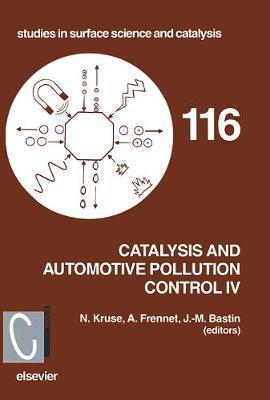
Catalysis and Automotive Pollution Control IV

Author:   N. Kruse ,  A. Frennet ,  J.-M. Bastin (Chimie Physique des Surfaces - Catalyse Hétérogène, Université Libre de Bruxelles, Brussels, Belgium)
Publisher:   Elsevier Science & Technology
Volume:   v.116
ISBN:  

9780444827951


Pages:   696
Publication Date:   29 May 1998
Format:   Hardback
Availability:   In Print   Availability explained
This item will be ordered in for you from one of our suppliers. Upon receipt, we will promptly dispatch it out to you. For in store availability, please contact us.

Our Price $620.40 Quantity:  
Add to Cart

Share |

Catalysis and Automotive Pollution Control IV


Overview

In spite of the energy crises and the recession, there has been a global, explosive growth in the amount of motor vehicles. In the past 50 years, the amount has increased from 50 to 700 million vehicles. For economical reasons they will probably continue to be used for a considerable number of years, despite the poor yield of internal combustion engines resulting in the inevitable production of some gaseous pollutants. The subsequent increase of gaseous pollutants in our atmosphere caused by exhaust gas from automobiles has enhanced the problem of the elimination of these pollutants produced by internal combustion engines. Catalysis has proven to be the best solution to lower the content of exhaust gas in pollutants. As its predecessors, CAPoC4 proved to be a suitable platform for discussing technological improvements and developments along with future perspectives and challenges.In the light of new results and further legislative regulations, the following topics were intensely discussed: *low light-off behaviour based on improved catalysts and substrate formulations *efficient adsorber systems for storage of hydrocarbon emissions *electrically heated catalyst systems ahead the main catalyst or, alternatively, close coupled catalysts (at the manifold of the engine) * lean DeNO catalysts allowing for decomposition of NO in the oxygen-rich exhaust of direct injection gasoline engines and high speed injection diesel engines or, alternatively, NO trapping/reduction in a hybrid approach * collection and destruction of dry particulates or soot. There is no doubt that clean vehicle technology is a vital part of improving air quality. Challenges remain and call for technological answers. Catalytic air pollution control is still an area providing a considerable incentive for innovative work.

Full Product Details

Author:   N. Kruse ,  A. Frennet ,  J.-M. Bastin (Chimie Physique des Surfaces - Catalyse Hétérogène, Université Libre de Bruxelles, Brussels, Belgium)
Publisher:   Elsevier Science & Technology
Imprint:   Elsevier Science Ltd
Volume:   v.116
Dimensions:   Width: 17.10cm , Height: 3.20cm , Length: 23.00cm
Weight:   1.440kg
ISBN:  

9780444827951


ISBN 10:   0444827951
Pages:   696
Publication Date:   29 May 1998
Audience:   Professional and scholarly ,  Professional & Vocational
Format:   Hardback
Publisher's Status:   Active
Availability:   In Print   Availability explained
This item will be ordered in for you from one of our suppliers. Upon receipt, we will promptly dispatch it out to you. For in store availability, please contact us.

Table of Contents

Reviews

Author Information

Tab Content 6

Author Website:  

Countries Available

All regions
Latest Reading Guide

NOV RG 20252


Shopping Cart
Your cart is empty
Shopping cart
Mailing List