Overview
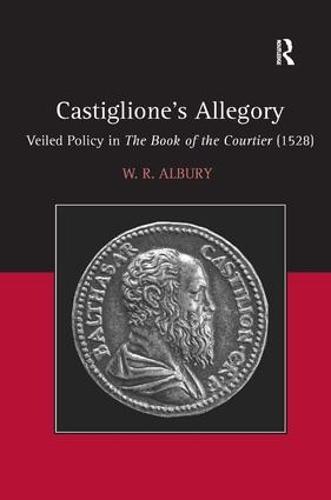
Castiglione’s Book of the Courtier (Il libro del cortegiano, 1528), a dialogue in which the interlocutors attempt to describe the perfect courtier, was one of the most influential books of the Renaissance. In recent decades a number of postmodern readings of this work have appeared, emphasizing what is often characterized as the playful indeterminacy of the text, and seeking to detect inconsistencies which are interpreted as signs of anxiety or bad faith in its presentation. In contrast to these postmodern readings, the present study conducts an experiment. What understanding does one gain of Castiglione’s book if one attempts an early modern reading? The author approaches The Book of the Courtier as a text in which some of its most important aspects are intentionally concealed and veiled in allegory. W.R. Albury argues that this early modern reading of The Book of the Courtier enables us to recover a serious political message which has a great deal of contemporary relevance and which is lost from sight when the work is approached primarily as a courtly etiquette book, or as a lament for the lost influence of the aristocracy in an age when autocratic nation-states were coming into being, or as an impersonal textual field upon which a free play of transformations and deconstructions may be performed.
Full Product Details
Author: W.R. Albury
Publisher: Taylor & Francis Ltd
Imprint: Routledge
Edition: New edition
Dimensions:
Width: 15.60cm
, Height: 1.80cm
, Length: 23.40cm
Weight: 0.680kg
ISBN: 9781472432636
ISBN 10: 1472432630
Pages: 290
Publication Date: 18 July 2014
Audience:
Professional and scholarly
,
General/trade
,
Professional & Vocational
,
General
Format: Hardback
Publisher's Status: Active
Availability: In Print

This item will be ordered in for you from one of our suppliers. Upon receipt, we will promptly dispatch it out to you. For in store availability, please contact us.
Reviews
'... an important new reading of Castiglione's work even as it builds upon a vast body of previous scholarship. The chapter sections fall into place like pieces of a puzzle, each elucidating a complementary aspect of The Book of the Courtier's veiled policy . The author provides historical, political, cultural, literary, and biographical contexts that helpfully support this new interpretation of the work ... a sheer joy to read.' Jo Ann Cavallo, Columbia University, USA; author of The World beyond Europe in the Romance Epics of Boiardo and Ariosto 'The book concludes with a thoughtful and thought-provoking chapter analyzing Castiglione's medal and impresa. Rarely can a medal have been subjected to such rigorous examination.' Philip Attwood, Keeper of Coins and Medals, The British Museum, UK; author of Italian Medals c. 1530-1600 in British Public Collections
...an important new reading of Castiglione's work even as it builds upon a vast body of previous scholarship. The chapter sections fall into place like pieces of a puzzle, each elucidating a complementary aspect of The Book of the Courtier's 'veiled policy.' The author provides historical, political, cultural, literary, and biographical contexts that helpfully support this new interpretation of the work...a sheer joy to read.'Jo Ann Cavallo, Columbia University, USA; author of The World beyond Europe in the Romance Epics of Boiardo and Ariosto
Author Information
Emeritus Professor W.R. Albury is currently Adjunct Professor in the School of Humanities at the University of New England, Armidale NSW, Australia.