Overview
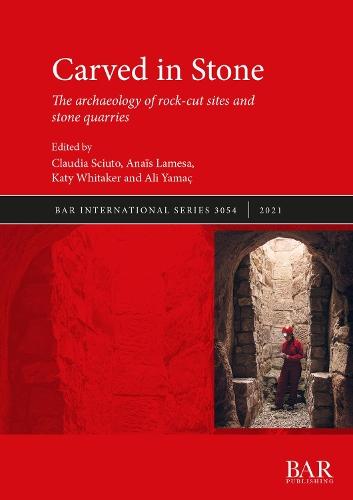
The study of marks left by humans on stone outcrops is an interdisciplinary endeavour that entails geology, history of techniques, ethnography as well as experimental archaeology. Moreover, the investigation of carved landscapes contributes to the understanding of the complex relationship between human groups and their environments. This volume represents an overview of different case studies of rock-cut sites and quarries, approached as knots in the network of people-stone interactions. The book is the result of a long exchange developed during European Archaeologist Association conference sessions aimed at turning the attention of the international scientific community towards the relevance of the archaeological study of rock-cut sites and quarries, and to promote the creation of a European network of researchers working on the subject.
Full Product Details
Author: Anaïs Lamesa ,
Katy Whitaker ,
Claudia Sciuto ,
Ali Yamaç
Publisher: BAR Publishing
Imprint: BAR Publishing
Weight: 0.766kg
ISBN: 9781407358093
ISBN 10: 140735809
Pages: 192
Publication Date: 29 October 2021
Audience:
Professional and scholarly
,
Professional & Vocational
Format: Paperback
Publisher's Status: Active
Availability: Available To Order

We have confirmation that this item is in stock with the supplier. It will be ordered in for you and dispatched immediately.
Reviews
This volume contains numerous interesting contributions that undoubtedly enrich the panorama and our knowledge of rock architecture. Contributors to this volume are international scholars, all bringing their personal input to the general debate on the matter. Dr Roberto Dan, Research Fellow at Tuscia University/ ISMEO
Author Information
Editors: Claudia Sciuto is a postdoctoral researcher at the University of Pisa, Italy, working on stone supply strategies, the archaeology of quarries as well as archaeological theory. She holds a PhD in Environmental Archaeology from the University of Umeå, Sweden. Anaïs Lamesa is a postdoctoral researcher at the CNRS, France, working on medieval rock-cut churches in Ethiopia. She holds a PhD in Ancient History from the University of Paris-Sorbonne, France. Katy Whitaker is an archaeologist with Historic England, the UK government advice agency on the historic environment, and a doctoral research student at the University of Reading. She researches quarrying and stone-working in southern England, focussing on the long-term uses of sarsen stone. Ali Yamaç is a speleologist. In addition to his natural cave explorations, he led several artificial cave study projects for over ten years. At the time being, he is working on four different underground structure inventory projects around different regions of Turkey. List of contributors: Ron Adams, Simon Fraser University, Canada Maxence Bailly, University Aix-Marseille, France - CNRS, France Hiluf Berhe, Mekelle University, Ethiopia Jean-Claude Bessac, CNRS Montpellier, France Constantin Canavas, Hamburg University of Applied Sciences, Germany Paolo Fallavollita, Oben srl, Sassari, Italy Jean-Pierre Gély, University of Paris I Panthéon-Sorbonne, France Ivan Lafarge, Cultural heritage office, Département de la Seine-Saint-Denis, France Anaïs Lamesa, CNRS Paris, France Christina Marangou, Independent researcher, Athens, Greece Xavier Margarit, University Aix-Marseille, France - CNRS, France Maria Grazia Melis, University of Sassari, Italy Martin Mino, Regional Board Banská Bystrica - Monument Board, Slovak Republic Daniel Morleghem, University of Tours, France Marie-Elise Porqueddu, Universidad Autónoma de Madrid, Spain - University Aix-Marseille, France Guillaume Robin, University of Edinburgh, UK Claudia Sciuto, University of Pisa, Italy Luc Stevens, French Society for Souterrains Studies Katy Whitaker, University of Reading, UK Ali Yamaç, OBRUK Cave Research Group, Turkey