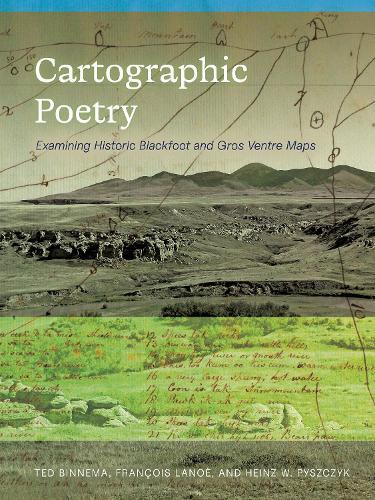
Full Product Details
Author: Ted Binnema (Professor, University of Northern British Columbia) ,
François Lanoë (Assistant Research Professor of Anthropology, University of Arizona, Research Associate in Archaeology, University of Alaska Museum of the North) ,
Heinz W. Pyszczyk (Departments of Geography & Environment and Archaeology, University of Lethbridge)
Publisher: University of Alberta Press
Imprint: University of Alberta Press
Dimensions:
Width: 19.10cm
, Height: 1.90cm
, Length: 25.40cm
Weight: 0.650kg
ISBN: 9781772127997
ISBN 10: 177212799
Pages: 232
Publication Date: 22 May 2025
Audience:
College/higher education
,
Professional and scholarly
,
Postgraduate, Research & Scholarly
,
Professional & Vocational
Format: Paperback
Publisher's Status: Active
Availability: In Print

This item will be ordered in for you from one of our suppliers. Upon receipt, we will promptly dispatch it out to you. For in store availability, please contact us.
Reviews
""Cartographic Poetry is the first detailed study of these five Indigenous maps as ethnohistoric documents. The authors describe the cartographic conventions of the mapmakers and provide their identifications of the named places. Given the recent interest in the study of toponyms, this book will be a valuable resource to researchers, members of First Nations communities, and the public.” Gerald Oetelaar, Professor Emeritus, University of Calgary ""Cartographic Poetry is a major contribution. It illustrates Indigenous Knowledge of the northern Great Plains as expressed through maps. Indigenous peoples shared their deep understanding of their land and landscape by drawing maps of their world that showed both physical and metaphysical realms."" Rosalyn LaPier, author of Invisible Reality: Storytellers, Storytakers and the Supernatural World of the Blackfeet ""[Cartographic Poetry] links the art of map-making with Indigenous storytelling and gives a fascinating look at Blackfoot cartography from the early 1800s. At its core, it ties the Blackfoot people to the vast Alberta landscape."" Alberta Native News, November 2025
""Cartographic Poetry is the first detailed study of these five Indigenous maps as ethnohistoric documents. The authors describe the cartographic conventions of the mapmakers and provide their identifications of the named places. Given the recent interest in the study of toponyms, this book will be a valuable resource to researchers, members of First Nations communities, and the public.” Gerald Oetelaar, Professor Emeritus, University of Calgary
""Cartographic Poetry is the first detailed study of these five Indigenous maps as ethnohistoric documents. The authors describe the cartographic conventions of the mapmakers and provide their identifications of the named places. Given the recent interest in the study of toponyms, this book will be a valuable resource to researchers, members of First Nations communities, and the public.” Gerald Oetelaar, Professor Emeritus, University of Calgary ""Cartographic Poetry is a major contribution. It illustrates Indigenous Knowledge of the northern Great Plains as expressed through maps. Indigenous peoples shared their deep understanding of their land and landscape by drawing maps of their world that showed both physical and metaphysical realms."" Rosalyn LaPier, author of Invisible Reality: Storytellers, Storytakers and the Supernatural World of the Blackfeet ""[Cartographic Poetry] links the art of map-making with Indigenous storytelling and gives a fascinating look at Blackfoot cartography from the early 1800s. At its core, it ties the Blackfoot people to the vast Alberta landscape."" Alberta Native News, November 2025 ""[Cartographic Poetry] links the art of map-making with Indigenous storytelling and gives a fascinating look at Blackfoot cartography from the early 1800s. At its core, it ties the Blackfoot people to the vast Alberta landscape."" Alberta Native News, November 2025
Author Information
Ted Binnema is Professor Emeritus of History at the University of Northern British Columbia. He is the author of The Vancouver Island Treaties and the Evolving Principles of Indigenous Title, Enlightened Zeal: The Hudson’s Bay Company and Scientific Networks, 1670–1870, and Common and Contested Ground: A Human and Environmental History of the Northwestern Plains. He co-edited with Gerhard Ens three volumes of The Hudson’s Bay Company Edmonton House Journals, published by the Historical Society of Alberta. He has also published scholarly articles and book chapters on a wide range of topics. His fascination with and research into Blackfoot and Gros Ventre maps dates to the 1990s. François Lanoë is Assistant Research Professor in the School of Anthropology at the University of Arizona and Research Associate at the University of Alaska Museum of the North. He works on the pre-contact archaeology of Indigenous peoples of northwestern North America, from early settlement during the last Ice Age, to interactions with Euro-American colonial powers. He has worked with tribes of the Blackfoot Confederacy since 2013, leading to several publications on Blackfoot archaeology, ancient DNA, and oral history. Heinz W. Pyszczyk, retired staff archaeologist with the Government of Alberta, is an adjunct professor at the University of Lethbridge. His primary research interest is Canadian fur trade archaeology and ethnohistory. His most recent publications include: The Last Fort Standing. Fort Vermilion and the Peace River Fur Trade, 1798-1830 and Fifty years of fur trade archaeology in northern Alberta forests: what have we accomplished? He has also published numerous articles in a wide range of topics in Canadian archaeology. As Parkland Archaeologist for the Government of Alberta, he first became interested in the Ki oo cus map in 2010 as it covered parts of his regional mandate.