|
|
|||
|
||||
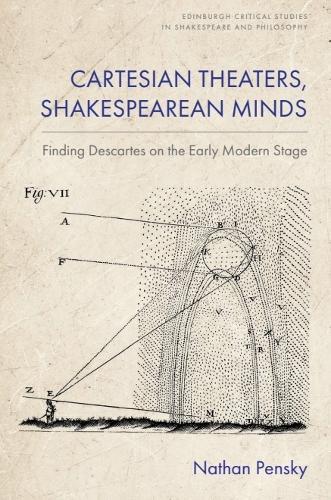
OverviewMost scholars of early modern English literature consider Cartesian rationalism to be a poor theoretical lens. Though Rene Descartes figures as one of the most important philosophers in the early modern period, and in the history of philosophy itself, he has received scorn from literary scholars of the Renaissance who have become skeptical of ""heroes of subjectivity."" Cartesian Theaters, Shakespearean Minds challenges the commonplace dichotomy between Cartesian subjectivity and early modern material culture and reconsiders Descartes as a foundational figure in early modern literary studies. It corrects outdated readings by scholars that would position him as a champion of disembodied mind. Instead, Nathan Pensky argues that both Descartes and Shakespeare, as well as several of the latter's contemporaries, draw from overlapping philosophical histories, and that the mind-body problem as evident in early modern drama clearly anticipates Cartesian thought. Full Product DetailsAuthor: Nathan Pensky (Adjunct Professor of English, University of Pittsburgh and Duquesne University)Publisher: Edinburgh University Press Imprint: Edinburgh University Press ISBN: 9781399556965ISBN 10: 1399556967 Pages: 312 Publication Date: 31 March 2026 Audience: Professional and scholarly , College/higher education , Professional & Vocational , Postgraduate, Research & Scholarly Format: Hardback Publisher's Status: Active Availability: Not yet available This item is yet to be released. You can pre-order this item and we will dispatch it to you upon its release. Language: English Table of ContentsAcknowledgements Introduction: Exorcising the Ghost in the Machine 1. Devilish Entertainment and Divine Thoughts in Doctor Faustus 2. Mind, Intension, and Wordplay in Endymion and Love’s Labour’s Lost 3. Hal as Cartesian Anti-Hero in Shakespeare’s Henriad 4. The Phenomenology of Revenge in The Spanish Tragedy 5. Imagining Descartes in Hamlet and Othello Coda: Narrative at the Intersection of Being and Seeming BibliographyReviewsThis book promises to reshape our understanding of the relationship between thought and experience on the early modern English stage. Pensky shows how early modern dramatists anticipated Descartes, not as a philosopher of the modern disembodied self but as one who offered a way back to the body through skepticism. -- James A. Knapp, Loyola University Chicago Author InformationNathan Pensky is an Adjunct Professor of English at the University of Pittsburgh and Duquesne University. He has published work in Early Theater and Early Modern Literary Studies and in non-academic outlets, including The Los Angeles Review of Books, The Chronicle of Higher Education, The Boston Globe, and many others. His interests of study include early modern literature, hermeneutics, ethics and philosophy of mind. Tab Content 6Author Website:Countries AvailableAll regions |
||||