Overview
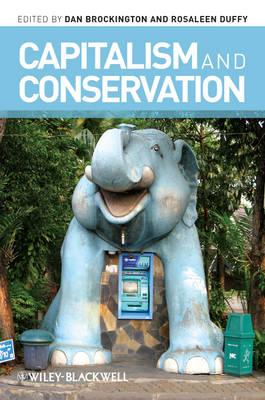
Through a series of case studies from around the world, Capitalism and Conservation presents a critique of conservation's role as a central driver of global capitalism. Features innovative new research on case studies on the connections between capitalism and conservation drawn from all over the world Examines some of our most popular leisure pursuits and consumption habits to uncover the ways they drive and deepen global capitalism Reveals the increase in intensity and variety of forms of capitalist conservation throughout the world
Full Product Details
Author: Dan Brockington (University of Manchester, UK) ,
Rosaleen Duffy (University of Manchester, UK)
Publisher: John Wiley and Sons Ltd
Imprint: Wiley-Blackwell
Dimensions:
Width: 15.50cm
, Height: 2.00cm
, Length: 23.10cm
Weight: 0.504kg
ISBN: 9781444338348
ISBN 10: 144433834
Pages: 344
Publication Date: 26 August 2011
Audience:
Professional and scholarly
,
Professional & Vocational
Format: Paperback
Publisher's Status: Active
Availability: Out of stock

The supplier is temporarily out of stock of this item. It will be ordered for you on backorder and shipped when it becomes available.
Reviews
This book is suitable for a range of audiences seeking a more in depth understanding of the pervasion of neoliberalism in conservation and the peripheral role of conservation to neoliberalism. It would be useful for politics, geography and tourism researchers while also being a potential pertinent resource for practitioners pursuing greater understanding of the processes. It is good value for money for these individuals. (Economic Geography Research Group, 2012)
?This book is suitable for a range of audiences seeking a more in depth understanding of the pervasion of neoliberalism in conservation and the peripheral role of conservation to neoliberalism. It would be useful for politics, geography and tourism researchers while also being a potential pertinent resource for practitioners pursuing greater understanding of the processes. It is good value for money for these individuals.? (Economic Geography Research Group, 2012)
<p> This book is suitable for a range of audiences seeking amore in depth understanding of the pervasion of neoliberalism inconservation and the peripheral role of conservation toneoliberalism. It would be useful for politics, geography andtourism researchers while also being a potential pertinent resourcefor practitioners pursuing greater understanding of the processes.It is good value for money for these individuals. (Economic Geography Research Group, 2012) <p>
This book is suitable for a range of audiences seeking amore in depth understanding of the pervasion of neoliberalism inconservation and the peripheral role of conservation toneoliberalism. It would be useful for politics, geography andtourism researchers while also being a potential pertinent resourcefor practitioners pursuing greater understanding of the processes.It is good value for money for these individuals. (Economic Geography Research Group, 2012)
This book is suitable for a range of audiences seeking a more in depth understanding of the pervasion of neoliberalism in conservation and the peripheral role of conservation to neoliberalism. It would be useful for politics, geography and tourism researchers while also being a potential pertinent resource for practitioners pursuing greater understanding of the processes. It is good value for money for these individuals. ( Economic Geography Research Group , 2012)
“This book is suitable for a range of audiences seeking a more in depth understanding of the pervasion of neoliberalism in conservation and the peripheral role of conservation to neoliberalism. It would be useful for politics, geography and tourism researchers while also being a potential pertinent resource for practitioners pursuing greater understanding of the processes. It is good value for money for these individuals. (Economic Geography Research Group, 2012)
Author Information
Dan Brockington is a Senior Lecturer in the School of Environment and Development at the University of Manchester. He is the author of Fortress Conservation (2002), Celebrity and the Environment. Fame, Wealth and Power in Conservation (2009) and, with Rosaleen Duffy and Jim Igoe, Nature Unbound: Conservation, Capitalism and the Future of Protected Areas (2008). Rosaleen Duffy is Professor of International Politics at Manchester University. She is author or co-author of several books, including Killing for Conservation (2000), A Trip Too Far: Politics, Ecotourism and Exploitation (2002), and Nature Crime: How We’re Getting Conservation Wrong (forthcoming, 2010).