Overview
Dramatic advances in our understanding of cancer causation have come from epidemiologic and laboratory research, particularly over the past two decades. These developments have included a broadening interest in the critical events that take place during the early stages of the dynamic multistep process leading to - vasive cancer. Increasingly, cancer epidemiologists are pursuing research into the origins and natural history of premalignant lesions, including intermediate or surrogate endpoints, a trend - celerated by the development of molecular technologies that are revolutionizing our understanding of the transformation of normal to malignant cells. There seems little doubt that this emerging knowledge will provide further insights not only into carcinogenic processes, but also into more sensitive methods of early detection and more effective means of prevention. In this book, Drs. Franco and Rohan have succeeded in prep- ing a comprehensive, timely, and critical review of the substantial progress that has been made in our understanding of cancer p- cursors. They have enlisted experts in the ?eld who have c- tributed authoritative chapters on the precursors to a wide variety of cancers,with emphasis on etiology and natural history,including the role of environmental and heritable factors that provoke normal cells to undergo malignant transformation. Epidemiologic data are linked whenever possible to molecular as well as classical cellular pathology, providing a fuller understanding of the causal events and mechanisms that initiate the carcinogenic process.
Full Product Details
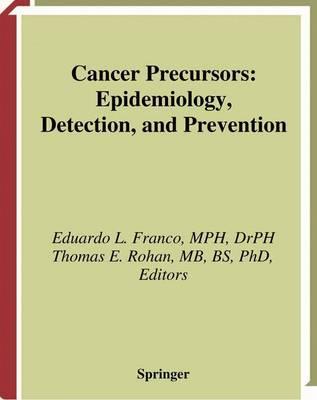
Author: Eduardo L. Franco ,
J.F. Fraumeni ,
Thomas E. Rohan
Publisher: Springer-Verlag New York Inc.
Imprint: Springer-Verlag New York Inc.
Edition: Softcover reprint of the original 1st ed. 2002
Dimensions:
Width: 17.80cm
, Height: 2.30cm
, Length: 25.40cm
Weight: 0.854kg
ISBN: 9781441929013
ISBN 10: 1441929010
Pages: 430
Publication Date: 14 December 2011
Audience:
Professional and scholarly
,
Professional and scholarly
,
Professional & Vocational
,
Postgraduate, Research & Scholarly
Format: Paperback
Publisher's Status: Active
Availability: Awaiting stock

The supplier is currently out of stock of this item. It will be ordered for you and placed on backorder. Once it does come back in stock, we will ship it out for you.
Reviews
From the reviews: Drs. Franco and Rohan bring together a timely and comprehensive set of reviews describing the biologic basis of carcinogenesis, issues related to measurement and interpretation of cancer precursors, site specific precancerous conditions, and control of cancer precursors ...The book has several important strengths, most notably the wealth of current information on cancer precursors and related topics provided by an impressive cast of cancer researchers. ... it effectively provides specific and compelling reasons for studying cancer precursors, the most up-to-date and comprehensive collection of reviews on the topic, and a realistic picture of the complexities facing research of cancer precursors. -American Journal of Epidemiology In this book, Drs. Franco and Rohan have succeeded in preparing a comprehensive, timely, and critical review of the substantial progress that has been made in our understanding of cancer precursors. They have enlisted experts in the field who have contributed authoritative chapters to a wide variety of cancers with emphasis on the etiology and natural history, including the role of environmental and heritable factor that provoke normal cells to undergo malignant transformation. Epidemiologic data are linked whenever possible to molecular as well as clasical cellular pathology, providing a fuller understanding of the casual events and mechanisms that initiate the carcinogenic process. -From the Foreward by Joseph F. Fraumeni, Jr., M.D., M.S. Director, Division of Cancer Epidemiology and Genetics National Cancer Institute National Institutes of Health Rockville, MD This first edition text presents epidemiological data on the importance of precursor lesions at all the major anatomical sites. ... The strongest and most interesting section of the book is part three, which deals with precursor lesions at each of the important anatomical sites. ... The most interesting chapters were those that sought to integrate the epidemiology, pathology and molecular biology of the disease ... . Overall, I found this book made interesting reading and certainly some chapters would serve as an excellent reference text. (R Ward, Cancer Forum, Vol. 26 (3), 2002)
From the reviews: Drs. Franco and Rohan bring together a timely and comprehensive set of reviews describing the biologic basis of carcinogenesis, issues related to measurement and interpretation of cancer precursors, site specific precancerous conditions, and control of cancer precursors !The book has several important strengths, most notably the wealth of current information on cancer precursors and related topics provided by an impressive cast of cancer researchers. ! it effectively provides specific and compelling reasons for studying cancer precursors, the most up-to-date and comprehensive collection of reviews on the topic, and a realistic picture of the complexities facing research of cancer precursors. --American Journal of Epidemiology In this book, Drs. Franco and Rohan have succeeded in preparing a comprehensive, timely, and critical review of the substantial progress that has been made in our understanding of cancer precursors. They have enlisted experts in the field who have contributed authoritative chapters to a wide variety of cancers with emphasis on the etiology and natural history, including the role of environmental and heritable factor that provoke normal cells to undergo malignant transformation. Epidemiologic data are linked whenever possible to molecular as well as clasical cellular pathology, providing a fuller understanding of the casual events and mechanisms that initiate the carcinogenic process. -From the Foreward by Joseph F. Fraumeni, Jr., M.D., M.S.Director, Division of Cancer Epidemiology and GeneticsNational Cancer InstituteNational Institutes of HealthRockville, MD This first edition text presents epidemiological data on the importance of precursor lesions at all the major anatomical sites. ! The strongest and most interesting section of the book is part three, which deals with precursor lesions at each of the important anatomical sites. ! The most interesting chapters were those that sought to integrate the epidemiology, pathology and molecular biology of the disease ! . Overall, I found this book made interesting reading and certainly some chapters would serve as an excellent reference text. (R Ward, Cancer Forum, Vol. 26 (3), 2002)
From the reviews: Drs. Franco and Rohan bring together a timely and comprehensive set of reviews describing the biologic basis of carcinogenesis, issues related to measurement and interpretation of cancer precursors, site specific precancerous conditions, and control of cancer precursors !The book has several important strengths, most notably the wealth of current information on cancer precursors and related topics provided by an impressive cast of cancer researchers. ! it effectively provides specific and compelling reasons for studying cancer precursors, the most up-to-date and comprehensive collection of reviews on the topic, and a realistic picture of the complexities facing research of cancer precursors. --American Journal of Epidemiology In this book, Drs. Franco and Rohan have succeeded in preparing a comprehensive, timely, and critical review of the substantial progress that has been made in our understanding of cancer precursors. They have enlisted experts in the field who have contributed authoritative chapters to a wide variety of cancers with emphasis on the etiology and natural history, including the role of environmental and heritable factor that provoke normal cells to undergo malignant transformation. Epidemiologic data are linked whenever possible to molecular as well as clasical cellular pathology, providing a fuller understanding of the casual events and mechanisms that initiate the carcinogenic process. -From the Foreward by Joseph F. Fraumeni, Jr., M.D., M.S. Director, Division of Cancer Epidemiology and Genetics National Cancer Institute National Institutes of Health Rockville, MD This first edition text presents epidemiological data on the importance of precursor lesions at all the major anatomical sites. ! The strongest and most interesting section of the book is part three, which deals with precursor lesions at each of the important anatomical sites. ! The most interesting chapters were those that sought to integrate the epidemiology, pathology and molecular biology of the disease ! . Overall, I found this book made interesting reading and certainly some chapters would serve as an excellent reference text. (R Ward, Cancer Forum, Vol. 26 (3), 2002)
From the reviews: Drs. Franco and Rohan bring together a timely and comprehensive set of reviews describing the biologic basis of carcinogenesis, issues related to measurement and interpretation of cancer precursors, site specific precancerous conditions, and control of cancer precursors !The book has several important strengths, most notably the wealth of current information on cancer precursors and related topics provided by an impressive cast of cancer researchers. ! it effectively provides specific and compelling reasons for studying cancer precursors, the most up-to-date and comprehensive collection of reviews on the topic, and a realistic picture of the complexities facing research of cancer precursors. --American Journal of Epidemiology In this book, Drs. Franco and Rohan have succeeded in preparing a comprehensive, timely, and critical review of the substantial progress that has been made in our understanding of cancer precursors. They have enlisted experts in the field who have contributed authoritative chapters to a wide variety of cancers with emphasis on the etiology and natural history, including the role of environmental and heritable factor that provoke normal cells to undergo malignant transformation. Epidemiologic data are linked whenever possible to molecular as well as clasical cellular pathology, providing a fuller understanding of the casual events and mechanisms that initiate the carcinogenic process. -From the Foreward by Joseph F. Fraumeni, Jr., M.D., M.S. Director, Division of Cancer Epidemiology and Genetics National Cancer Institute National Institutes of Health Rockville, MD This first edition text presents epidemiological data on the importance of precursor lesions at all the major anatomical sites. ! The strongest and most interesting section of the book is part three, which deals with precursor lesions at each of the important anatomical sites. ! The most interesting chapters were those that sought to integrate the epidemiology, pathology and molecular biology of the disease ! . Overall, I found this book made interesting reading and certainly some chapters would serve as an excellent reference text. (R Ward, Cancer Forum, Vol. 26 (3), 2002)