Overview
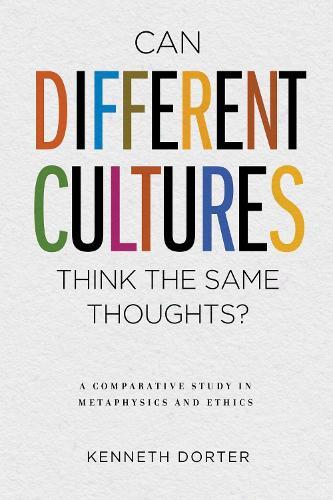
Kenneth Dorter's Can Different Cultures Think the Same Thoughts? is a study of fundamental issues in metaphysics and ethics across major philosophical traditions of the world, including the way in which metaphysics can be a foundation for ethics, as well as the importance of metaphysics on its own terms. Dorter examines such questions through a detailed comparison of selected major thinkers and classic works in three global philosophical traditions, those of India, China, and the West. In each chapter Dorter juxtaposes and compares two or more philosophers or classic works from different traditions, from Spinoza and Shankara, to Confucius and Plato, to Marcus Aurelius and the Bhagavad Gita. In doing so he explores different perspectives and reveals limitations and assumptions that might otherwise be obscure. The goal of Dorter's cross-cultural approach is to consider how far works from different cultures can be understood as holding comparable philosophical views. Although Dorter reveals commonalities across the different traditions, he makes no claim that there is such a thing as a universal philosophy. Clearly there are fundamental disagreements among the philosophers and works studied. Yet in each of the case studies of a particular chapter, we can discover a shared, or at least analogous, way of looking at issues across different cultures. All those interested in metaphysics, ethics, Indian philosophy, Chinese philosophy, and comparative philosophy will find much of interest in this book.
Full Product Details
Author: Kenneth Dorter
Publisher: University of Notre Dame Press
Imprint: University of Notre Dame Press
Dimensions:
Width: 15.20cm
, Height: 1.80cm
, Length: 22.90cm
Weight: 0.558kg
ISBN: 9780268103538
ISBN 10: 0268103534
Pages: 286
Publication Date: 30 April 2018
Audience:
Professional and scholarly
,
Professional & Vocational
Format: Hardback
Publisher's Status: Active
Availability: To order

Stock availability from the supplier is unknown. We will order it for you and ship this item to you once it is received by us.
Reviews
The analyses of this book are lucid and profound, attending to the roles of individual experience and cultural influence in the formation of philosophical doctrines. Throughout the chapters the author has presented nuanced discussions with regard to both similarities and differences of philosophers from a variety of cultures. Written in a clear language, this book is accessible to scholars from various fields and to non-academic readers as well. --Lin Ma and Jaap van Brakel, authors of Fundamentals of Comparative and Intercultural Philosophy Kenneth Dorter's Can Different Cultures Think the Same Thoughts? is a welcome contribution to the burgeoning multicultural revolution in philosophy. Dorter demonstrates that when we compare cultures there is a middle ground between abstract universalism and radical incommensurability. Dorter leads the reader through elegant comparisons among a range of thinkers and texts in the European, Indian, and Chinese traditions, including Parmenides, Shankara, Confucius, Plato, the Bhagavad Gita, and Laozi. Through these comparisons, Dorter persuasively shows that ethics cannot be innocent of metaphysics. This book is sure to engage readers from a variety of fields, including philosophy, religious studies, intellectual history, and comparative literature. --Bryan W. Van Norden, author of Taking Back Philosophy: A Multicultural Manifesto
Dorter makes a persuasive case for the proposition that, despite great differences in cultural formation, philosophers from disparate cultures can entertain the same metaphysical and moral conceptions. . . . The presentation is well researched, subtle, and historically grounded. --Choice Kenneth Dorter's Can Different Cultures Think the Same Thoughts? is a welcome contribution to the burgeoning multicultural revolution in philosophy. Dorter demonstrates that when we compare cultures there is a middle ground between abstract universalism and radical incommensurability. Dorter leads the reader through elegant comparisons among a range of thinkers and texts in the European, Indian, and Chinese traditions, including Parmenides, Shankara, Confucius, Plato, the Bhagavad Gita, and Laozi. Through these comparisons, Dorter persuasively shows that ethics cannot be innocent of metaphysics. This book is sure to engage readers from a variety of fields, including philosophy, religious studies, intellectual history, and comparative literature. --Bryan W. Van Norden, author of Taking Back Philosophy: A Multicultural Manifesto The analyses of this book are lucid and profound, attending to the roles of individual experience and cultural influence in the formation of philosophical doctrines. Throughout the chapters the author has presented nuanced discussions with regard to both similarities and differences of philosophers from a variety of cultures. Written in a clear language, this book is accessible to scholars from various fields and to non-academic readers as well. --Lin Ma and Jaap van Brakel, authors of Fundamentals of Comparative and Intercultural Philosophy
Author Information
Kenneth Dorter is a professor of philosophy at the University of Guelph. He has published three books on Plato and has written on various areas of philosophy.