Overview
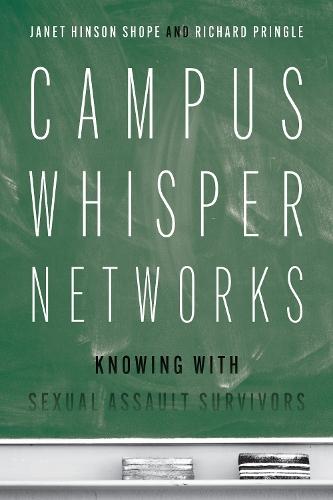
Campus Whisper Networks examines how personal knowledge about student sexual assault circulates within college campus communities. Based upon both qualitative and quantitative survey data, Janet Shope and Richard Pringle's research demonstrates that students who have been sexually assaulted tell someone -almost always a friend. Most college students know someone who has been assaulted. Simply knowing, by means of relationships, that one or more peers have been assaulted affects the knowers, and the effects reverberate unevenly across campuses. Shope and Pringle highlight the structural properties that prohibit relational knowledge from becoming official institutional knowledge, confining it to whispers and secrecy within informal spheres of knowledge. The rules governing the circulation of such knowledge create an uneven epistemic field of sexual assault. This uneven field is consequential for the communities, affecting survivors and their confidants and shaping student views of the college community. Campus Whisper Networks demonstrates how personal and institutional avoidance, both the “need to not know” and “no need to know,” create knowledge gaps that hide the community’s wounds and prevent personal knowledge from becoming social knowledge.
Full Product Details
Author: Janet Hinson Shope ,
Richard Pringle
Publisher: Rutgers University Press
Imprint: Rutgers University Press
Dimensions:
Width: 15.20cm
, Height: 1.30cm
, Length: 22.90cm
Weight: 0.286kg
ISBN: 9781978845022
ISBN 10: 1978845022
Pages: 166
Publication Date: 13 February 2026
Audience:
Professional and scholarly
,
College/higher education
,
General/trade
,
Professional & Vocational
,
Postgraduate, Research & Scholarly
Format: Paperback
Publisher's Status: Active
Availability: In Print

This item will be ordered in for you from one of our suppliers. Upon receipt, we will promptly dispatch it out to you. For in store availability, please contact us.
Reviews
""Campus Whisper Networks differs from other books on the market in its emphasis on the roles of peers and community as sites for disclosures and action. Rather than focusing on the survivors themselves or calling for action from a largely faceless university 'administration,' this book uses multiple methods to establish different ways of knowing on campus. The content is challenging and charged emotionally, but the authors' language is precise and empathetic."" - Lauren J. Germain, author of Campus Sexual Assault: College Women Respond ""The focus of Campus Whisper Networks on relational knowledge offers a distinct and important new perspective. The authors challenge notions of survivor silence in response to violence by showing how and why such silence is not pervasive. Effectively organized, well-written, and highly readable, Campus Whisper Networks treats a critically important subject in higher education with important policy and political implications."" - Debra L. DeLaet, author of The Global Struggle for Human Rights: Universal Principles in World Politics
""Campus Whisper Networks differs from other books on the market in its emphasis on the roles of peers and community as sites for disclosures and action. Rather than focusing on the survivors themselves or calling for action from a largely faceless university 'administration, ' this book uses multiple methods to establish different ways of knowing on campus. The content is challenging and charged emotionally, but the authors' language is precise and empathetic."" --Lauren J. Germain ""author of Campus Sexual Assault: College Women Respond"" ""The focus of Campus Whisper Networks on relational knowledge offers a distinct and important new perspective. The authors challenge notions of survivor silence in response to violence by showing how and why such silence is not pervasive. Effectively organized, well-written, and highly readable, Campus Whisper Networks treats a critically important subject in higher education with important policy and political implications."" --Debra L. DeLaet ""author of The Global Struggle for Human Rights: Universal Principles in World Politics""
Author Information
Janet Hinson Shope is a professor of sociology at Goucher College in Baltimore, MD. She is a coauthor of Paid to Party: Working Time and Emotion in Direct Home Sales (Rutgers University Press). Richard Pringle is an emeritus professor of psychology at Goucher College in Baltimore, MD.