Overview
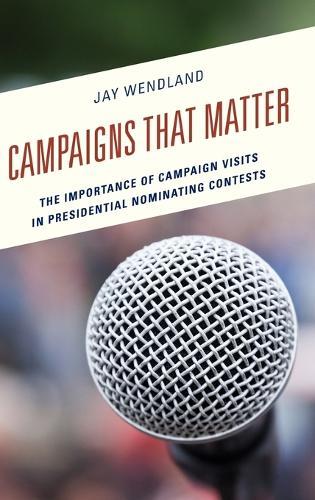
Every four years Americans are inundated with campaign activities from candidates attempting to become the next president of the United States. An under-researched area of these campaign activities are campaign visits—rallies, town hall meetings, and candidate meet-and-greets for example. Almost all candidates conduct visits, yet we do not have a good understanding of how they affect voters. Wendland tackles four big questions throughout Campaigns That Matter: 1) Do campaigns matter? 2) Are campaign visits strategic? 3) Do visits help mobilize voters? 4) Do visits impact candidate preference? Using a unique set of data that includes all visits conducted throughout the 2008, 2012, and 2016 presidential nominating contests, Wendland explores how these visits affected voters compared to traditional measures of advertisements, campaign spending, and momentum. In doing so, Wendland has provided us with a more comprehensive picture of how voters make decisions in the voting booth.
Full Product Details
Author: Jay Wendland
Publisher: Bloomsbury Publishing Plc
Imprint: Lexington Books
Dimensions:
Width: 15.90cm
, Height: 2.10cm
, Length: 23.70cm
Weight: 0.472kg
ISBN: 9781498532099
ISBN 10: 1498532098
Pages: 194
Publication Date: 30 June 2017
Audience:
Professional and scholarly
,
Professional & Vocational
Format: Hardback
Publisher's Status: Active
Availability: In Print

This item will be ordered in for you from one of our suppliers. Upon receipt, we will promptly dispatch it out to you. For in store availability, please contact us.
Reviews
In 1964, Nelson Rockefeller won the Oregon Republican Presidential Primary after advertising '(h)e Cared Enough to Come to Corvallis.' For the next half-century though, most political scientists questioned whether candidate visits actually translated into votes. Jay Wendland's new book finally settles this question through a thorough analysis of the 2008, 2012, and 2016 presidential primaries. This work is a must-read for all scholars and journalists who are interested in how and why presidential campaign events matter. -- Andrew Dowdle, University of Arkansas In the early days of the United States candidates for public office climbed on the stump in the local town square and spoke to their fellow citizens, but not presidential candidates. That was considered to be beneath the dignity of the office. Then, in 1896 William Jennings Bryan traveled thousands of miles to more than 25 states to give more than 600 speeches, and presidential campaigns have never been the same. Wendland explores the impact of the campaign visit in terms of recent presidential nomination contests on voter mobilization and candidate preference, and finds they make a meaningful difference in presidential campaigns. -- Randall E. Adkins, University of Nebraska at Omaha
In 1964, Nelson Rockefeller won the Oregon Republican Presidential Primary after advertising ‘(h)e Cared Enough to Come to Corvallis.’ For the next half-century though, most political scientists questioned whether candidate visits actually translated into votes. Jay Wendland’s new book finally settles this question through a thorough analysis of the 2008, 2012, and 2016 presidential primaries. This work is a must-read for all scholars and journalists who are interested in how and why presidential campaign events matter. -- Andrew Dowdle, University of Arkansas In the early days of the United States candidates for public office climbed on the stump in the local town square and spoke to their fellow citizens, but not presidential candidates. That was considered to be beneath the dignity of the office. Then, in 1896 William Jennings Bryan traveled thousands of miles to more than 25 states to give more than 600 speeches, and presidential campaigns have never been the same. Wendland explores the impact of the campaign visit in terms of recent presidential nomination contests on voter mobilization and candidate preference, and finds they make a meaningful difference in presidential campaigns. -- Randall E. Adkins, University of Nebraska at Omaha
Author Information
Jay Wendland is assistant professor of history and political science at Daemen College.