|
|
|||
|
||||
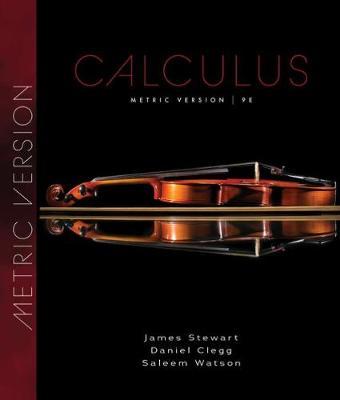
OverviewFull Product DetailsAuthor: James Stewart (McMaster University) , Daniel K. Clegg (Palomar College) , Saleem Watson (California State University, Long Beach)Publisher: Cengage Learning, Inc Imprint: Brooks/Cole Edition: 9th edition Dimensions: Width: 22.80cm , Height: 25.60cm , Length: 5.00cm Weight: 3.084kg ISBN: 9780357113462ISBN 10: 0357113462 Pages: 1392 Publication Date: 02 June 2020 Audience: College/higher education , Tertiary & Higher Education Format: Hardback Publisher's Status: Active Availability: In Print This item will be ordered in for you from one of our suppliers. Upon receipt, we will promptly dispatch it out to you. For in store availability, please contact us. Table of ContentsPreface. To the Student. Diagnostic Tests. A Preview of Calculus. 1. FUNCTIONS AND LIMITS. Four Ways to Represent a Function. Mathematical Models: A Catalog of Essential Functions. New Functions from Old Functions. The Tangent and Velocity Problems. The Limit of a Function. Calculating Limits Using the Limit Laws. The Precise Definition of a Limit. Continuity. Review. Principles of Problem Solving. 2. DERIVATIVES. Derivatives and Rates of Change. Writing Project: Early Methods for Finding Tangents. The Derivative as a Function. Differentiation Formulas. Applied Project: Building a Better Roller Coaster. Derivatives of Trigonometric Functions. The Chain Rule. Applied Project: Where Should a Pilot Start Descent? Implicit Differentiation. Discovery Project: Families of Implicit Curves. Rates of Change in the Natural and Social Sciences. Related Rates. Linear Approximations and Differentials. Discovery Project: Polynomial Approximations. Review. Problems Plus. 3. APPLICATIONS OF DIFFERENTIATION. Maximum and Minimum Values. Applied Project: The Calculus of Rainbows. The Mean Value Theorem. What Derivatives Tell Us About the Shape of a Graph. Limits at Infinity; Horizontal Asymptotes. Summary of Curve Sketching. Graphing with Calculus and Technology. Optimization Problems. Applied Project: The Shape of a Can. Applied Project: Planes and Birds: Minimizing Energy. Newton�s Method. Antiderivatives. Review. Problems Plus. 4. INTEGRALS. The Area and Distance Problems. The Definite Integral. Discovery Project: Area Functions. The Fundamental Theorem of Calculus. Indefinite Integrals and the Net Change Theorem. Writing Project: Newton, Leibniz, and the Invention of Calculus. The Substitution Rule. Review. Problems Plus. 5. APPLICATIONS OF INTEGRATION. Areas Between Curves. Applied Project: The Gini Index. Volumes. Volumes by Cylindrical Shells. Work. Average Value of a Function. Applied Project: Calculus and Baseball. Review. Problems Plus. 6. INVERSE FUNCTIONS: EXPONENTIAL, LOGARITHMIC, AND INVERSE TRIGONOMETRIC FUNCTIONS. Inverse Functions. Instructors may cover either Sections 6.2�6.4 or Sections 6.2*�6.4*. Exponential Functions and Their Derivatives. Logarithmic Functions. Derivatives of Logarithmic Functions. The Natural Logarithmic Function. The Natural Exponential Function. General Logarithmic and Exponential Functions. Exponential Growth and Decay. Applied Project: Controlling Red Blood Cell Loss During Surgery. Inverse Trigonometric Functions. Applied Project: Where to Sit at the Movies. Hyperbolic Functions. Indeterminate Forms and l�Hospital�s Rule. Writing Project: The Origins of l�Hospital�s Rule. Review. Problems Plus. 7. TECHNIQUES OF INTEGRATION. Integration by Parts. Trigonometric Integrals. Trigonometric Substitution. Integration of Rational Functions by Partial Fractions. Strategy for Integration. Integration Using Tables and Technology. Discovery Project: Patterns in Integrals. Approximate Integration. Improper Integrals. Review. Problems Plus. 8. FURTHER APPLICATIONS OF INTEGRATION. Arc Length. Discovery Project: Arc Length Contest. Area of a Surface of Revolution. Discovery Project: Rotating on a Slant. Applications to Physics and Engineering. Discovery Project: Complementary Coffee Cups. Applications to Economics and Biology. Probability. Review. Problems Plus. 9. DIFFERENTIAL EQUATIONS. Modeling with Differential Equations. Direction Fields and Euler�s Method. Separable Equations. Applied Project: How Fast Does a Tank Drain? Models for Population Growth. Linear Equations. Applied Project: Which Is Faster, Going Up or Coming Down? Predator-Prey Systems. Review. Problems Plus. 10. PARAMETRIC EQUATIONS AND POLAR COORDINATES. Curves Defined by Parametric Equations. Discovery Project: Running Circles Around Circles. Calculus with Parametric Curves. Discovery Project: B�zier Curves. Polar Coordinates. Discovery Project: Families of Polar Curves. Calculus in Polar Coordinates. Conic Sections. Conic Sections in Polar Coordinates. Review. Problems Plus. 11. SEQUENCES, SERIES, AND POWER SERIES. Sequences. Discovery Project: Logistic Sequences. Series. The Integral Test and Estimates of Sums. The Comparison Tests. Alternating Series and Absolute Convergence. The Ratio and Root Tests. Strategy for Testing Series. Power Series. Representations of Functions as Power Series. Taylor and Maclaurin Series. Discovery Project: An Elusive Limit. Writing Project: How Newton Discovered the Binomial Series. Applications of Taylor Polynomials. Applied Project: Radiation from the Stars. Review. Problems Plus. 12. VECTORS AND THE GEOMETRY OF SPACE. Three-Dimensional Coordinate Systems. Vectors. Discovery Project: The Shape of a Hanging Chain. The Dot Product. The Cross Product. Discovery Project: The Geometry of a Tetrahedron. Equations of Lines and Planes. Discovery Project: Putting 3D in Perspective. Cylinders and Quadric Surfaces. Review. Problems Plus. 13. VECTOR FUNCTIONS. Vector Functions and Space Curves. Derivatives and Integrals of Vector Functions. Arc Length and Curvature. Motion in Space: Velocity and Acceleration. Applied Project: Kepler�s Laws. Review. Problems Plus. 14. PARTIAL DERIVATIVES. Functions of Several Variables. Limits and Continuity. Partial Derivatives. Discovery Project: Deriving the Cobb-Douglas Production Function. Tangent Planes and Linear Approximations. Applied Project: The Speedo LZR Racer. The Chain Rule. Directional Derivatives and the Gradient Vector. Maximum and Minimum Values. Discovery Project: Quadratic Approximations and Critical Points. Lagrange Multipliers. Applied Project: Rocket Science. Applied Project: Hydro-Turbine Optimization. Review. Problems Plus. 15. MULTIPLE INTEGRALS. Double Integrals over Rectangles. Double Integrals over General Regions. Double Integrals in Polar Coordinates. Applications of Double Integrals. Surface Area. Triple Integrals. Discovery Project: Volumes of Hyperspheres. Triple Integrals in Cylindrical Coordinates. Discovery Project: The Intersection of Three Cylinders. Triple Integrals in Spherical Coordinates. Applied Project: Roller Derby. Change of Variables in Multiple Integrals. Review. Problems Plus. 16. VECTOR CALCULUS. Vector Fields. Line Integrals. The Fundamental Theorem for Line Integrals. Green�s Theorem. Curl and Divergence. Parametric Surfaces and Their Areas. Surface Integrals. Stokes� Theorem. The Divergence Theorem. Summary. Review. Problems Plus. APPENDIXES. Numbers, Inequalities, and Absolute Values. Coordinate Geometry and Lines. Graphs of Second-Degree Equations. Trigonometry. Sigma Notation. Proofs of Theorems. Answers to Odd-Numbered Exercises. INDEX.ReviewsAuthor InformationJames Stewart received the M.S. degree from Stanford University and the Ph.D. from the University of Toronto. After two years as a postdoctoral fellow at the University of London, he became Professor of Mathematics at McMaster University. His research has been in harmonic analysis and functional analysis. Stewart’s books include a series of high school textbooks as well as a best-selling series of calculus textbooks published by Cengage Learning. He is also co-author, with Lothar Redlin and Saleem Watson, of a series of college algebra and precalculus textbooks. Translations of his books include those into Spanish, Portuguese, French, Italian, Korean, Chinese, Greek, Indonesian and Japanese. A talented violinist, Stewart was concertmaster of the McMaster Symphony Orchestra for many years and played professionally in the Hamilton Philharmonic Orchestra. He has given more than 20 talks worldwide on mathematics and music. Stewart was named a Fellow of the Fields Institute in 2002 and was awarded an honorary D.Sc. in 2003 by McMaster University. The library of the Fields Institute is named after him. The James Stewart Mathematics Centre was opened in October, 2003, at McMaster University. Daniel Clegg received his B.A. in Mathematics from California State University, Fullerton and his M.A. in Mathematics from UCLA. He is currently a professor of mathematics at Palomar College near San Diego, California, where he has taught for more than 20 years. Clegg co-authored BRIEF APPLIED CALCULUS with James Stewart and also assisted Stewart with various aspects of his calculus texts and ancillaries for almost 20 years. Saleem Watson received his bachelor of science degree from Andrews University in Michigan. He completed his graduate studies at Dalhousie University and McMaster University, where he received his Ph.D. Dr. Watson conducted subsequently research at the Mathematics Institute of the University of Warsaw in Poland. He taught mathematics at Pennsylvania State University before serving at California State University, Long Beach, where he is currently professor emeritus. Dr. Watson's research encompasses the field of functional analysis. Dr. Watson is an important co-author for Dr. Stewart's best-selling calculus textbook series as well as his popular precalculus, college algebra and trigonometry texts. Tab Content 6Author Website:Countries AvailableAll regions |
||||