Overview
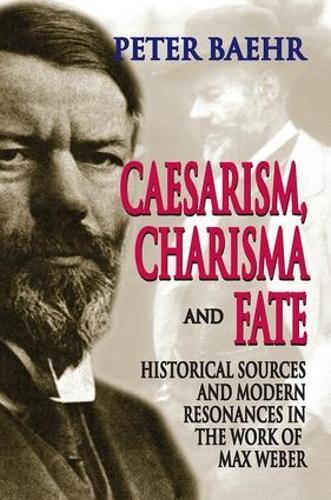
How do writers, marginalized by the authoritarian state in which they live, intervene in the political process? They cannot do so directly because they are not politicians. Other modes of engagement are possible, however. A writer may take up arms and become a revolutionary. Or, as Max Weber did, he may try to influence politics by playing the role of constitutional advisor, or by seeking to shape the dominant language in which his contemporaries think. Weber sought to reconstitute the political and social vocabulary of his day. Part I of Caesarism, Charisma and Fate examines a great writer's political passions and the linguistic creativity they generated. Specially, it is an analysis of the manner in which Weber reshaped the nineteenth century idea of ""Caesarism,"" a term traditionally associated with the authoritarian populism of Napoleon III and Bismarck, and transmuted it into a concept that was either neutral or positive. The coup de grace of this alchemy was to make Caesarism reappear as charisma. In that transformation, a highly contentious political concept, suffused with disapproval and anxiety, was naturalized into an ideal type of universal value-free sociology. Part II augments Weber's ideas for the modem age. A recurrent preoccupation of Weber's writings was human ""fate,"" a condition that evokes the pathos of choice, the political meaning of death, and the formation of national solidarity. Peter Baehr, marrying Weber and Durkheim, fashions a new concept, ""community of fate,"" for sociological theory. Communities of fate--such as the Warsaw Ghetto or Hong Kong dealing with the Severe Acute Respiratory Syndrome (SARS) crisis--are embattled social sites in which people face the prospect of collective death. They cohere because of an intense and broadly shared focus of attention on a common plight. Weber's work helps us grasp the nature of such communities, the mechanisms that produce them, and, not least, their dramatic consequences.
Full Product Details
Author: Peter Baehr
Publisher: Taylor & Francis Inc
Imprint: Routledge
Dimensions:
Width: 15.20cm
, Height: 2.30cm
, Length: 22.90cm
Weight: 0.630kg
ISBN: 9781412808132
ISBN 10: 1412808138
Pages: 256
Publication Date: 15 December 2008
Audience:
College/higher education
,
Professional and scholarly
,
Undergraduate
,
Postgraduate, Research & Scholarly
Format: Hardback
Publisher's Status: Active
Availability: In Print

This item will be ordered in for you from one of our suppliers. Upon receipt, we will promptly dispatch it out to you. For in store availability, please contact us.
Reviews
-Peter Baeher has written a thoughtful, wide-ranging and nuanced discussion of the concept of Caesarism in political thought. Probing the historical and linguistic evidence, he shows convincingly how the concept develops in classical discourse and is transposed in Max Weber's discussion of charisma. . . . Baer's study achieves distinction as an exemplary contribution to both political theory and sociological investigation.- --Lawrence A. Scaff, Wayne State University -Baehr has written an intriguing, valuable book.- --Contemporary Sociology Peter Baeher has written a thoughtful, wide-ranging and nuanced discussion of the concept of Caesarism in political thought. Probing the historical and linguistic evidence, he shows convincingly how the concept develops in classical discourse and is transposed in Max Weber's discussion of charisma. . . . Baer's study achieves distinction as an exemplary contribution to both political theory and sociological investigation. --Lawrence A. Scaff, Wayne State University Baehr has written an intriguing, valuable book. --Contemporary Sociology Peter Baeher has written a thoughtful, wide-ranging and nuanced discussion of the concept of Caesarism in political thought. Probing the historical and linguistic evidence, he shows convincingly how the concept develops in classical discourse and is transposed in Max Weber's discussion of charisma. . . . Baer's study achieves distinction as an exemplary contribution to both political theory and sociological investigation. --Lawrence A. Scaff, Wayne State University Baehr has written an intriguing, valuable book. --Contemporary Sociology
Peter Baeher has written a thoughtful, wide-ranging and nuanced discussion of the concept of Caesarism in political thought. Probing the historical and linguistic evidence, he shows convincingly how the concept develops in classical discourse and is transposed in Max Weber's discussion of charisma. . . . Baer's study achieves distinction as an exemplary contribution to both political theory and sociological investigation. --Lawrence A. Scaff, Wayne State University Baehr has written an intriguing, valuable book. --Contemporary Sociology Peter Baeher has written a thoughtful, wide-ranging and nuanced discussion of the concept of Caesarism in political thought. Probing the historical and linguistic evidence, he shows convincingly how the concept develops in classical discourse and is transposed in Max Weber's discussion of charisma. . . . Baer's study achieves distinction as an exemplary contribution to both political theory and sociological investigation. --Lawrence A. Scaff, Wayne State University Baehr has written an intriguing, valuable book. --Contemporary Sociology -Peter Baeher has written a thoughtful, wide-ranging and nuanced discussion of the concept of Caesarism in political thought. Probing the historical and linguistic evidence, he shows convincingly how the concept develops in classical discourse and is transposed in Max Weber's discussion of charisma. . . . Baer's study achieves distinction as an exemplary contribution to both political theory and sociological investigation.- --Lawrence A. Scaff, Wayne State University -Baehr has written an intriguing, valuable book.- --Contemporary Sociology
-Peter Baeher has written a thoughtful, wide-ranging and nuanced discussion of the concept of Caesarism in political thought. Probing the historical and linguistic evidence, he shows convincingly how the concept develops in classical discourse and is transposed in Max Weber's discussion of charisma. . . . Baer's study achieves distinction as an exemplary contribution to both political theory and sociological investigation.- --Lawrence A. Scaff, Wayne State University -Baehr has written an intriguing, valuable book.- --Contemporary Sociology Peter Baeher has written a thoughtful, wide-ranging and nuanced discussion of the concept of Caesarism in political thought. Probing the historical and linguistic evidence, he shows convincingly how the concept develops in classical discourse and is transposed in Max Weber's discussion of charisma. . . . Baer's study achieves distinction as an exemplary contribution to both political theory and sociological investigation. --Lawrence A. Scaff, Wayne State University Baehr has written an intriguing, valuable book. --Contemporary Sociology Peter Baeher has written a thoughtful, wide-ranging and nuanced discussion of the concept of Caesarism in political thought. Probing the historical and linguistic evidence, he shows convincingly how the concept develops in classical discourse and is transposed in Max Weber's discussion of charisma. . . . Baer's study achieves distinction as an exemplary contribution to both political theory and sociological investigation. --Lawrence A. Scaff, Wayne State University Baehr has written an intriguing, valuable book. --Contemporary Sociology
Peter Baeher has written a thoughtful, wide-ranging and nuanced discussion of the concept of Caesarism in political thought. Probing the historical and linguistic evidence, he shows convincingly how the concept develops in classical discourse and is transposed in Max Weber's discussion of charisma. . . . Baer's study achieves distinction as an exemplary contribution to both political theory and sociological investigation. --Lawrence A. Scaff, Wayne State University Baehr has written an intriguing, valuable book. --Contemporary Sociology
Peter Baeher has written a thoughtful, wide-ranging and nuanced discussion of the concept of Caesarism in political thought. Probing the historical and linguistic evidence, he shows convincingly how the concept develops in classical discourse and is transposed in Max Weber's discussion of charisma. . . . Baer's study achieves distinction as an exemplary contribution to both political theory and sociological investigation. </p> --Lawrence A. Scaff, Wayne State University</p> Baehr has written an intriguing, valuable book. </p> --<em>Contemporary Sociology</em></p>
-Peter Baeher has written a thoughtful, wide-ranging and nuanced discussion of the concept of Caesarism in political thought. Probing the historical and linguistic evidence, he shows convincingly how the concept develops in classical discourse and is transposed in Max Weber's discussion of charisma. . . . Baer's study achieves distinction as an exemplary contribution to both political theory and sociological investigation.- --Lawrence A. Scaff, Wayne State University -Baehr has written an intriguing, valuable book.- --Contemporary Sociology ""Peter Baeher has written a thoughtful, wide-ranging and nuanced discussion of the concept of Caesarism in political thought. Probing the historical and linguistic evidence, he shows convincingly how the concept develops in classical discourse and is transposed in Max Weber's discussion of charisma. . . . Baer's study achieves distinction as an exemplary contribution to both political theory and sociological investigation."" --Lawrence A. Scaff, Wayne State University ""Baehr has written an intriguing, valuable book."" --Contemporary Sociology ""Peter Baeher has written a thoughtful, wide-ranging and nuanced discussion of the concept of Caesarism in political thought. Probing the historical and linguistic evidence, he shows convincingly how the concept develops in classical discourse and is transposed in Max Weber's discussion of charisma. . . . Baer's study achieves distinction as an exemplary contribution to both political theory and sociological investigation."" --Lawrence A. Scaff, Wayne State University ""Baehr has written an intriguing, valuable book."" --Contemporary Sociology
Author Information
Peter Baehr is professor and head of the department of sociology and social policy at Lingnan University (Hong Kong) as well as a fellow of the Center for Asian Pacific Studies. His books include Hannah Arendt, Totalitarianism, and the Social Sciences: Critical Encounters; Founders, Classics, Canons: Modern Disputes on the Origins and Appraisal of Sociology's Heritage; and Caesar and the Fading of the Roman World: A Study in Republicanism and Caesarism.