Overview
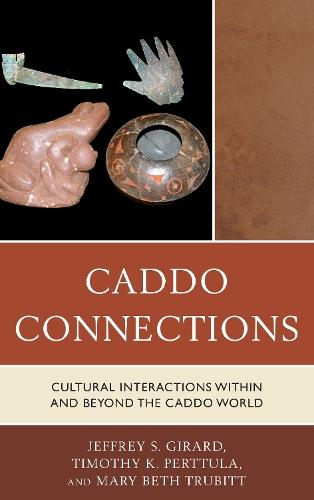
Drawing on the latest archaeological fieldwork, Caddo Connections looks at the highly dynamic cultural landscape of the Caddo Area and its complex interconnections and exchanges with surrounding regions. The authors employ a multiscalar approach to examine cultural diversity through time and across space within the Caddo Area. They explore how and why this diversity developed, consider what allowed it to stabilize during the Mississippian period, and analyze changes following contact between historic Caddo peoples and Europeans. Looking beyond individual river valleys to the broader macroregion, they also address the linkages connecting the Caddo Area with the Southeast, southern Plains, and Southwest.
Full Product Details
Author: Jeffrey S. Girard ,
Timothy K. Perttula ,
Mary Beth Trubitt
Publisher: Bloomsbury Publishing Plc
Imprint: Rowman & Littlefield
Dimensions:
Width: 15.90cm
, Height: 1.80cm
, Length: 23.70cm
Weight: 0.431kg
ISBN: 9780759122871
ISBN 10: 0759122873
Pages: 184
Publication Date: 10 April 2014
Recommended Age: From 20 to 99 years
Audience:
Professional and scholarly
,
Professional & Vocational
Format: Hardback
Publisher's Status: Active
Availability: Manufactured on demand

We will order this item for you from a manufactured on demand supplier.
Reviews
This five-chapter book is an excellent, deep summary of what scholars know about Caddo archaeology and ethnohistory. Chapter 1 notes that Caddo refers to a historical ethnic group, a geographic area, a collection of archaeological traits, and a language family. The authors examine the history of Caddo archaeology, including how it was defined as a culture area; the individuals involved in its definition, via 'Caddo conferences'; its various foci, complexes, and phases; and problems of chronology and dating. The second chapter examines the origins of Caddo remains out of Late Woodland complexes in the regions of eastern Oklahoma, western Arkansas, eastern Texas, and western Louisiana—the core of the Caddo heartland. Chapter 3 deals with cultural elaborations as expressed in various archaeological phases, focusing on ceramics, subsistence practices, settlement models, and trade among the Caddo themselves as well as with peoples of the Southeast and Southwest. Chapter 4 outlines in detail the relations between the historical Caddo peoples and the various European and, ultimately, American peoples, starting with the de Soto entrada. The final chapter is a three-page summary of the book. Summing Up: Recommended. Upper-division undergraduates and above. * Choice Reviews * Caddo Connections examines the evidence that linked the Caddo region to the Southeast ,the southern plains, and the Southwest, revealing complex cultural and trading connections with all these neighboring areas. The authors see the Caddo area not as a homogeneous ethnographic region, but rather as a multifarious one inhabited by people who shared distinctive stylistic traits, settlement configurations, developmental sequences, and mortuary customs. . . .The authors have succeeded in giving the reader the most up-to-date view of one of North America's most interesting and complicated cultural areas. It will be a major reference work on the Caddo for many years to come. * American Archaeology * This book will be an essential reference for North American archeologists for many years to come. The authors bring together old and new research from throughout the Caddo area to explore what makes this region distinct from the greater Southeast while also highlighting the history of intra-regional diversity from the 11th century appearance of the Caddo tradition to the 19th century consolidation of a scattered people into the modern Caddo Nation. Throughout, they consider the evidence for Caddo relationships with people elsewhere in North America, thereby situating Caddo studies in the mainstream of North American archeology. An extensive and up to date bibliography is a welcome bonus. -- Ann M. Early, Arkansas Archeological Survey
This book will be an essential reference for North American archeologists for many years to come. The authors bring together old and new research from throughout the Caddo area to explore what makes this region distinct from the greater Southeast while also highlighting the history of intra-regional diversity from the 11th century appearance of the Caddo tradition to the 19th century consolidation of a scattered people into the modern Caddo Nation. Throughout, they consider the evidence for Caddo relationships with people elsewhere in North America, thereby situating Caddo studies in the mainstream of North American archeology. An extensive and up to date bibliography is a welcome bonus. -- Ann M. Early, Arkansas Archeological Survey
Author Information
Jeffrey S. Girard is a regional archaeologist for the Louisiana Division of Archaeology and assistant professor at Northwestern State University of Louisiana. Timothy K. Perttula is the owner and cultural resources director of Archaeological & Environmental Consultants, LLC, a Texas-based cultural resource management firm established in 1996. Mary Beth Trubitt is an archaeologist for the Arkansas Archaeological Survey and research professor of anthropology at University of Arkansas.