Overview
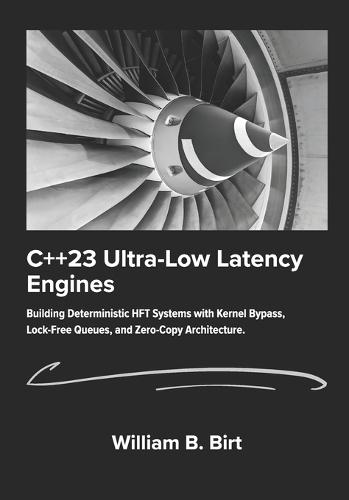
In the race to zero, the standard library is your enemy. High-Frequency Trading (HFT) is the most unforgiving environment in software engineering. In this domain, ""fast"" is not measured in milliseconds; it is measured in nanoseconds. A single cache miss, a wayward branch prediction, or a context switch caused by a clumsy system call is the difference between capturing a profitable arbitrage and being picked off by a competitor who understood the hardware better than you. C++23 Ultra-Low Latency Engines is the definitive handbook for the modern systems programmer who is ready to abandon the safety of general-purpose computing and descend into the metal. It does not teach you how to write C++; it teaches you how to weaponize it. Written by an expert in low-latency architecture, this book dismantles the traditional trading stack, socket buffers, kernel interrupts, heap allocations, and mutexes and reconstructs it for deterministic speed. You will learn to view the CPU not as an abstract logic machine, but as a physical device with thermal limits, pipeline constraints, and memory hierarchies that must be respected. Inside, you will master the art of: The Kernel Bypass: Stop asking the Linux kernel for permission to send a packet. Master user-space networking with DPDK and Solarflare EF_VI to write directly to the NIC ring buffer, cutting network latency from microseconds to nanoseconds. Zero-Copy Architecture: Architect data pipelines that never move memory. Implement Ring Buffers and Arena Allocators that keep your order books hot in the L1 cache, eliminating the jitter of malloc, free, and the OS page fault handler. Lock-Free Concurrency: Abandon the std:: mutex. Build SPSC (Single Producer, Single Consumer) queues and utilize C++23 atomic memory orderings to create a ""Single Writer"" thread model that processes millions of events per second without a single context switch. Deterministic Simulation: Construct a ""Time Machine"" simulator that abstracts rdtsc and std:: chrono, allowing you to replay historical market data with bit-perfect accuracy to reproduce bugs that only exist on the wire. Modern C++23 for Speed: Leverage consteval for compile-time lookup tables, Concepts for interface safety without vtables, and [[likely]] attributes to guide the CPU's branch predictor down the happy path. Forensic Optimization: Go beyond -O3. Learn to read assembly outputs, use perf to track cache coherence traffic, and implement bit-hacks that replace expensive division and branching with single-cycle ALU operations. This book is not for the faint of heart. It is for the engineer who looks at a 500-nanosecond round-trip time and asks, ""Where did the other 200 nanoseconds go?"" Stop optimizing code. Start engineering latency.
Full Product Details
Author: William B Birt
Publisher: Independently Published
Imprint: Independently Published
Dimensions:
Width: 17.00cm
, Height: 1.30cm
, Length: 24.40cm
Weight: 0.408kg
ISBN: 9798242614086
Pages: 252
Publication Date: 04 January 2026
Audience:
General/trade
,
General
Format: Paperback
Publisher's Status: Active
Availability: Available To Order

We have confirmation that this item is in stock with the supplier. It will be ordered in for you and dispatched immediately.