Overview
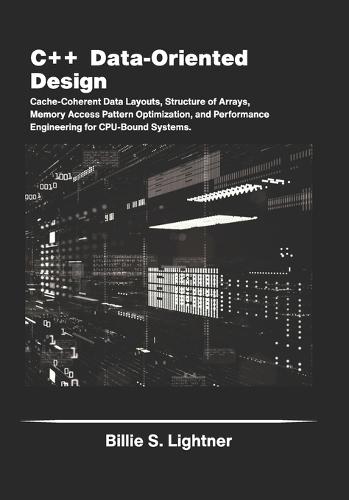
Stop Fighting the CPU. Ditch Object-Oriented Bottlenecks and Architect for Pure Hardware Throughput. Modern CPUs are insanely fast, but memory is slow. If you are writing traditional Object-Oriented C++ relying on arrays of pointers, virtual dispatch, and deeply nested objects, you are starving the processor. A single L3 cache miss costs hundreds of clock cycles. C++ Data-Oriented Design is the definitive engineering manual for breaking the OOP habit and structuring your data to perfectly align with the physical realities of the silicon. Whether you are building a custom game engine, a high-frequency trading order book, or a massive particle simulation, this book teaches you how to transform pathological memory access patterns into cache-coherent, vectorized data pipelines. You will learn to measure the true cost of a cache miss using perf and Intel VTune, and then completely re-architect your data layouts for maximum throughput. Inside, you will discover: The Hardware Reality: Understand cache line mechanics, TLB pressure, and why OOP memory layouts betray the CPU's prefetcher. Layout Fundamentals: Master structure packing, hot/cold data separation, and alignment to maximize useful bytes per cache fetch. Structure of Arrays (SoA) vs. Array of Structures (AoS): Learn exactly when to transition your data models to SoA to unlock massive SIMD throughput and AVX-512 auto-vectorization. Entity Component Systems (ECS): Build a production-grade ECS from scratch, comparing Archetypal storage versus Sparse Sets for data-driven architectures. Pointer Elimination: Eradicate pointer-based trees and linked lists. Implement Flat Arrays, Slot Maps, and Generational Indices for O(1) lookups without heap fragmentation. Concurrent DOD: Defeat false sharing at the cache-line level and design lock-free, per-thread data partitions that scale linearly across 64+ cores. Real-World Application: Step-by-step refactoring guides for transforming Game Engine Scene Graphs and HFT Order Books to data-oriented layouts. THE PERFORMANCE VAULT (Appendix) Built for the systems architect who needs immediate answers, the Appendix provides drop-in reference material: The Cache Line Size Reference: Architecture comparison table for x86-64, ARM, RISC-V, and Embedded targets. The AoS vs. SoA Decision Matrix: Instantly determine the optimal layout for your specific workload characteristics. The Data Layout Audit Checklist: 12 mandatory questions to evaluate the cache efficiency of any production data structure before it ships. Don't let memory latency throttle your application. Align your data with the hardware, master Data-Oriented Design, and squeeze every drop of performance from the silicon.
Full Product Details
Author: Billie S Lightner
Publisher: Independently Published
Imprint: Independently Published
Dimensions:
Width: 17.00cm
, Height: 1.40cm
, Length: 24.40cm
Weight: 0.422kg
ISBN: 9798195672515
Pages: 262
Publication Date: 05 May 2026
Audience:
General/trade
,
General
Format: Paperback
Publisher's Status: Active
Availability: Available To Order

We have confirmation that this item is in stock with the supplier. It will be ordered in for you and dispatched immediately.