Overview
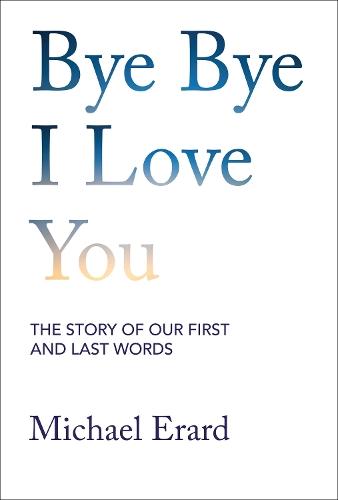
A beautiful and intimate exploration of first and last words-and the many facets of how language begins and ends-from a pioneering language writer. A beautiful and intimate exploration of first and last words-and the many facets of how language begins and ends-from a pioneering language writer. With our earliest utterances, we announce ourselves-and are recognized-as persons ready for social life. With our final ones, we mark where others must release us to death's embrace. In Bye Bye I Love You, linguist and author Michael Erard explores these phenomena, commonly called ""first words"" and ""last words,"" uncovering their cultural, historical, and biological entanglements and honoring their deep private significance. Erard draws from personal, historical, and anthropological sources to provide a sense of the breadth of beliefs and practices about these phenomena across eras, religions, and cultures around the world. What do babies' first words have in common? How do people really communicate at the end of life? In the first half of the book, Erard tells the story of first words in human development and evolution, and how the attention to children's early language-a modern phenomenon-arose. In the second half, he provides a groundbreaking overview of language at the end of life and the cultural conventions that surround it. Throughout he reveals the many parallels and asymmetries between first and last words and asks whether we might be able to use a linguistic understanding of end of life to discover what we truly want.
Full Product Details
Author: Michael Erard
Publisher: MIT Press Ltd
Imprint: MIT Press
Weight: 0.567kg
ISBN: 9780262049429
ISBN 10: 0262049422
Pages: 336
Publication Date: 11 February 2025
Audience:
General/trade
,
General
Format: Hardback
Publisher's Status: Active
Availability: To order

Stock availability from the supplier is unknown. We will order it for you and ship this item to you once it is received by us.
Reviews
“Care for the dying resembles nothing so much as care for the newly born. This deep, immeasurable connection is precisely what Michael Erard, a linguist and historian, most wants to explore. 'With our earliest utterances,' he writes, 'we announce ourselves' and are recognized 'as persons ready to participate in social life.' With our last sounds, we carve out a space for leaving it. Bye Bye I Love You follows both of these journeys, searching for what these words—and our desperate need to hear them—reveal about their meaning, our mortality and the ephemerality of being human.” —The Wall Street Journal “A book ending with so much death may sound like a hard read. Instead, it is a beautiful and even strangely comforting one, with Mr Erard as a pensive, patient guide. The end must come; unrealistic expectations about final messages need not.” —The Economist “Erard’s most essential point is that the recently born and the about-to-die share a state of signifying that is just beyond words” —4columns
“Care for the dying resembles nothing so much as care for the newly born. This deep, immeasurable connection is precisely what Michael Erard, a linguist and historian, most wants to explore. 'With our earliest utterances,' he writes, 'we announce ourselves' and are recognized 'as persons ready to participate in social life.' With our last sounds, we carve out a space for leaving it. Bye Bye I Love You follows both of these journeys, searching for what these words—and our desperate need to hear them—reveal about their meaning, our mortality and the ephemerality of being human.” —The Wall Street Journal “A book ending with so much death may sound like a hard read. Instead, it is a beautiful and even strangely comforting one, with Mr Erard as a pensive, patient guide. The end must come; unrealistic expectations about final messages need not.” —The Economist “Erard’s most essential point is that the recently born and the about-to-die share a state of signifying that is just beyond words” —4columns “As fascinating as it is original…it’s beautifully written, it’s wide-ranging, it’s deeply personal too, and moving, and chock-full of information about language…Erard is a fantastic linguist and a great writer…this book is packed with all kinds of interesting ideas that will be new to lots of people.” —A Way with Words ""In the end, what emerges is a book that is less concerned with words than with how language fails the human experience....Among Bye Bye I Love You’s strengths is its empathy....[Erard's] book...is a creative and resolutely interdisciplinary endeavor that raises questions about death, delirium, and language. No answers are on offer."" — Los Angeles Review of Books “Bye Bye I Love You is erudite, sensitive, and groundbreaking, and will leave readers pondering whether first and last words are ritualized events or idiosyncratic expressions of agency… Essential. All readers.” - Choice
“Care for the dying resembles nothing so much as care for the newly born. This deep, immeasurable connection is precisely what Michael Erard, a linguist and historian, most wants to explore. 'With our earliest utterances,' he writes, 'we announce ourselves' and are recognized 'as persons ready to participate in social life.' With our last sounds, we carve out a space for leaving it. Bye Bye I Love You follows both of these journeys, searching for what these words—and our desperate need to hear them—reveal about their meaning, our mortality and the ephemerality of being human.” —The Wall Street Journal “A book ending with so much death may sound like a hard read. Instead, it is a beautiful and even strangely comforting one, with Mr Erard as a pensive, patient guide. The end must come; unrealistic expectations about final messages need not.” —The Economist “Erard’s most essential point is that the recently born and the about-to-die share a state of signifying that is just beyond words” —4columns “As fascinating as it is original…it’s beautifully written, it’s wide-ranging, it’s deeply personal too, and moving, and chock-full of information about language…Erard is a fantastic linguist and a great writer…this book is packed with all kinds of interesting ideas that will be new to lots of people.” —A Way with Words ""In the end, what emerges is a book that is less concerned with words than with how language fails the human experience....Among Bye Bye I Love You’s strengths is its empathy....[Erard's] book...is a creative and resolutely interdisciplinary endeavor that raises questions about death, delirium, and language."" — Los Angeles Review of Books “Bye Bye I Love You is erudite, sensitive, and groundbreaking, and will leave readers pondering whether first and last words are ritualized events or idiosyncratic expressions of agency… Essential. All readers.” — Choice ""[A] unique cultural history, erudite and wide ranging, spanning cultures and disciplines....The audience for Bye Bye I Love You will be quite diverse. Linguistics, sociologists, psychologists, doctors, nurses, and end-of-life doulas will all find value in Erard’s sensitive history and first and last words."" — Journal of the Medical Library Association
Author Information
Trained as a linguist and historian, Michael Erard has spent more than two decades sharing compelling stories about language, languages, and the people who use and study them. He is the author of two previous books, Um . . . Slips, Stumbles, and Verbal Blunders, and What They Mean and Babel No More- The Search for the World's Most Extraordinary Language Learners, which has been translated into eight languages. He is a researcher at the Centre for Language Studies at Radboud University in Nijmegen, the Netherlands, and is training to become an end-of-life doula. Find out more at www.michaelerard.com.