Awards
- Winner of Columbia University Press Distinguished Book Award 2025
- Winner of Columbia University Press Distinguished Book Award 2025 (United States)
Overview
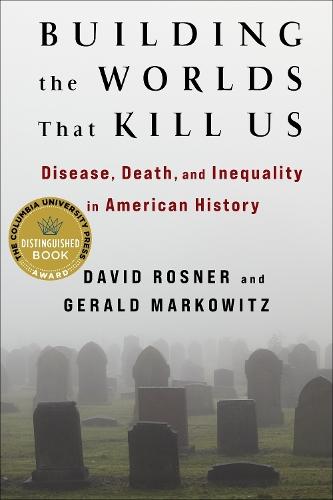
Across American history, the question of whose lives are long and healthy and whose lives are short and sick has always been shaped by the social and economic order. From the dispossession of Indigenous people and the horrors of slavery to infectious diseases spreading in overcrowded tenements and the vast environmental contamination caused by industrialization, and through climate change and pandemics in the twenty-first century, those in power have left others behind. Through the lens of death and disease, Building the Worlds That Kill Us provides a new way of understanding the history of the United States from the colonial era to the present. David Rosner and Gerald Markowitz demonstrate that the changing rates and kinds of illnesses reflect social, political, and economic structures and inequalities of race, class, and gender. These deep inequities determine the disparate health experiences of rich and poor, Black and white, men and women, immigrant and native-born, boss and worker, Indigenous and settler. This book underscores that powerful people and institutions have always seen some lives as more valuable than others, and it emphasizes how those who have been most affected by the disparities in rates of disease and death have challenged and changed these systems. Ultimately, this history shows that unequal outcomes are a choice-and we can instead collectively make decisions that foster life and health.
Full Product Details
Author: David Rosner ,
Gerald Markowitz
Publisher: Columbia University Press
Imprint: Columbia University Press
ISBN: 9780231200844
ISBN 10: 0231200846
Pages: 408
Publication Date: 05 November 2024
Audience:
Professional and scholarly
,
Professional & Vocational
Format: Hardback
Publisher's Status: Active
Availability: Manufactured on demand

We will order this item for you from a manufactured on demand supplier.
Reviews
The discussion of health disparities has needed an overview book for a long time that links the social and institutional reasons for ill health. This book will be critical to anyone in public health or the health professions as well as to a general audience. I wish I had it when I was teaching. -- Susan M. Reverby, author of <i>Examining Tuskegee: The Infamous Syphilis Study and Its Legacy</i>
The discussion of health disparities has needed an overview book for a long time that links the social and institutional reasons for ill health. This book will be critical to anyone in public health or the health professions as well as to a general audience. Historians of American health care will welcome it into their syllabi. I wish I had it when I was teaching. -- Susan M. Reverby, author of <i>Examining Tuskegee: The Infamous Syphilis Study and Its Legacy</i> In this remarkable book, David Rosner and Gerald Markowitz examine the entire course of American history to demonstrate the inequalities that have always been built into Americans' experience of health and disease, death and dying. With economic inequality at record levels today, Building the Worlds that Kill Us explains why the health experiences of different groups of Americans differ so widely and what this tells us about our society and its history. -- Eric Foner, author of <i>The Second Founding: How the Civil War and Reconstruction Remade the Constitution</i> Rosner and Markowitz have gifted us with an industrial and literary history which focuses on the poisons we eat, the pollutants we inhale, the economic systems which render them possible, the political movements which challenge their dominance. Profoundly researched and vividly written, this brilliant reconception of humanity 's journey facing chemicals and infectious disease to occupational health and clean water is filled with stunning amazements. Everyone is connected to and will benefit from reading this dazzling, most significant book. -- Blanche Wiesen Cook, City University of New York After collaborating for more than fifty years, Rosner and Markowitz have written a sweeping book that traces devastating patterns in American public health history. Again and again, they show that economic and social forces determine the distribution of disease and suffering. Even as the particular health threats change over time—from smallpox, tuberculosis, cholera, and typhoid through lead, tobacco, PCBs, endocrine-disrupting chemicals, and even climate change—they take their toll on the poorest and most vulnerable. The esteemed elders of public health history leave little question that sickness and death often result from the decisions we make as a society. It’s a dark truth, though one they leaven with the reminder that we always have the power to make better choices -- Sharon Lerner, reporter at ProPublica This book shows why public health needs to learn history. Beginning with the European settlement of what became the United States, it addresses the seizure of indigenous lands, the adoption of a labor system that relied on enslaved workers and continues through nineteenth century industrialization up to the present day. The authors ask the larger question of what accounts for exploitative working conditions and environmental degradation. The answer lies in how the particularly predatory form of capitalism in the United States can win out over healthful lives. History also offers hope. The call to protect health can be unifying, and social arrangements can be changed. -- Mary Travis Bassett, Harvard University To understand a society deeply, to reveal who has powers to shape how people work and live, look to its societal patterns of disease and health inequities—and who fights for health justice. Rosner and Markowitz’s rich history of the United States offers solidaristic hope in a time of deep peril. -- Nancy Krieger, author of <i>Epidemiology and the People’s Health: Theory and Context</i>
The discussion of health disparities has needed an overview book for a long time that links the social and institutional reasons for ill health. This book will be critical to anyone in public health or the health professions as well as to a general audience. Historians of American health care will welcome it into their syllabi. I wish I had it when I was teaching. -- Susan M. Reverby, author of <i>Examining Tuskegee: The Infamous Syphilis Study and Its Legacy</i> In this remarkable book, David Rosner and Gerald Markowitz examine the entire course of American history to demonstrate the inequalities that have always been built into Americans' experience of health and disease, death and dying. With economic inequality at record levels today, Building the Worlds that Kill Us explains why the health experiences of different groups of Americans differ so widely and what this tells us about our society and its history. -- Eric Foner, author of <i>The Second Founding: How the Civil War and Reconstruction Remade the Constitution</i> Rosner and Markowitz have gifted us with an industrial and literary history which focuses on the poisons we eat, the pollutants we inhale, the economic systems which render them possible, the political movements which challenge their dominance. Profoundly researched and vividly written, this brilliant reconception of humanity 's journey facing chemicals and infectious disease to occupational health and clean water is filled with stunning amazements. Everyone is connected to and will benefit from reading this dazzling, most significant book. -- Blanche Wiesen Cook, City University of New York After collaborating for more than fifty years, Rosner and Markowitz have written a sweeping book that traces devastating patterns in American public health history. Again and again, they show that economic and social forces determine the distribution of disease and suffering. Even as the particular health threats change over time—from smallpox, tuberculosis, cholera, and typhoid through lead, tobacco, PCBs, endocrine-disrupting chemicals, and even climate change—they take their toll on the poorest and most vulnerable. The esteemed elders of public health history leave little question that sickness and death often result from the decisions we make as a society. It’s a dark truth, though one they leaven with the reminder that we always have the power to make better choices -- Sharon Lerner, reporter at ProPublica This book shows why public health needs to learn history. Beginning with the European settlement of what became the United States, it addresses the seizure of indigenous lands, the adoption of a labor system that relied on enslaved workers and continues through nineteenth century industrialization up to the present day. The authors ask the larger question of what accounts for exploitative working conditions and environmental degradation. The answer lies in how the particularly predatory form of capitalism in the United States can win out over healthful lives. History also offers hope. The call to protect health can be unifying, and social arrangements can be changed. -- Mary Travis Bassett, Harvard University To understand a society deeply, to reveal who has powers to shape how people work and live, look to its societal patterns of disease and health inequities—and who fights for health justice. Rosner and Markowitz’s rich history of the United States offers solidaristic hope in a time of deep peril. -- Nancy Krieger, author of <i>Epidemiology and the People’s Health: Theory and Context</i> This important book spotlights the inequity of big industries imposing their harms on the general public (often protected by allies bought with political spending) and the further inequity of where those harms tend to fall. -- Senator Sheldon Whitehouse Building the Worlds that Kill Us is a great read and a historical tour de force - it is a fascinating, thorough, and terrifically important exploration of the social factors that have driven the health and disease of Americans from the nation’s earliest days to the present. -- David Michaels, George Washington University School of Public Health For four decades, Rosner and Markowitz have been among the nation’s leading historians of public health. Now in this magisterial work, they examine public health in America from the 1600s to the present, documenting that for 400 years structural inequalities based on race, history, economics, and social class have shaped disparities in health and disease to a previously unimagined extent, determining which Americans’ lives are long and healthy and whose are marked by disease, suffering, and premature death. The book also describes the work of labor unions, civil rights activists, and brave individuals like Greta Thunberg and US Senator Sheldon Whitehouse who have fought for justice and countered the forces of greed and exploitation. It shows that inequality is not inevitable. This book is essential reading not only for physicians, nurses, and public health workers but also for ethicists, historians, policymakers, and all concerned with advancing health and bending the arc of moral justice. -- Philip J. Landrigan, Boston College Building the Worlds That Kill Us does not simply demonstrate the many ways in which we (and our industries, legislatures, and courts) are responsible for the diseases that kill us. Instead, it also reveals the history of people fighting back to protect their health. This book is the culmination of decades of research by Rosner and Markowitz: it assembles their key arguments and case studies into a single volume. It is invaluable to have such a comprehensive overview. -- David S. Jones, author of <i>Broken Hearts: The Tangled History of Cardiac Care</i> An eagerly anticipated global history of environment and health, penned by two esteemed historians of public health. -- Alfredo Morabia, Editor-in-Chief, American Journal of Public Health In this sweeping tour de force, Rosner and Markowitz reveal that from the first colonial encounters to the global climate crisis, societies have chosen to allow some to prosper and others to languish. This long history, summarizing two lifetimes of scholarship, shows how social inequality is inextricably linked to life and death decisions made in policy, in institutions, and in the service of unbridled profit. This important book should be widely read and is an invaluable resource for scholars, policymakers, and the public. -- Alondra Nelson, Science, Technology, and Social Values Lab, Institute for Advanced Study Every few decades a major study emerges that shines a vital new light on the appalling health inequalities in our society. Building the World that Kills Us is one such study. Like earlier works by George Rosen, Rosemary Stevens, and Byrd and Clayton, this book by eminent historians David Rosner and Gerald Markowitz probes deeply into the socio-economic roots of persistent health disparities and medical neglect. Covering the collective struggles against health injustices from America’s birth to the present, Building the World provides an invaluable roadmap to social changes needed to improve the nation’s health care for its most vulnerable segments. -- David McBride, author of <i>Caring for Equality: A History of African American Health and Healthcare</i>
Author Information
David Rosner is the Ronald H. Lauterstein Professor of Sociomedical Sciences and professor of history in the Graduate School of Arts and Sciences at Columbia University and the director of the Center for the History and Ethics of Public Health at the Mailman School. Gerald Markowitz is distinguished professor of history at John Jay College. Together, they have written many books, including Deadly Dust: Silicosis and the Politics of Occupational Disease in Twentieth-Century America (1991) and Lead Wars: The Politics of Science and the Fate of America’s Children (2014). They are both elected members of the National Academy of Science’s National Academy of Medicine.