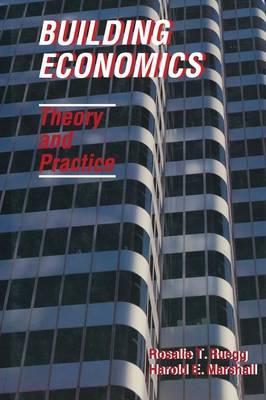
Building Economics: Theory and Practice

Author:   Rosalie Ruegg ,  Harold Marshall
Publisher:   Springer-Verlag New York Inc.
Edition:   Softcover reprint of the original 1st ed. 1990
ISBN:  

9781475746907


Pages:   486
Publication Date:   16 July 2013
Format:   Paperback
Availability:   Manufactured on demand   Availability explained
We will order this item for you from a manufactured on demand supplier.

Our Price $448.77 Quantity:  
Add to Cart

Share |

Building Economics: Theory and Practice


Overview

We no longer build buildings like we used to nor do we pay for them in the same way. Buildings today are no longer only shelter but are also life support systems, communication terminals, data manufacturing centers, and much more. Buildings are incredibly expensive tools that must be constantly adjusted to function efficiently. The economics of building has become as complex as its design. When buildings were shelter they lasted longer than their builders. The av­ erage gothic master mason lived 35 or 40 years. Cathedrals took 3 or 4 hundred years to build. Cost estimates were verified by great great grandchildren of the original designer. Today, creative economics has become as important as creative design and creative building. The dient brings builder, contractor, architect, and facilities manager to account in their life time. The cost of building can therefore no longer be left to chance or act of god. Solutions are no longer as ingeniously simple as those proposed by a Flor­ entine builder early in the 15th century. He proposed to center the dome of S. Maria deI Fiore on a great mound of earth mixed with pennies. When the job was done street urchins would carry away the dirt in their search for the pennies. This was a serious suggestion offered by an early construction manager before Brunelleschi solved the problem more sensibly.

Full Product Details

Author:   Rosalie Ruegg ,  Harold Marshall
Publisher:   Springer-Verlag New York Inc.
Imprint:   Springer-Verlag New York Inc.
Edition:   Softcover reprint of the original 1st ed. 1990
Dimensions:   Width: 15.20cm , Height: 2.60cm , Length: 22.90cm
Weight:   0.731kg
ISBN:  

9781475746907


ISBN 10:   1475746903
Pages:   486
Publication Date:   16 July 2013
Audience:   Professional and scholarly ,  Professional & Vocational
Format:   Paperback
Publisher's Status:   Active
Availability:   Manufactured on demand   Availability explained
We will order this item for you from a manufactured on demand supplier.

Table of Contents

1 Methods of Economic Evaluation.- 1. Building Economics at a Glance.- 2. Life-Cycle Cost (LCC).- 3. Net Benefit (NB) and Net Savings (NS).- 4. Benefit-to-Cost Ratio (BCR) and Savings-to-Investment Ratio (SIR).- 5. Internal Rate of Return (IRR).- 6. Overall Rate of Return (ORR).- 7. Payback (PB).- 2 What You Need to Know to Apply the Methods.- 8. Adjusting Dollar Amounts for Time of Occurrence.- 9. Treatment of Price Changes.- 10. Setting the Study Period.- 11. Selecting a Discount Rate or MARR.- 12. Estimating Costs and Benefits.- 13. Accounting for Taxes and Financing.- 3 Techniques for Treating Uncertainty and Risk.- 14. Risk Exposure and Risk Attitude.- 15. Conservative Estimating, Breakeven Analysis, and Sensitivity Analysis.- 16. Risk-Adjusted Discount Rate and Certainty Equivalent Techniques.- 17. Decision Analysis, Simulation, and Other Techniques.- 18. Selecting the Best Technique.- 4 Applications of Economic Evaluation Methods and Risk Analysis Techniques.- 19. Selection of Building Designs and Building Components.- 20. Decision to Accept or Reject a Project.- 21. Decisions on Building Location.- 22. Lease or Buy Decisions.- 23. Economic Size of Building Components.- 24. Allocating Limited Budgets Among Competing Projects.- 25. Decisions on Timing of Equipment Replacements.- 26. Selecting Combinations of Interdependent Systems.- Appendixes.- A. Glossary.- B. Worksheets and Supporting Reference Tables for Computing Life-Cycle Costs, Net Savings, Savings-to-Investment Ratio, and Payback.- C. Graphs for Converting SPB to DPB.- D. Computer Programs.- E. Derivation of a Utility Function.- F. Guide to Published Sources of Data.- G. Discount Factor Tables.- Subject.

Reviews

Author Information

Tab Content 6

Author Website:  

Countries Available

All regions
Latest Reading Guide

MRGC26


Shopping Cart
Your cart is empty
Shopping cart
Mailing List