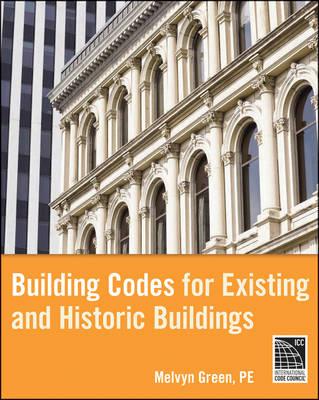
Building Codes for Existing and Historic Buildings

Author:   Melvyn Green
Publisher:   John Wiley & Sons Inc
Edition:   2nd edition
ISBN:  

9780470195918


Pages:   264
Publication Date:   16 December 2011
Format:   Hardback
Availability:   Awaiting stock   Availability explained


Our Price $224.40 Quantity:  
Add to Cart

Share |

Building Codes for Existing and Historic Buildings


Overview

Written for architects, engineers, and preservation professionals, this is the only comprehensive book to examine how the International Building Code and the International Existing Building Code (IEBC) can be applied to historic buildings. For ease of use, the book is organized to parallel the IEBC itself. It discusses code history and the reasoning behind specific regulations, and how codes are applied to existing buildings, along with issues such as occupancy and use, type of construction, safety, and energy conservation. No building professional should be without this handy guide.

Full Product Details

Author:   Melvyn Green
Publisher:   John Wiley & Sons Inc
Imprint:   John Wiley & Sons Inc
Edition:   2nd edition
Dimensions:   Width: 19.40cm , Height: 2.00cm , Length: 24.30cm
Weight:   0.612kg
ISBN:  

9780470195918


ISBN 10:   0470195916
Pages:   264
Publication Date:   16 December 2011
Audience:   Professional and scholarly ,  Professional & Vocational
Format:   Hardback
Publisher's Status:   Out of Print
Availability:   Awaiting stock   Availability explained

Table of Contents

PREFACE?xi ACKNOWLEDGMENTS?xiii ABOUT MELVYN GREEN?xv PART 1 INTRODUCTION 1 CHAPTER 1 INTRODUCTION?3 How Are Building Codes Developed? 5 How Are Building Codes Applied? 5 Building Code Updates and Compliance 6 CHAPTER 2 HOW CODES REGULATE BUILDINGS?9 Understanding Code Approach 9 PART 2 DEVELOPMENT OF CODES AND STANDARDS IN THE UNITED STATES 11 CHAPTER 3 DEVELOPMENT OF BUILDING CODES IN THE UNITED STATES?13 Local Codes 15 Early Model Codes 15 Comprehensive Model Codes 16 Regional Model Codes 16 International Building Code 17 CHAPTER 4 DEVELOPMENT OF MODEL CODE PROVISIONS FOR EXISTING BUILDINGS?19 Regional Model Codes 19 International Building Code 24 Change of Occupancy Classification or Group 28 International Existing Building Code 29 CHAPTER 5 DEVELOPMENT OF CODE PROVISIONS FOR HISTORIC BUILDINGS?31 Regional Model Codes 31 International Building Code Provisions for Historic Buildings 32 International Existing Building Code Provisions for Historic Buildings 33 State Building Codes for Historic Buildings 33 California 33 Massachusetts 34 New Jersey 34 Federal Activities 34 Legislation 34 Tax Incentives 35 Federal Agencies 35 Conclusion 37 PART 3 THE RATIONALE BEHIND CODE PROVISIONS 39 CHAPTER 6 OCCUPANCY?41 Factors Infl uenced or Determined by Occupancy 41 Fire Safety Factors 41 Structural Factors 42 General Health and Safety Factors 42 Occupancy Classifications 42 Assembly Occupancies?roup A 43 Business Occupancies?roup B 46 Educational Occupancies?roup E 47 Factory and Industrial Occupancies?roup F 47 High-hazard Occupancies?roup H 50 Institutional Occupancies?roup I 51 Mercantile Occupancies?roup M 55 Residential Occupancies?roup R 56 Storage Occupancies?roup S 58 Utility and Miscellaneous Occupancies?roup U 61 Occupancy Classifi cations in Previous Building Codes 61 CHAPTER 7 PLANNING AND CONSTRUCTION FACTORS?63 Siting 63 Fire Concerns 63 Health and Habitability 64 Type of Construction and Materials 64 Type Construction Requirements 65 Fire Concerns 69 Health and Habitability 71 Building and Component Size 71 Fire Concerns 72 Health and Habitability 72 PART 4 HOW CODES REGULATE EXISTING BUILDINGS 73 CHAPTER 8 PRINCIPLES OF REGULATING EXISTING BUILDINGS?75 What Do You Need to Know about Your Building? 76 Building Rehabilitation and Regulation 76 Nonconforming Rights 79 Change of Occupancy 79 CHAPTER 9 INTERNATIONAL EXISTING BUILDING CODE COMPLIANCE METHODS?81 Why Use the International Existing Building Code? 81 How Is the IEBC Organized? 81 Alternate Materials and Methods 85 Plan Requirements 85 Prescriptive Compliance Method 88 Work Area Compliance Method 89 Performance Compliance Method 89 Example Buildings 90 CHAPTER 10 INTERNATIONAL EXISTING BUILDING CODE?RESCRIPTIVE COMPLIANCE METHOD?97 General 97 Additions, Alterations, and Repairs 98 Structural and Seismic Requirements 99 Nonstructural Alterations and Repairs 100 Other Requirements 100 Change of Occupancy Classification 101 Structural Requirements 102 Conclusion 103 Evaluating the Prescriptive Compliance Method for a Project 103 Prescriptive Compliance Method?xamples 105 CHAPTER 11 INTERNATIONAL EXISTING BUILDING CODE-WORK AREA COMPLIANCE METHOD: REPAIRS AND ALTERATIONS?111 Repairs 112 Nonstructural Repairs 113 Structural Repairs 113 Alterations 115 Alteration Level 1 115 Alteration Level 2 116 Alteration Level 3 118 Work Area Compliance Method Alteration Examples 119 CHAPTER 12 INTERNATIONAL EXISTING BUILDING CODE-WORK AREA COMPLIANCE METHOD: SPECIAL CONDITIONS?125 Additions 125 Change of Occupancy 126 Change in Character of Use 131 Change to Another Occupancy Classifi cation or Group 131 Applying the Work Area Compliance Method to Change of Occupancy 137 Code Provisions for Change of Occupancy Classifi cation 139 Historic Structures 143 Repairs to Historic Buildings 145 Alterations to Historic Buildings 145 Change of Occupancy in Historic Buildings 146 Relocated Historic Buildings 147 Work Area Compliance Method Examples 150 CHAPTER 13 INTERNATIONAL EXISTING BUILDING CODE PERFORMANCE COMPLIANCE METHOD?155 Scope 155 Additional Code Requirements 156 Performance Compliance Procedure 156 Performance Compliance Method Examples 160 Low-rise Building 160 High-rise Building 184 Conclusion 204 CHAPTER 14 SUMMARY OF THE COMPLIANCE METHODOLOGIES?205 Low-rise Building 205 High-rise Building 208 Summary 208 PART 5 HISTORIC PRESERVATION REGULATIONS 209 CHAPTER 15 THE LEGAL BASIS FOR HISTORIC PRESERVATION REGULATIONS?211 Federal Level 211 American Antiquities Act of 1906 211 Historic Sites Act of 1935 211 National Historic Preservation Act of 1966 212 National Environmental Policy Act of 1969 212 Executive Order 11593 of 1971 212 The Secretary of the Interior? Standards of 1978 212 State Laws and Regulations 213 Model Code Provisions 214 Local Laws 214 CHAPTER 16 THE RATIONALE BEHIND HISTORIC PRESERVATION REGULATIONS?215 Underlying Philosophy of the Standards 215 Accuracy versus Subjectivity 215 Reproduction versus Original 217 Reversibility 217 Continuity of History 218 Examples 218 Historic Church 218 Victorian House 221 CHAPTER 17 THE IEBC AND THE SECRETARY OF THE INTERIOR?S STANDARDS?223 Preservation 224 Background and Definitions 224 Application to Specific Projects 225 Preservation and Building Code Provisions 226 Rehabilitation 226 Background and Definitions 226 Application to Specific Projects 227 Rehabilitation and Building Code Provisions 228 Restoration 229 Background and Definitions 229 Application to Specific Projects 230 Restoration and Building Code Provisions 231 Reconstruction 232 Background and Definitions 232 Application to Specific Projects 233 Reconstruction and Building Code Provisions 233 CHAPTER 18 RESOURCES?237 Historic Buildings 237 Natural Hazards Information 237 Fire Safety 238 INDEX?239

Reviews

Author Information

MELVYN GREEN, S.E., a licensed engineer in several states, is a structural engineer specializing in historic structures. President of the consulting firm Melvyn Green and Associates, Inc., for over thirty-five years, and a previous building official, he is active in building code development and education. He served on the drafting committee of the International Existing Building Code.

Tab Content 6

Author Website:  

Countries Available

All regions
Latest Reading Guide

MRGC26


Shopping Cart
Your cart is empty
Shopping cart
Mailing List