Overview
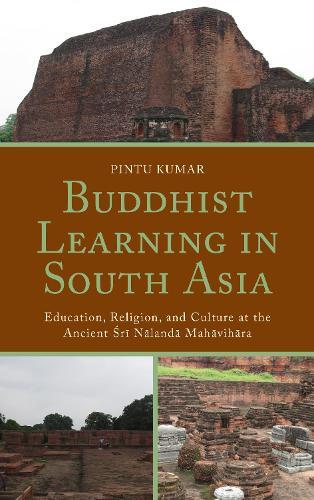
This interdisciplinary study is the first book to provide a complete survey of Sri Nalanda Mahavihara from the perspective of its educational curricula as well as its religious influence. It provides detailed descriptions of the origin, growth, management, and academic and cultural life of Nalanda, with particular attention to its pedagogy, curriculum, teachers, and students. It also presents an alternative interpretation of nationalist and popular notions about Sri Nalanda as an international university and proves that it was, at its core, a Buddhist monastery and an institution of Buddhist learning focused on the study and promotion of Buddhism.
Full Product Details
Author: Pintu Kumar
Publisher: Bloomsbury Publishing Plc
Imprint: Lexington Books
Dimensions:
Width: 15.30cm
, Height: 2.00cm
, Length: 21.90cm
Weight: 0.535kg
ISBN: 9781498554947
ISBN 10: 1498554946
Pages: 348
Publication Date: 12 May 2021
Audience:
Professional and scholarly
,
Professional & Vocational
Format: Paperback
Publisher's Status: Active
Availability: Manufactured on demand

We will order this item for you from a manufactured on demand supplier.
Reviews
Pintu Kumar's Buddhist Learning in South Asia sheds light on various aspects of this ancient monastery. In his book, Kumar addresses the problem whether Nalanda can be treated as a university. Buddhist Learning in South Asia is a comprehensive book that provides rich details about different aspects of the mahavihara. It is a welcome addition to the existing literature, where most books on Nalanda are quite old or lean volumes, covering only specific aspects. * Reading Religion * This voluminous and timely monograph calls into question some flawed assumptions of early Buddhism at the place of its origin. The author moves away from crude modern day categorizations of the historic Sri Nalanda Mahavihara either as 'half monastery, half university' or more megalomaniac International University-formulations which ascribe modern meanings to an ancient institution for advanced training into Buddhist religion and philosophy. Instead, the setting up and functioning of the large monastic institution of learning is examined here in terms of its ideological orientation and physical expansion in relation to the politics of patronage. This richly detailed work is a must read for those misled by ill-informed assertions in the service of modern politics of religion or secularism with a misplaced sense of pride in the past. -- Raziuddin Aquil, University of Delhi; author of In the Name of Allah: Understanding Islam and Indian History Sri Nalanda Mahavihara is the epitome of what Indian culture and civilization offers. In outlining its historical journey, Pintu Kumar has performed a great service. This study will be welcomed by scholars interested in the history of education, religion, and culture. -- Deepak Kumar, Jawaharlal Nehru University This informative and well-documented book on Nalanda is, up to now, the most comprehensive study of the history of this famous monastic complex, its economic and administrative organization, and its religious and intellectual life. The author bases his analysis on a large body of sources that encompass the textual, historical, archaeological, and architectural data as well as the travel lodges of Chinese and Tibetan pilgrims to Nalanda. This book is an excellent study for anyone interested in Indian Buddhist monasticism and monastic education in general and in Nalanda's role in the development of Indian Mahayana Buddhism in particular. -- Vesna A. Wallace, University of California, Santa Barbara This monograph on education in the early history of India focuses on Nalanda, which has been eulogized as the first university in the world going back to the pre-Christian era-perhaps a better definition of Nalanda would be the description coined by J. E. Carpenter in 1914, who called it 'Half Monastery-Half University.' In this study, Pintu Kumar traces the fascinating journey of a Mahavihara that evolved to become a major center of Buddhist learning. Kumar takes readers through the Brahmanical system of learning in the Gurukula to the various complex subjects-ranging from theology to mathematics-taught in the Buddhist centers of learning, with Nalanda as the focal point. This monograph will enrich scholars working on Buddhism or education-or both-through Pintu Kumar's meticulous presentation of a forgotten, or partially understood, part of the history of education in India. -- Vijaya Ramaswamy, Jawaharlal Nehru University
Pintu Kumar’s Buddhist Learning in South Asia sheds light on various aspects of this ancient monastery. In his book, Kumar addresses the problem whether Nalanda can be treated as a university. Buddhist Learning in South Asia is a comprehensive book that provides rich details about different aspects of the mahavihara. It is a welcome addition to the existing literature, where most books on Nalanda are quite old or lean volumes, covering only specific aspects. * Reading Religion * This voluminous and timely monograph calls into question some flawed assumptions of early Buddhism at the place of its origin. The author moves away from crude modern day categorizations of the historic Sri Nalanda Mahavihara either as ‘half monastery, half university’ or more megalomaniac International University—formulations which ascribe modern meanings to an ancient institution for advanced training into Buddhist religion and philosophy. Instead, the setting up and functioning of the large monastic institution of learning is examined here in terms of its ideological orientation and physical expansion in relation to the politics of patronage. This richly detailed work is a must read for those misled by ill-informed assertions in the service of modern politics of religion or secularism with a misplaced sense of pride in the past. -- Raziuddin Aquil, University of Delhi; author of In the Name of Allah: Understanding Islam and Indian History Sri Nalanda Mahavihara is the epitome of what Indian culture and civilization offers. In outlining its historical journey, Pintu Kumar has performed a great service. This study will be welcomed by scholars interested in the history of education, religion, and culture. -- Deepak Kumar, Jawaharlal Nehru University This informative and well-documented book on Nalanda is, up to now, the most comprehensive study of the history of this famous monastic complex, its economic and administrative organization, and its religious and intellectual life. The author bases his analysis on a large body of sources that encompass the textual, historical, archaeological, and architectural data as well as the travel lodges of Chinese and Tibetan pilgrims to Nalanda. This book is an excellent study for anyone interested in Indian Buddhist monasticism and monastic education in general and in Nalanda’s role in the development of Indian Mahayana Buddhism in particular. -- Vesna A. Wallace, University of California, Santa Barbara This monograph on education in the early history of India focuses on Nalanda, which has been eulogized as the first university in the world going back to the pre-Christian era—perhaps a better definition of Nalanda would be the description coined by J. E. Carpenter in 1914, who called it ‘Half Monastery-Half University.’ In this study, Pintu Kumar traces the fascinating journey of a Mahavihara that evolved to become a major center of Buddhist learning. Kumar takes readers through the Brahmanical system of learning in the Gurukula to the various complex subjects—ranging from theology to mathematics—taught in the Buddhist centers of learning, with Nalanda as the focal point. This monograph will enrich scholars working on Buddhism or education—or both—through Pintu Kumar’s meticulous presentation of a forgotten, or partially understood, part of the history of education in India. -- Vijaya Ramaswamy, Jawaharlal Nehru University
Author Information
Pintu Kumar is assistant professor in the Department of History at Delhi University.