Overview
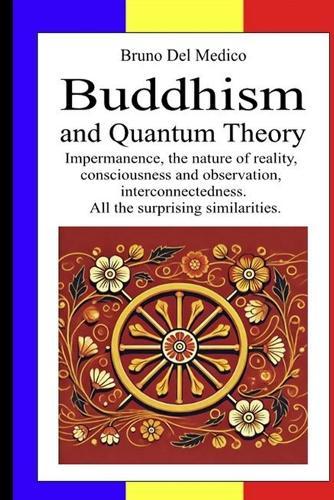
In the landscape of human knowledge, the boundaries between science and philosophy are proving increasingly permeable, giving rise to unexpected dialogues between seemingly distant worlds. In this book, we aim to explore the fascinating intersection between Eastern philosophies, with a particular focus on Buddhism, and modern discoveries in quantum physics. The goal is clear: to outline how the millennia-old insights of traditions such as Buddhism can offer new light on quantum theories, raising profound questions about the nature of reality, perception, and existence itself. This book is the first in a trilogy focusing on Buddhism, Hinduism and Taoism. The topics covered highlight similarities between these systems of thought and the fundamental principles of quantum physics. The similarities are striking. In Buddhism, the concept of impermanence is central. Everything that exists is constantly changing; nothing is static. Similarly, quantum physics teaches us that at the subatomic level, particles do not exist in definite states, but rather in probabilistic states. For example, the famous wave-particle duality suggests that particles can also behave as waves, challenging our traditional understanding of physical matter. The principle of interdependence emphasizes how each phenomenon is connected to all others. In quantum physics, the phenomenon of quantum entanglement illustrates such a network of relationships between particles. When two particles are entangled, the change in the state of one instantaneously affects the other, even at vast distances, proposing a link that transcends space-time barriers. An important part is devoted to the ego illusion (Anatta): Buddhism teaches that the sense of a separate self is an illusion. In quantum physics, our perception of reality is similarly illusory. Many scientific discoveries reveal that our observation alters the observed reality. The famous double-slit experience, for example, shows how simply observing quantum particles alters their behavior. Regarding meditation and mindfulness, Buddhist meditative practices are known to promote a contemplative view of reality, allowing practitioners to follow paths that go beyond the appearance of things. Contemporary scientists, such as physicist David Bohm, have suggested that what we see as 'reality' may be only a surface image of a deeper order, analogous to the states of consciousness achieved through meditation. To illustrate these similarities, it is useful to cite the dialogue between physicist Niels Bohr and Buddhist philosopher Daisetsu Teitarō Suzuki. Bohr, considered one of the fathers of quantum physics, found in Eastern concepts a surprising resonance. In one of his famous quotes, he said: ""Physics is not a description of reality, but a construction of our thinking."" This is reminiscent of the Buddhist view of perception as a reflection of our mind. Another significant testimony comes from physicist Fritjof Capra, whose book ""The Tao of Physics"" explores the similarities between modern physics and Eastern philosophies, including Buddhism and Taoism. Capra suggests that quantum reality invokes an interpretation of matter not as a collection of solid objects but as a field of energies, in perfect harmony with Buddhist thought on impermanence. In this first volume, we have drawn the contours of a profound and transformative connection between Buddhism and quantum physics. Exploring these relationships not only enriches our understanding of science, but also invites deeper reflection on how we perceive reality. In an increasingly complex world, Buddhist principles offer a vital cue for a new vision of our place in the universe: a space of interconnectedness, impermanence and awareness.
Full Product Details
Author: del Medico
Publisher: Pensarediverso-Ing
Imprint: Pensarediverso-Ing
Dimensions:
Width: 15.20cm
, Height: 1.10cm
, Length: 22.90cm
Weight: 0.281kg
ISBN: 9791282549080
Pages: 204
Publication Date: 03 February 2026
Audience:
General/trade
,
General
Format: Paperback
Publisher's Status: Active
Availability: Available To Order

We have confirmation that this item is in stock with the supplier. It will be ordered in for you and dispatched immediately.
Language: Spanish
Author Information
Bruno Del Medico, born in 1946 in Sabaudia, Italy, during his working life has been involved in computer science and software development. Later he devoted himself to the study and popularization of the most current scientific theories, such as quantum theory in its metaphysical meaning. Currently Bruno Del Medico is the author of numerous works published in PensareDiverso Editions. Bruno Del Medico's work differs from traditional narratives in the field of technical sciences in its critical, independent and unconventional approach. Instead of limiting himself to standard interpretations or general consensus on purely scientific issues, Bruno Del Medico explores alternative perspectives that often go against the grain, questioning commonly accepted assumptions. A distinctive feature of his works is his ability to weave science, ethics and philosophy into an open dialogue that encourages the reader to reflect independently and consider the deeper implications of technological and scientific innovations.