Overview
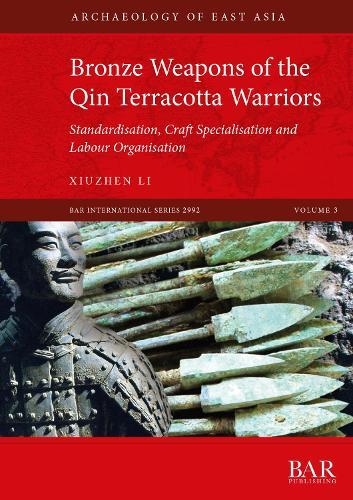
Over 40,000 lethal bronze weapons were discovered with thousands of terracotta warriors in the tomb complex of the Qin First Emperor (259-210 BC). This book carries out the first systematic and comprehensive study on these weapons to investigate the mass production and labour organisation in early imperial China. The research draws upon extensive measurements, typological analysis and related statistical treatment, as well as a study of the spatial distribution of the bronze weapons. A combination of metrical and spatial data is used to assess the degree of standardisation of the weapons' production, and to evaluate the spatial patterns in the array of the Terracotta Army. This provides further information about the labour organisation behind the production, transportation and placement of weapons as they were moved from the workshop and/or arsenal to the funeral pits. Integrating these insights with inscriptions, tool marks, and chemical analysis, this book fills a gap in the study of mass production, the behaviour of craftspeople, and related imperial logistical organisation in the Qin Dynasty (221-206 BC), marking the most crucial early stage in Chinese political unification.
Full Product Details
Author: Xiuzhen Li
Publisher: BAR Publishing
Imprint: BAR Publishing
Weight: 0.953kg
ISBN: 9781407316901
ISBN 10: 1407316907
Pages: 239
Publication Date: 28 July 2020
Audience:
Professional and scholarly
,
Professional & Vocational
Format: Paperback
Publisher's Status: Active
Availability: Available To Order

We have confirmation that this item is in stock with the supplier. It will be ordered in for you and dispatched immediately.
Reviews
{\rtf1\fbidis\ansi\ansicpg1252\deff0\deflang2057{\fonttbl{\f0\fswiss\fprq2\fcharset0 Calibri;}{\f1\fnil\fcharset0 Verdana;}} \viewkind4\uc1\pard\ltrpar\lang1033\f0\fs22\lquote This book is a massively detailed study of this (40,000 bronze weapons) with the specific goal of learning how weapons production was organized and the extent to which products were standardized. Thousands of artifacts were measured very precisely with digital callipers, and statistical studies of the measurements, together with studies of the inscriptions on many of the artifacts, give important insights into both questions.\rquote Donald B. Wagner, Asian Perspectives, Volume 61(1), 2022\par \par \lquote (A) crucial contribution to advancing our knowledge of the Qin\rquote s formidable military power and the underlying social structures of the empire. (\'85) This monograph marks a critical step forward in combining multi-disciplinary methods in Chinese archaeology. It offers an excellent case study of quantitative typological analysis, which builds critical foundations for the spatial analysis in subsequent chapters. The book is accessible, and its statistical and spatial analyses vividly illustrate the great potential of big-data approaches to archaeological research.\rquote Ruiliang Liu, Antiquity (2020)\par \lang2057\par \pard\ltrpar\sa160\sl240\slmult0 'The research methods adopted are innovative and original. The systematic metrical measurements and spatial analysis of the distribution of different types of bronze weapons in the sacrificial pit are especially impressive.\rquote Professor Jianjun Mei, University of Cambridge\par \lquote All of these data are completely new and have made a significant contribution to the overall understanding of the production organization in late Bronze Age China.\rquote Dr Ruiliang Liu, University of Oxford\f1\fs17\par }
{\rtf1\fbidis\ansi\ansicpg1252\deff0\deflang2057{\fonttbl{\f0\fswiss\fprq2\fcharset0 Calibri;}{\f1\fnil\fcharset0 Verdana;}} \viewkind4\uc1\pard\ltrpar\lang1033\f0\fs22\lquote (A) crucial contribution to advancing our knowledge of the Qin\rquote s formidable military power and the underlying social structures of the empire. (\'85) This monograph marks a critical step forward in combining multi-disciplinary methods in Chinese archaeology. It offers an excellent case study of quantitative typological analysis, which builds critical foundations for the spatial analysis in subsequent chapters. The book is accessible, and its statistical and spatial analyses vividly illustrate the great potential of big-data approaches to archaeological research.\rquote Ruiliang Liu, Antiquity (2020)\par \lang2057\par \pard\ltrpar\sa160\sl240\slmult0 'The research methods adopted are innovative and original. The systematic metrical measurements and spatial analysis of the distribution of different types of bronze weapons in the sacrificial pit are especially impressive.\rquote Professor Jianjun Mei, University of Cambridge\par \lquote All of these data are completely new and have made a significant contribution to the overall understanding of the production organization in late Bronze Age China.\rquote Dr Ruiliang Liu, University of Oxford\par \pard\ltrpar\f1\fs17\par }
'The research methods adopted are innovative and original. The systematic metrical measurements and spatial analysis of the distribution of different types of bronze weapons in the sacrificial pit are especially impressive.' Professor Jianjun Mei, University of Cambridge 'All of these data are completely new and have made a significant contribution to the overall understanding of the production organization in late Bronze Age China.' Dr Ruiliang Liu, University of Oxford
Author Information
Xiuzhen Li is a senior archaeologist at the Museum of the Qin Terracotta Army, China, and has also recently become a departmental lecturer in Chinese Archaeology at University of Oxford. She has contributed substantially to the international collaboration between the Museum and University College London, first via a doctoral project and since as a UCL Honorary Senior Research Associate.