Overview
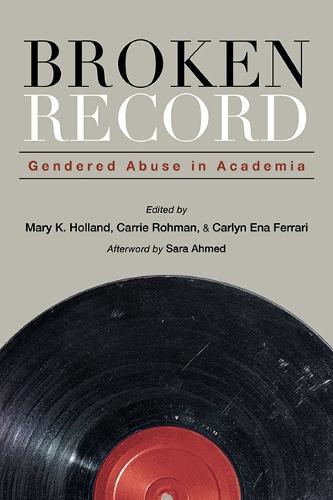
A landmark volume documenting the scope and insidiousness of gendered abuse in academia, revealing the limits of institutional redress, and sharing hard-won strategies for change. Broken Record brings together narratives of gendered abuse in academia from across disciplines, at every career stage, around the United States and the world. Individually and collectively, contributors describe harrowing experiences of bullying, mobbing, harassment, and assault in a range of institutional spaces, including classrooms, offices, library stacks, conferences, interviews, and out on field research. Their abusers are teachers, mentors, students, colleagues, chairs, administrators, and even representatives of the very offices tasked with protecting them. Beyond using storytelling to expose the ubiquity of abuse, these writers also theorize its causes and proffer strategies for resistance and healing. With an afterword by Sara Ahmed, author of the groundbreaking Complaint!, Broken Record forms its own powerful collective-a chorus of nearly fifty academics with highly varied yet strikingly consistent narratives, united in a clarion call for change.
Full Product Details
Author: Mary K. Holland (SUNY New Paltz) , Carrie Rohman , Carlyn Ena Ferrari (Seattle University) , Sara Ahmed (University of London)
Publisher: State University of New York Press
Imprint: State University of New York Press
Dimensions:
Width: 15.20cm
, Height: 2.50cm
, Length: 22.90cm
Weight: 0.476kg
ISBN: 9798855801965
Pages: 267
Publication Date: 01 September 2025
Audience:
Professional and scholarly
,
Professional & Vocational
Format: Hardback
Publisher's Status: Active
Availability: Manufactured on demand 
We will order this item for you from a manufactured on demand supplier.
Table of Contents
Introduction: ""A Fragile Archive"" Mary K. Holland, Carrie Rohman, and Carlyn Ena Ferrari Part One: Contexts and Systems of Abuse 1. Survival Analysis: Why Do We Vanish, Where Do We Go? Anonymous 2. This Chapter Not Intentionally Left Blank Anonymous 3. Unbecoming the Other Me: A Female Academic Trapped in the Male Student Gaze Aimee Parkison 4. Keeping Women in Their Place: Sexism in Religious Universities Rachel Noorda 5. The Snake: Surviving Misogyny in Tunisia Souhir Zekri Masson 6. Tall Poppy in the English Field: How Successful Women Are Mowed Down Anonymous 7. Misogyny and Abuse in the Academic Library Workplace: Reflections on Fifteen Years in American Academic Libraries Carolyn Carpan 8. ""Tell Me More"": When Bleeding on the Page Isn't Enough Carlyn Ena Ferrari Part Two: Resistance and Consequences 9. Mad Woman in the Ivory Tower: The Continuous Costs of Speaking Up after Professor/Student Abuse Sarah Cheshire 10. Muffled Voices: Creating Safe Space in a Toxic Department Rifat Siddiqui 11. Rocking the Boat: Experiences of ""Silencing"" from the Global South Darlene Demandante and Raphaella Elaine Miranda 12. To Make a Fuss: The Chronic Predator in Higher Education Anonymous 13. Too Woke, Too Radical, Too Unforgiving: Queer Resistance to the Patriarchal Panopticon Nancy Pathak 14. Shocked: Resisting and Rising above Abuse in Academe (Karen) Irene Countryman-Roswurm 15. The Specter of Anonymity and the Shadow Labor of Complaint Alison E. Vogelaar Part Three: Theorizing and Enacting Change as Individuals and Collectives 16. All My Skinfolk Ain't Kinfolk: The Politics of Solidarity in Black Academia Nicole Carr 17. In Defense of Remembering Shannon Walsh 18. How Black Men Can Help Eradicate Gendered Abuse on University Campuses Kudzaiishe Peter Vanyoro 19. Tracking Sexual Predators across Academic Institutions: Benefits and Limits of Informal Complaints and Recommendations for Change Anonymous 20. The LIEG's Complaint Collective: Reclaiming Academic Voices Lidia M. V. Possas and M. Emilia Barbosa 21. Disrupting the Past as Prologue: Recognizing and Responding to Strategies and Tactics of Gendered Oppression Christina Gallup, Anne Hinderliter, Njoki M. Kamau, Arshia Khan, Lu Smith, and Elizabethada Wright 22. Feminist Secretaries: Silence, Authenticity, and Resistance in the Academy Francine Banner, Pamela Aronson, Kathleen Darcy, Maureen Linker, Jean-Carlos Lopez, and Lisa A. Martin 23. It Is Better to Speak: A Complaint Collective Lori Wright, Neisha Ginae Wiley, Elizabeth VanWassenhove, Brandelyn Tosolt, Rae Loftis, and Meg L. Hensley Afterword: ""Heard as a Broken Record"" Sara Ahmed Acknowledgments Notes on Contributors Index
Reviews
""As the editors hope and intend, this volume functions as a complaint collective. In their specificity and range, the essays cast light on many corners of academe, elucidating patterns of harassment and the blocking of efforts to prevent or redress harm. Although the essays document diabolically successful campaigns to isolate women academics and demonstrate the fragile bonds that hold whistleblowers together, the volume also provides the context necessary to understand the pervasiveness and nuances of harassment, as well as the processes that leave those who complain open to doubt and discrediting."" — Leigh Gilmore, author of The #MeToo Effect: What Happens When We Believe Women ""Sharing our stories of complaint matters even when, or perhaps because, we have shared these stories many times before … The message is hopeful and hard. Yes: there is still so much work to do. Yes: we have to keep saying it because they keep doing it. Yes: the need to repeat ourselves can be tiring, frustrating. That is why we need to say it more and for more to say it."" — Sara Ahmed, from the afterword
""Sharing our stories of complaint matters even when, or perhaps because, we have shared these stories many times before … The message is hopeful and hard. Yes: there is still so much work to do. Yes: we have to keep saying it because they keep doing it. Yes: the need to repeat ourselves can be tiring, frustrating. That is why we need to say it more and for more to say it."" — Sara Ahmed, from the afterword ""As the editors hope and intend, this volume functions as a complaint collective. In their specificity and range, the essays cast light on many corners of academe, elucidating patterns of harassment and the blocking of efforts to prevent or redress harm. Although the essays document diabolically successful campaigns to isolate women academics and demonstrate the fragile bonds that hold whistleblowers together, the volume also provides the context necessary to understand the pervasiveness and nuances of harassment, as well as the processes that leave those who complain open to doubt and discrediting."" — Leigh Gilmore, author of The #MeToo Effect: What Happens When We Believe Women
Author Information
Mary K. Holland is Professor of English at SUNY New Paltz. She is the author of The Moral Worlds of Contemporary Realism and coeditor, with Heather Hewett, of #MeToo and Literary Studies: Reading, Writing, and Teaching about Sexual Violence and Rape Culture. Carrie Rohman is Professor of English at Lafayette College. She is the author of Choreographies of the Living: Bioaesthetics in Literature, Art, and Performance and Stalking the Subject: Modernism and the Animal. Carlyn Ena Ferrari is Assistant Professor of English at Seattle University. She is the author of Do Not Separate Her from Her Garden: Anne Spencer's Ecopoetics.
Tab Content 6
Author Website:
Countries Available
All regions
|