Overview
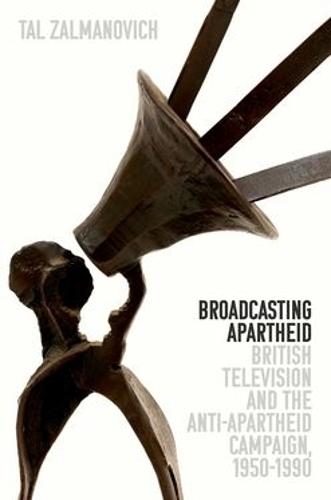
From the early days of the anti-apartheid struggle in South Africa, activists collaborated with artists, musicians, and entertainers, strategically using celebrity and popular culture to amplify protest. Due to the apartheid regime's prosecution of dissent and concentrated effort to suppress information, Britain became a hub of anti-apartheid activity, spearheading the international campaign against apartheid. And, as television came to dominate the British public sphere in the 1950s, grassroots organizations such as the Anti-Apartheid Movement (AAM) directly engaged with the medium and recognized it as an opportunity for political activism. They staged impactful public spectacles and orchestrated large-scale media events, including benefit concerts and mass marches. In doing so, these organizations leveraged the power of television to foster new forms of presentation, perception, and civic participation.In Broadcasting Apartheid, Tal Zalmanovich explores how television revolutionized the political landscape in postwar Britain and played a pivotal role in the anti-apartheid campaign from 1950 to 1990. Drawing on print and audiovisual sources, as well as case studies spanning a range of television content, Zalmanovich shows how television's audiovisual capacities and narrative power evoked empathy and solidarity, galvanizing ordinary citizens into anti-apartheid activism through AAM branches, trade unions, and local government. As Zalmanovich shows, television's ability to transcend geographical and temporal boundaries proved instrumental in building a global coalition against apartheid. Moreover, she argues that television became a key battleground in the broader struggle for racial equality in Britain, where debates over apartheid intersected with contemporary discussions about race, immigration, decolonization, and Cold War politics.Providing valuable insights into media's power in shaping political activism and public opinion, Broadcasting Apartheid is an original and comprehensive analysis of television's role in the British anti-apartheid campaign.
Full Product Details
Author: Tal Zalmanovich (Research and Teaching Associate, Research and Teaching Associate, University of Haifa)
Publisher: Oxford University Press Inc
Imprint: Oxford University Press Inc
ISBN: 9780197774786
ISBN 10: 0197774784
Pages: 256
Publication Date: 10 February 2026
Audience:
College/higher education
,
Postgraduate, Research & Scholarly
Format: Hardback
Publisher's Status: Active
Availability: To order

Stock availability from the supplier is unknown. We will order it for you and ship this item to you once it is received by us.
Author Information
Tal Zalmanovich is a Research and Teaching Associate at the University of Haifa, specializing in broadcasting and protest in modern Britain and its empire. Her research focuses on the intersection of television, spectatorship, and political activism, and she has previously published in Postcolonial Studies, Critical Arts, and Safundi. She recently received the Marconi Fellowship at Oxford's Bodleian Library. Previously, Zalmanovich worked as a journalist and podcast host for New Books Network.