Overview
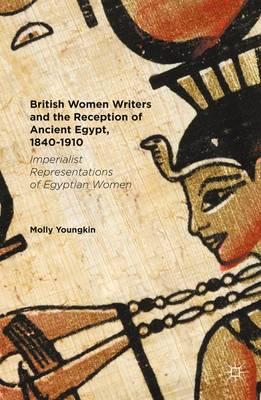
Focusing on British women writers' knowledge of ancient Egypt, Youngkin shows the oftentimes limited but pervasive representations of ancient Egyptian women in their written and visual works. Images of Hathor, Isis, and Cleopatra influenced how British writers such as George Eliot and Edith Cooper came to represent female emancipation.
Full Product Details
Author: Molly Youngkin
Publisher: Palgrave Macmillan
Imprint: Palgrave Macmillan
Edition: 1st ed. 2016
Dimensions:
Width: 14.00cm
, Height: 1.60cm
, Length: 21.60cm
Weight: 4.287kg
ISBN: 9781137570765
ISBN 10: 1137570768
Pages: 229
Publication Date: 20 January 2016
Audience:
Professional and scholarly
,
Professional & Vocational
Format: Hardback
Publisher's Status: Active
Availability: Manufactured on demand

We will order this item for you from a manufactured on demand supplier.
Reviews
Molly Youngkin draws on a remarkably varied range of Victorian and Edwardian woman writers to demonstrate how Egypt both as ancient empire or modern imperial holding was never distant from their notions of feminist liberation. Through careful attention to literary detail and allusion, this innovative book explores the previously unexamined connections between the imaginings of colonial British writers and the political possibilities explored by postcolonial Egyptian novelists and poets still writing today. - Neil Hultgren, Associate Professor of English, California State University, Long Beach, USA, and author of Melodramatic Imperial Writing: From the Sepoy Rebellion to Cecil Rhodes This book offers a timely and important contribution to a growing body of work analyzing the contact between British women writers and so-called 'antique' cultures. Her work is successful in undertaking a complex framework that brings together discussions of imperialism and women's writing within the specific context of Egypt. This monograph offers essential reading for scholars interested in Victorian culture and antiquity, as well as those working on the history of women's writing. - Churnjeet Mahn, Chancellor's Fellow, University of Strathclyde, UK and author of British Women's Travel to Greece, 1840-1914: Travels in the Palimpsest Reviewer: Isobel Hurst, Lecturer in English, Goldsmiths, University of London, UK SECOND REVIEW Molly Youngkin, Ancient Egyptian Women and British Women Writers, 1840-1910 The revisions to the book title and manuscript successfully highlight the most original aspects of the project, focusing on the reception of ancient Egypt by women writers in the context of a period of developing feminism and imperialism. The strength of this project is the originality of the central idea of exploring the reception of Egypt in the context of feminist and postcolonial readings of poetry and fiction. Youngkin's work is informed by scholarship on the reception of ancient Greece in the period (Evangelista, Prins, Fiske, Hurst, Olverson) but now more clearly complementing than completing with such studies, as distinctions between Greece and Egypt have been emphasised. Scholars and students of Victorian literature and culture, postcolonial and gender studies will find much of interest in this volume. The revisions to the introduction and Chapter 1 address many of the points in my first report. The rationale for the timespan, now 1840 to 1910, is clearly articulated as a significant period of development in British imperialist interests in Egypt. The separation of the theoretical and methodological basis of the study from the focus on reception and access to Egyptian culture has been beneficial, as has the focus on e.g. evidence from contemporary periodicals that discuss the role of ancient Egyptian women as creators and shapers of culture. Youngkin has given greater emphasis to her own readings of texts such as Villette and Aurora Leigh. The chapters relating to individual authors (now chapters 2-5) include some relatively minor changes and additions, largely contributing to the reframing of the project to focus on the Egyptian theme. The revision of the Afterword as the new Chapter 6, My ancestor, my sister': Ancient Heritage Imagery and Modern Egyptian Women Writers' now includes fluent and persuasive readings of texts such as Soueif's novels. This is a fascinating chapter that offers new perspectives on the feminist and postcolonial theories discussed in the introduction as well as the primary texts discussed in previous chapters. The revisions to the manuscript have significantly improved the coherence and focus of the volume, so that its originality is evident. I recommend publication of the revised manuscript. FIRST REVIEW Molly Youngkin, Bound by an English Eye: British Women Writers' Encounters with Ancient Greek and Egyptian Women, 1850-1910 The manuscript contributes to a fast-growing area of interest in women's role in the Victorian reception of antiquity, supplementing earlier studies of nineteenth-century men's responses to the ancient world. It is addressed to academics and students of Victorian literature and culture, postcolonial and gender studies. The book draws on recent classical reception studies, feminist and postcolonial criticism and explores a less familiar area of interest, the reception of ancient Egypt. Beginning with the image of the temples of two goddesses, the Graeco-Roman Venus and the Egyptian Isis, this study sets out to examine the responses of white British women writers to images of ancient Greek and Egyptian women, and the ways in which those writers used the images to represent their own emancipation in novels and poetry. Youngkin argues that receptions of Egypt are important because they are influenced by an imperialist perspective (distinct from earlier Orientalism). There is a separation between West and East but also the intermingling of cultures, whether experienced in direct encounters through travel or indirectly through reading about ancient cultures. This argument connects with more familiar feminist and postcolonial readings of Victorian fiction through the idea that British women's ideas about their own emancipation were contingent on denying emancipation to Eastern women, on the basis that Eastern women were enslaved and British women should not be subject to the same type of oppression. Youngkin also suggests that there are parallels between women's roles in ancient Egyptian religion and contemporary Christianity, particularly in the writing of Florence Nightingale (chapter 1). Chapter 2, on George Eliot, suggests that Eliot's well-known preference for images and characters based on ancient Greek literature and history is bound up with a deliberate avoidance of images of Egyptian women - this argument about the absence of Egyptian images is not easy to prove. Chapter 3, on 'Michael Field', shows women writers trained in a specifically Western aesthetic (based on Graeco-Roman ideals of beauty) attempting to assess images of ancient Egyptian women according to standards developed through viewing Italian art. Chapter 4 looks at Elinor Glyn's fiction as a commodified form of knowledge about Greek and Egyptian cultures, in which women are represented as imaginary Eastern goddesses who could influence Western men without threatening them. The Afterword examines Egyptian women writers 'writing back', and the development of Egyptian feminism. The key strength of this project is the originality of the central idea of exploring the reception of Egypt in the context of feminist and postcolonial readings of poetry and fiction. This brings together key areas in Victorian studies, and the success of current scholarship on the reception of ancient Greece in the Victorian period suggests that this could be a very useful perspective. However, the discussion of those studies (surveyed in the introduction) by critics such as Yopie Prins, Shanyn Fiske, Stefano Evangelista, Isobel Hurst and T. D. Olverson, emphasises a weakness in this project - Youngkin does not offer any significant advance in understanding the reception of Greek literature or culture. Much of the information is gleaned from secondary sources and is sometimes inaccurate, such as the description of the Homeric epics as 'travel narratives'. I recommend reworking and resubmission of the project and would suggest the removal of 'Ancient Greece' from the book's title, to emphasise the more original part of the project - 'Egyptian Women'. In order to make an Egyptian-focused project comparable with works on Victorian Hellenism such as Olverson's Women Writers and the Dark Side of Late Victorian Hellenism or Fiske's Heretical Hellenism, a firmer grounding in Victorian scholarship on Egypt or the dissemination of Egyptology in e.g. periodical articles (much used by Fiske) would be desirable. The importance of the reception of ancient Greek texts and art in debates on women's role in nineteenth-century society (e.g. divorce, infant custody) has been convincingly presented in studies of Victorian Hellenism, and a closer comparison of such discourses with their Egyptian equivalents could be very interesting. There were several instances of images or areas of study that Youngkin introduces mainly through commenting on the available critical reading, where I would have liked more of her own readings. For example, the Cleopatra painting in Charlotte Bronte's Villette is an important point of reference, yet it is only briefly mentioned in the introduction in the context of readings by other critics. It would be worth spending more time on analysing the significance of this key image for this book. Travel writing about Egypt is another example of an area in which the author appeared too ready to concede to existing criticism when there might well be more to say about her chosen case studies in comparison with contemporary travel writing. Possible areas for revision: What is the rationale for the timespan 1850-1910? Is there more to say about the cultural influence of the Napoleonic 'expedition' to Egypt and the broader history of Romantic Orientalism? Rome as the mid-point between England and Africa - might this be as significant as Greece, given the focus on Italian art? 'Egyptian' is frequently expanded to the larger category of 'Eastern', so that it can be hard to discern a specifically Egyptian influence, however indirect that influence is suggested to be. Were ancient Egyptian women more privileged than those of other cultures? The images of 'women' are mostly goddesses or queens - how does this affect their use by middle- or upper-class British women writers? Chapter 1: the context of comparative mythology and religion at this period seems relevant here. What about the anti-Catholic rhetoric common in Victorian travel writing - how does Nightingale compare? Chapter 2: there seemed to be slippage between 'Egyptian', 'Eastern' and 'Jewish' in this chapter, and one brief description of Deronda as an 'accomplished Egyptian' was frequently invoked without really being explored. A closer study of the sources used by Eliot (e.g. Wilkinson, Lane) would be helpful. Chapter 3: the Alexandrian / Byzantine context offers an opportunity for considering the mingling of Greek and Egyptian cultures and also connects with the Decadent taste for late antiquity. The figure of the 'Egyptian Sappho' also seems worth attention, given the importance of Sappho in the period (see Prins, Victorian Sappho). Afterword: this section's clear focus on Egypt and feminism is illuminating and I wondered whether 'writing back' could be given a larger role in the project as a whole (e.g. Soueif's engagement with Eliot - In The Eye of the Sun). Some suggestions for reading: Churnjeet Mahn, British Women's Travel to Greece, 1840-1914 (Ashgate, 2012) - Greece as a meeting point between East and West, seen to be aligned with Europe after the end of Ottoman rule. John Pemble, The Mediterranean Passion: Victorians and Edwardians in the South (OUP, 1987) Margot K. Louis, Persephone Rises, 1860-1927 : Mythography, Gender and the Creation of a New Spirituality (Ashgate, 2009)
Molly Youngkin draws on a remarkably varied range of Victorian and Edwardian woman writers to demonstrate how Egypt-both as ancient empire or modern imperial holding-was never distant from their notions of feminist liberation. Through careful attention to literary detail and allusion, this innovative book explores the previously unexamined connections between the imaginings of colonial British writers and the political possibilities explored by postcolonial Egyptian novelists and poets still writing today. - Neil Hultgren, Associate Professor of English, California State University, Long Beach, USA, and author of Melodramatic Imperial Writing: From the Sepoy Rebellion to Cecil Rhodes This book offers a timely and important contribution to a growing body of work analyzing the contact between British women writers and so-called 'antique' cultures. Her work is successful in undertaking a complex framework that brings together discussions of imperialism and women's writing within the specific context of Egypt. This monograph offers essential reading for scholars interested in Victorian culture and antiquity, as well as those working on the history of women's writing. - Churnjeet Mahn, Chancellor's Fellow, University of Strathclyde, UK and author of British Women's Travel to Greece, 1840-1914: Travels in the Palimpsest
Molly Youngkin draws on a remarkably varied range of Victorian and Edwardian woman writers to demonstrate how Egypt both as ancient empire or modern imperial holding was never distant from their notions of feminist liberation. Through careful attention to literary detail and allusion, this innovative book explores the previously unexamined connections between the imaginings of colonial British writers and the political possibilities explored by postcolonial Egyptian novelists and poets still writing today. - Neil Hultgren, Associate Professor of English, California State University, Long Beach, USA, and author of Melodramatic Imperial Writing: From the Sepoy Rebellion to Cecil Rhodes This book offers a timely and important contribution to a growing body of work analyzing the contact between British women writers and so-called 'antique' cultures. Her work is successful in undertaking a complex framework that brings together discussions of imperialism and women's writing within the specific context of Egypt. This monograph offers essential reading for scholars interested in Victorian culture and antiquity, as well as those working on the history of women's writing. - Churnjeet Mahn, Chancellor's Fellow, University of Strathclyde, UK and author of British Women's Travel to Greece, 1840-1914: Travels in the Palimpsest
Author Information
Molly Youngkin is Professor of English at Loyola Marymount University, Los Angeles, USA. Her previous publications include Feminist Realism at the Fin de Siècle: The Influence of the Late-Victorian Woman's Press on the Development of the Novel (2007) and an annotated edition of Sarah Grand's 1888 novel Ideala (2008).