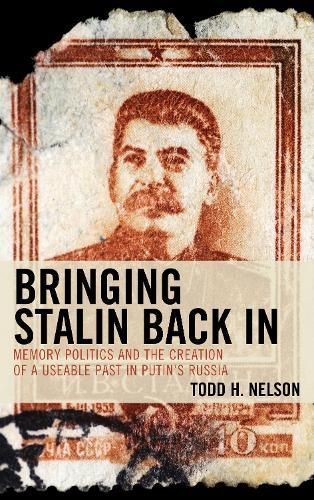
Full Product Details
Author: Todd H. Nelson
Publisher: Bloomsbury Publishing Plc
Imprint: Lexington Books
Dimensions:
Width: 16.00cm
, Height: 1.60cm
, Length: 23.70cm
Weight: 0.408kg
ISBN: 9781498591522
ISBN 10: 1498591523
Pages: 182
Publication Date: 16 October 2019
Audience:
Professional and scholarly
,
Professional & Vocational
Format: Hardback
Publisher's Status: Active
Availability: Manufactured on demand

We will order this item for you from a manufactured on demand supplier.
Reviews
Under the Soviet regime, Russians liked to joke that theirs was the only country with an unpredictable past. In this insightful, well-researched work, Todd Nelson shows how Vladimir Putin has modernized Soviet techniques to tighten his grip on the politics of memory in today's Russia. -- John Beyrle, United States Ambassador to Russia (2008-2012) In Russia, Stalin is the focal point of the memory; and memory is the central issue of contemporary politics. Moreover, conversations about Stalin in Russia are at the same time discussions about Russia's present and future. In this book Todd H. Nelson provides the reader with a deep analysis of that main controversy, demonstrates the difficult crossings of the memories of war victory and memories of terror, and suggests a framework for the future study of Russia's dealing with its past. -- Ivan Kurilla, European University at St. Petersburg Joseph Stalin's long reign as the leader of the Soviet Union was marked by violent terror and repression that caused the deaths of millions, and though he has been dead for nearly 70 years, his malevolent shadow still looms large over Russia. Far too often, Russian President Vladimir Putin has associated Stalin with images of Russian glory, while glossing over the Stalinist terror. In this important book, Todd Nelson makes excellent use of discourse analysis to examine how various types of official texts in Russia have shaped official and public memories of Stalin through a process of complex co-optation. Bringing Stalin Back In is crucial for those who want to understand why millions of Russians nowadays, including many whose relatives were murdered by Stalin's security apparatus, tell public opinion pollsters that Stalin was one of the `greatest leaders' in Russia's history. -- Mark Kramer, Harvard University
Under the Soviet regime, Russians liked to joke that theirs was the only country with an unpredictable past. In this insightful, well-researched work, Todd Nelson shows how Vladimir Putin has modernized Soviet techniques to tighten his grip on the politics of memory in today's Russia. -- John Beyrle, United States Ambassador to Russia (2008-2012) In Russia, Stalin is the focal point of the memory; and memory is the central issue of contemporary politics. Moreover, conversations about Stalin in Russia are at the same time discussions about Russia's present and future. In this book Todd H. Nelson provides the reader with a deep analysis of that main controversy, demonstrates the difficult crossings of the memories of war victory and memories of terror, and suggests a framework for the future study of Russia's dealing with its past. -- Ivan Kurilla, European University at St. Petersburg Joseph Stalin's long reign as the leader of the Soviet Union was marked by violent terror and repression that caused the deaths of millions, and though he has been dead for nearly 70 years, his malevolent shadow still looms large over Russia. Far too often, Russian President Vladimir Putin has associated Stalin with images of Russian glory, while glossing over the Stalinist terror. In this important book, Todd Nelson makes excellent use of discourse analysis to examine how various types of official texts in Russia have shaped official and public memories of Stalin through a process of complex co-optation. Bringing Stalin Back In is crucial for those who want to understand why millions of Russians nowadays, including many whose relatives were murdered by Stalin's security apparatus, tell public opinion pollsters that Stalin was one of the 'greatest leaders' in Russia's history. -- Mark Kramer, Harvard University
“Under the Soviet regime, Russians liked to joke that theirs was the only country with an unpredictable past. In this insightful, well-researched work, Todd Nelson shows how Vladimir Putin has modernized Soviet techniques to tighten his grip on the politics of memory in today’s Russia. “ -- John Beyrle, United States Ambassador to Russia (2008-2012) “In Russia, Stalin is the focal point of the memory; and memory is the central issue of contemporary politics. Moreover, conversations about Stalin in Russia are at the same time discussions about Russia’s present and future. In this book Todd H. Nelson provides the reader with a deep analysis of that main controversy, demonstrates the difficult crossings of the memories of war victory and memories of terror, and suggests a framework for the future study of Russia’s dealing with its past.” -- Ivan Kurilla, European University at St. Petersburg “Joseph Stalin’s long reign as the leader of the Soviet Union was marked by violent terror and repression that caused the deaths of millions, and though he has been dead for nearly 70 years, his malevolent shadow still looms large over Russia. Far too often, Russian President Vladimir Putin has associated Stalin with images of Russian glory, while glossing over the Stalinist terror. In this important book, Todd Nelson makes excellent use of discourse analysis to examine how various types of official texts in Russia have shaped official and public memories of Stalin through a process of complex co-optation. Bringing Stalin Back In is crucial for those who want to understand why millions of Russians nowadays, including many whose relatives were murdered by Stalin’s security apparatus, tell public opinion pollsters that Stalin was one of the ‘greatest leaders’ in Russia's history.” -- Mark Kramer, Harvard University
Author Information
Todd H. Nelson is assistant professor at Cleveland State University.