Overview
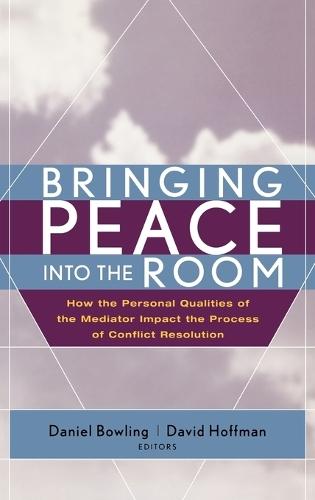
Bringing Peace Into the Room examines the personal qualities that make a mediator effective. The eminent authors of this volume go beyond traditional descriptions of academic training, theoretical orientation, and refinement of technique to confront issues related to personal temperament and the crucial psychological, intellectual and spiritual qualities of the mediation professional— qualities that are often the most potent elements of successful mediation. In this comprehensive resource, Daniel Bowling and David Hoffman bring together a stellar panel of practitioners, academics, teachers, and trainers in the field— Michele LeBaron, Kenneth Cloke, Robert Benjamin, Don Saposnek, Sara Cobb, Peter Adler, Jonathan Reitman, Lois Gold, Marvin Johnson, and others— ¾who share their personal experiences as mediators. Each contributor demonstrates that at the very heart of conflict resolution is the subtle interaction between the parties and the mediator's personal and authentic style.
Full Product Details
Author: Daniel Bowling (Duke University School of Law) ,
David Hoffman (Boston, Massachusetts)
Publisher: John Wiley & Sons Inc
Imprint: Jossey-Bass Inc.,U.S.
Dimensions:
Width: 16.10cm
, Height: 2.80cm
, Length: 23.70cm
Weight: 0.523kg
ISBN: 9780787968502
ISBN 10: 0787968501
Pages: 320
Publication Date: 22 September 2003
Audience:
Professional and scholarly
,
Professional & Vocational
Format: Hardback
Publisher's Status: Active
Availability: Out of stock

The supplier is temporarily out of stock of this item. It will be ordered for you on backorder and shipped when it becomes available.
Reviews
Ever wonder what personal qualities make a mediator effective? Read this wonderfully thought-provoking book for rich insights and diverse perspectives, valuable for novices and experienced practitioners alike. ? William Ury, co-author Getting to Yes, author The Third Side An important contribution about not just what we do but who we are as mediators. The authors reexamine often overlooked first premises. A must read for any self-reflective peacemaker. ? Eric D. Green, Law professor, co-founder, Endispute, Inc. and Resolutions, LLC. Finally, a book that touches on the heart of the mystery of mediation. Bowling, Hoffman and company have opened vistas for all mediators to use as touchstones for their work. ? Gary Friedman, co-founder and director of the Center for Mediation in Law This book is a must-read for both masters and novices in the field. Without ignoring the important issues of competency and credentialing, this book forces us to try to understand what we do at a level that surveys and questionnaires cannot uncover. It is a gem that will gleam for many years to come. ? Homer La Rue, arbitrator, mediator, law professor Anyone curious about how a skilled and self-aware mediator can help people in conflict will want to read this book. Drawing on philosophy, psychology, the arts, and education, the authors explore how mediators can bring real and lasting value to people in conflict. ? Susan Hackley, managing director, Program on Negotiation at Harvard Law School This rich collection of essays offers an array of perspectives on the mediator's dynamic effect on the parties and their conflict. It will provoke reflection and provide insight for even the most experienced mediators about who we are, what we do, and why it matters. ? Marjorie Aaron, mediator and law professor
Ever wonder what personal qualities make a mediator effective? Read this wonderfully thought-provoking book for rich insights and diverse perspectives, valuable for novices and experienced practitioners alike. ? William Ury, co-author Getting to Yes, author The Third Side An important contribution about not just what we do but who we are as mediators. The authors reexamine often overlooked first premises. A must read for any self-reflective peacemaker. ? Eric D. Green, Law professor, co-founder, Endispute, Inc. and Resolutions, LLC. Finally, a book that touches on the heart of the mystery of mediation. Bowling, Hoffman and company have opened vistas for all mediators to use as touchstones for their work. ? Gary Friedman, co-founder and director of the Center for Mediation in Law This book is a must-read for both masters and novices in the field. Without ignoring the important issues of competency and credentialing, this book forces us to try to understand what we do at a level that surveys and questionnaires cannot uncover. It is a gem that will gleam for many years to come. ? Homer La Rue, arbitrator, mediator, law professor Anyone curious about how a skilled and self-aware mediator can help people in conflict will want to read this book. Drawing on philosophy, psychology, the arts, and education, the authors explore how mediators can bring real and lasting value to people in conflict. ? Susan Hackley, managing director, Program on Negotiation at Harvard Law School This rich collection of essays offers an array of perspectives on the mediator's dynamic effect on the parties and their conflict. It will provoke reflection and provide insight for even the most experienced mediators about who we are, what we do, and why it matters. ? Marjorie Aaron, mediator and law professor
Author Information
Daniel Bowling is an attorney, mediator, mediator trainer, and the director of the Washington, D.C. office of Resolve, Inc., a public policy consensus building organization. He was the first CEO of ACR (The Association for Conflict Resolution), the executive director of SPIDR (Society of Professionals in Dispute Resolution), and cofounder of the Lowcountry Mediation Network, the first mediation organization in South Carolina. David A. Hoffman is an attorney, mediator, and arbitrator at the Boston Law Collaborative, LLC, a multi-disciplinary firm devoted to conflict resolution and the practice of collaborative law. He is chair-elect of the American Bar Association Section of Dispute Resolution and has taught mediation, negotiation, and family law at Northeastern University Law School and Harvard Law School.