Overview
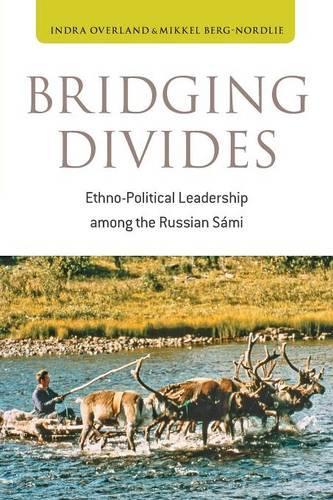
The Sámi are a Northern indigenous people whose land, Sápmi, covers territory in Finland, Norway, Russia, and Sweden. For the Nordic Sámi, the last decades of the twentieth century saw their indigenous rights partially recognized, a cultural and linguistic revival, and the establishment of Sámi parliaments. The Russian Sámi, however, did not have the same opportunities and were isolated behind the closed border until the dissolution of the Soviet Union. This book examines the following two decades and the Russian Sámi’s attempt to achieve a linguistic revival, to mend the Cold War scars, and to establish their own independent ethno-political organizations.
Full Product Details
Author: Indra Overland ,
Mikkel Berg-Nordlie
Publisher: Berghahn Books
Imprint: Berghahn Books
Dimensions:
Width: 15.20cm
, Height: 0.90cm
, Length: 22.90cm
Weight: 0.227kg
ISBN: 9781782389194
ISBN 10: 1782389199
Pages: 162
Publication Date: 01 April 2015
Audience:
General/trade
,
General
Format: Paperback
Publisher's Status: Active
Availability: In Print

This item will be ordered in for you from one of our suppliers. Upon receipt, we will promptly dispatch it out to you. For in store availability, please contact us.
Reviews
[These] excellent chapters detail the emergence of cross-border ties between Russia's Sami communities and Nordic Sami, and assess their contributions to cultural renewal . . . The socioeconomic and cultural portrait [drawn] will likely seem all too familiar to scholars of other Arctic and subarctic indigenous populations in northern Eurasia, but some of the information is unique to Russia's Sami, making this an indispensable contribution to the documentation of northern peoples. Essential. * Choice The Sami political movement, although mentioned in many works, has been a central topic in very few publications. This makes Overland's and Berg-Nordlie's monograph a long-awaited study . . . Bridging Divides, with its wide representation of diverse and often conflicting local opinions and societal attitudes toward the Sami political movement, that cross ethnic borders and limitations, is emblematic of the establishment of 'multivocality' and democratization gaining ground. * Acta Borealia The work offers an important case study . . . of an indigenous revitalization movement and thereby allows for comparison with similar developments not only among the officially recognized forty 'Indigenous small-numbered peoples of the North, Siberia, and the Far East of the Russian Federation' but also with other indigenous peoples in industrialized countries . . . It is a valuable contribution to the literature on language loss and bilingualism and the phenomenon of gender shift frequently discussed in recent anthropological literature about the Russian North. * Stephan Dudeck, Arctic Centre, University of Lapland The authors give the reader a close and sophisticated analysis of the almost impossible project of restoring a cultural tradition, a lost language, and way of life [while] balancing precariously under harsh and marginal ecological and economic conditions . . . [It is] well written, well organized as a text, and well documented. * Jens-Ivar Nergaard, University of Tromso
[These] excellent chapters detail the emergence of cross-border ties between Russia's Sami communities and Nordic Sami, and assess their contributions to cultural renewal . . . The socioeconomic and cultural portrait [drawn] will likely seem all too familiar to scholars of other Arctic and subarctic indigenous populations in northern Eurasia, but some of the information is unique to Russia's Sami, making this an indispensable contribution to the documentation of northern peoples. Essential. * Choice The Sami political movement, although mentioned in many works, has been a central topic in very few publications. This makes Overland's and Berg-Nordlie's monograph a long-awaited study . . . Bridging Divides, with its wide representation of diverse and often conflicting local opinions and societal attitudes toward the Sami political movement, that cross ethnic borders and limitations, is emblematic of the establishment of 'multivocality' and democratization gaining ground. * Acta Borealia The work offers an important case study . . . of an indigenous revitalization movement and thereby allows for comparison with similar developments not only among the officially recognized forty 'Indigenous small-numbered peoples of the North, Siberia, and the Far East of the Russian Federation' but also with other indigenous peoples in industrialized countries . . . It is a valuable contribution to the literature on language loss and bilingualism and the phenomenon of gender shift frequently discussed in recent anthropological literature about the Russian North. * Stephan Dudeck, Arctic Centre, University of Lapland The authors give the reader a close and sophisticated analysis of the almost impossible project of restoring a cultural tradition, a lost language, and way of life [while] balancing precariously under harsh and marginal ecological and economic conditions . . . [It is] well written, well organized as a text, and well documented. * Jens-Ivar Nergaard, University of Tromso
Excellent chapters detail the emergence of cross-border ties between Russia's Sami communities and Nordic Sami and assess their contributions to cultural renewal - The socioeconomic and cultural portrait will likely seem all too familiar to scholars of other Arctic and subarctic indigenous populations in northern Eurasia, but some of the information is unique to Russia's Sami, making this an indispensable contribution to the documentation of northern peoples. Essential. * Choice The work offers an important case study - of an indigenous revitalisation movement and thereby allows for comparison with similar developments not only among the officially recognised forty 'Indigenous small-numbered peoples of the North, Siberia and the Far East of the Russian Federation' but also with other indigenous peoples in industrialised countries - It is a valuable contribution to the literature on language loss and bilingualism and the phenomenon of gender-shift frequently discussed in recent anthropological literature about the Russian North. * Stephan Dudeck, Arctic Centre, University of Lapland The authors give the reader a close and sophisticated analysis of the almost impossible project of restoring a cultural tradition, a lost language and way of life balancing precariously under harsh and marginal ecological and economic conditions. - [It is] well written, well organized as a text and well-documented. * Jens-Ivar Nergaard, University of Tromso
Author Information
Indra Overland is Head of the Department of Russian and Eurasian Studies at the Norwegian Institute of International Affairs. He received his Ph.D. from the University of Cambridge and has previously worked for the University of Tromsø, the Norwegian Refugee Council, and the Nordic Research Board. His recent publications include Caspian Energy Politics (co-edited, 2009) and Russian Renewable Energy (co-authored, 2009).