Overview
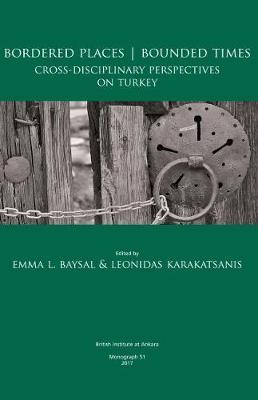
Building on similarities and exploring differences in the way scholars undertake their research, this volume presents crossdisciplinary communication on the study of borders, frontiers and boundaries through time, with a focus on Turkey. Standing at the dividing/connecting line between Europe and Asia, Turkey emerges as a place carrying a rich history of multiple layers of borders that have been drawn, shifted or unmade from the remote past until today: from Palaeolithic hunter-gatherers to the period of early states in the Bronze Age, from the poleis of classical antiquity to the period of the empires defined by the Roman expansion and Byzantine rule, from the imprints of the Ottoman state’s expanded frontiers to contemporary Turkey’s national borders. Amidst proliferating interdisciplinary collaborations for the study of borders between social anthropology, geography, political science and history, this book aims to contribute to a nascent but growing direction in border studies by including archaeology as a collocutor and using Turkey as a case study.
Full Product Details
Author: Emma L Baysal ,
Leonidas Karakatsanis
Publisher: British Institute of Archaeology at Ankara
Imprint: British Institute of Archaeology at Ankara
Volume: 51
ISBN: 9781898249382
ISBN 10: 1898249385
Pages: 224
Publication Date: 31 August 2017
Audience:
Professional and scholarly
,
Professional & Vocational
Format: Hardback
Publisher's Status: Active
Availability: Available To Order

We have confirmation that this item is in stock with the supplier. It will be ordered in for you and dispatched immediately.
Author Information
Emma L Baysal is a lecturer in prehistory at Trakya University in Turkey. She completed her PhD at the University of Liverpool in 2010 and has since held a Senior Fellowship at ANAMED in Istanbul and a Post-Doctoral Fellowship at the British Institute at Ankara. She specialises in, and has published extensively on, prehistoric ornaments and what they can tell us about social structure, technology, communication, trade and beliefs from the Epipalaeolithic period until the Early Bronze Age. She is currently working on artefacts from a range of prehistoric sites in Turkey. Leonidas Karakatsanis holds a PhD in Ideology and Discourse Analysis from the University of Essex. He has researched and published on issues related to the politics of identity and representation, minorities and migration, nationalism, peace and reconciliation, the politics of culture and emotion, and the theories of qualitative methods in social and political sciences. He is the author of Turkish-Greek relations: rapprochement, civil society and the politics of friendship (2014) published as part of the Routledge Advances in Mediterranean Studies series. Since 2015 he is the Assistant Director of the British Institute at Ankara.