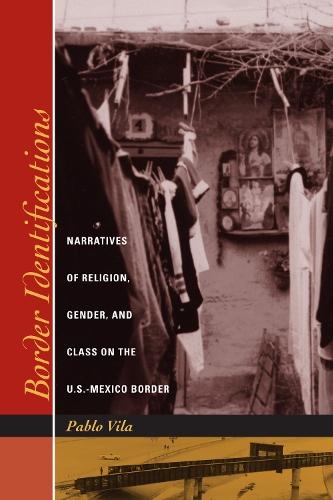
Border Identifications: Narratives of Religion, Gender, and Class on the U.S.-Mexico Border

Author:   Pablo Vila
Publisher:   University of Texas Press
ISBN:  

9780292705838


Pages:   312
Publication Date:   01 August 2005
Format:   Paperback
Availability:   In Print   Availability explained
This item will be ordered in for you from one of our suppliers. Upon receipt, we will promptly dispatch it out to you. For in store availability, please contact us.

Our Price $47.95 Quantity:  
Add to Cart

Share |

Border Identifications: Narratives of Religion, Gender, and Class on the U.S.-Mexico Border


Overview

From poets to sociologists, many people who write about life on the U.S.-Mexico border use terms such as ""border crossing"" and ""hybridity"" which suggest that a unified culture--neither Mexican nor American, but an amalgamation of both--has arisen in the borderlands. But talking to people who actually live on either side of the border reveals no single commonly shared sense of identity, as Pablo Vila demonstrated in his book Crossing Borders, Reinforcing Borders: Social Categories, Metaphors, and Narrative Identities on the U.S.-Mexico Frontier. Instead, people living near the border, like people everywhere, base their sense of identity on a constellation of interacting factors that includes regional identity, but also nationality, ethnicity, and race. In this book, Vila continues the exploration of identities he began in Crossing Borders, Reinforcing Borders by looking at how religion, gender, and class also affect people's identifications of self and ""others"" among Mexican nationals, Mexican immigrants, Mexican Americans, Anglos, and African Americans in the Cuidad Juarez-El Paso area. Among the many fascinating issues he raises are how the perception that ""all Mexicans are Catholic"" affects Mexican Protestants and Pentecostals; how the discourse about proper gender roles may feed the violence against women that has made Juarez the ""women's murder capital of the world""; and why class consciousness is paradoxically absent in a region with great disparities of wealth. His research underscores the complexity of the process of social identification and confirms that the idealized notion of ""hybridity"" is only partially adequate to define people's identity on the U.S.-Mexico border.

Full Product Details

Author:   Pablo Vila
Publisher:   University of Texas Press
Imprint:   University of Texas Press
Dimensions:   Width: 15.20cm , Height: 2.00cm , Length: 22.90cm
Weight:   0.454kg
ISBN:  

9780292705838


ISBN 10:   0292705832
Pages:   312
Publication Date:   01 August 2005
Audience:   College/higher education ,  Undergraduate
Format:   Paperback
Publisher's Status:   Active
Availability:   In Print   Availability explained
This item will be ordered in for you from one of our suppliers. Upon receipt, we will promptly dispatch it out to you. For in store availability, please contact us.

Table of Contents

Acknowledgments Introduction Chapter 1. Catholicism and Mexicanness on the U.S.-Mexico Border Chapter 2. Mexican and Mexican American Protestants Chapter 3. Regionalized Gender Narratives on the Mexican Side of the Border Chapter 4. Gender, Nationality, and Ethnicity on the American Side of the Border Chapter 5. The Problematic Class Discourse on the Border: The Mexican Side Chapter 6. The Problematic Class Discourse on the Border: The American Side Chapter 7. Conclusions Notes Bibliography Index

Reviews

Author Information

Pablo Vila is Professor of Sociology at Temple University in Philadelphia.

Tab Content 6

Author Website:  

Countries Available

All regions
Latest Reading Guide

NOV RG 20252


Shopping Cart
Your cart is empty
Shopping cart
Mailing List