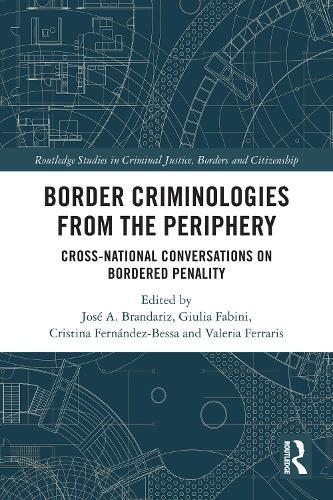
Full Product Details
Author: José A. Brandariz (University of A Coruña, Spain) ,
Giulia Fabini ,
Cristina Fernández-Bessa ,
Valeria Ferraris
Publisher: Taylor & Francis Ltd
Imprint: Routledge
ISBN: 9781032366692
ISBN 10: 1032366699
Pages: 362
Publication Date: 21 May 2026
Audience:
College/higher education
,
Tertiary & Higher Education
Format: Paperback
Publisher's Status: Forthcoming
Availability: Not yet available

This item is yet to be released. You can pre-order this item and we will dispatch it to you upon its release.
Reviews
""This collection makes a crucial contribution to contemporary debates on border criminology by rescuing voices from peripheral contexts, expanding the set of problems, concepts and arguments of this field of study, with the contributions situated in these other scenarios until now frequently neglected in the framework of the unequal relations of production of knowledge at a global level."" Máximo Sozzo, Professor of Sociology and Criminology, National University of Litoral, Argentina ""Finally a book that brings to the forefront voices that until now stood at the periphery of crimmigration and border criminology studies! This ambitious volume questions established assumptions about the how and why of migration control, upending what we thought we knew about the theories and realities of crimmigration and border criminology. Through comparing Global North and Global South experiences and practices and challenging traditional notions about migration control, the book charts a new course for the study of border control on a global scale. An impressive, timely, and finely wrought project."" Juliet Stumpf, Professor of Law, Lewis & Clark College, USA ""Border Criminologies from the Periphery offers a nuanced, scholarly examination of the intersections between criminal justice and immigration enforcement. This edited collection provides a critical comparative analysis of bordered penality, highlighting underrepresented jurisdictions and advancing theoretical debates. It is an indispensable resource for researchers and academics in criminology, sociology, and migration studies."" Maartje van der Woude, Professor of Law & Society, Leiden Law School, the Netherlands ""This impressive collection of essays ‘from the periphery’ expands the horizons of border criminology geopolitically, while also capturing the multi-scalar nature of bordering and the ever-changing modalities of state power recruited to the bordering effort. Many of the contributions challenge the validity of established conceptual borders separating the Global North and South, identifying new peripheral spaces from which to examine and critique border control. A powerhouse of a book that enriches the discipline."" Leanne Weber, Professor of Criminology, University of Canberra, Australia
Author Information
José A. Brandariz is Professor of Criminal Law and Criminology at the University of A Coruña, Spain. Giulia Fabini is Assistant Professor in Sociology of Law and Deviance at the University of Bologna, Italy. Cristina Fernández-Bessa is Ramón y Cajal Distinguished Research Fellow and Lecturer in Criminal Law and Criminology at the University of A Coruña, Spain. Valeria Ferraris is Associate Professor of Sociology of Law and Deviance at the University of Turin, Italy.