Overview
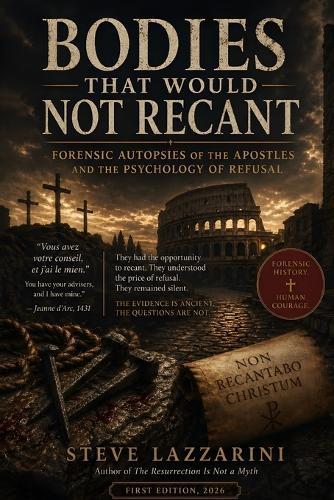
This book is a work of nonfiction. Every execution method described here was practiced by Roman authorities in the first and second centuries. Every archaeological site cited is real. Every psychological study referenced was peer-reviewed and published in a recognized journal. Where I have used hypothetical reconstruction-imagining the smell of a Roman arena, the temperature of a Vatican Hill morning, the weight of an iron nail driven through a heel-bone-I say so explicitly. The book makes one strong empirical claim and one careful theological caveat. The empirical claim is this: the earliest leaders of the Christian movement died, in many cases gruesomely, when a single sentence of recantation would have saved them. They had access to that exit. They did not take it. The reasons can be studied with the same tools used to analyze any other human conviction-forensic pathology, archaeology, psychology, primary sources. The theological caveat is equally important: historical method cannot, by itself, settle metaphysical questions. The fact that the apostles were sincere does not, by ordinary historical reasoning, prove the resurrection. The book respects that distinction throughout. I should also be transparent about my own position. I write as a French Catholic from Lorraine, raised within walking distance of Domrémy-la-Pucelle-the village where, on the feast of the Epiphany 1412, a peasant girl named Jeanne was born who would, by the age of nineteen, have lifted the siege of Orléans, crowned a king at Reims, and stood trial in front of seventy Burgundian and English clerics demanding that she recant her voices. She did not recant. The line she gave one of her judges, when he pressed her about whose authority she trusted against the assembled doctors of the University of Paris, has stayed with me my whole life: ""Vous avez votre conseil, et j'ai le mien."" ""You have your advisers, and I have mine."" That phrase, spoken by a girl who could not read, in front of the highest ecclesiastical and academic authorities of fifteenth-century France, three weeks before they burned her, is the same phrase the apostles spoke in their own way to Pliny in Bithynia, to the proconsul at Smyrna, to the magistrate at Lyon. The book is, in part, an inquiry into where that kind of unmoved adviser came from. I write also as a French Catholic formed by the long memory of Provence and the basilicas of Saint-Maximin and Saint-Victor de Marseille, where the bones of Lazarus of Bethany and Mary Magdalene have been venerated since the earliest centuries of the western Church. I do not regard these traditions as legend; I regard them, with the Catholic sensus fidelium of nearly two millennia, as the preserved memory of a real apostolic mission. But I have tried throughout this book to distinguish what historical method can independently establish from what Catholic tradition transmits-because both deserve respect, and confusing them weakens both. What you decide after reading is your own.
Full Product Details
Author: Steve Lazzarini
Publisher: Independently Published
Imprint: Independently Published
Dimensions:
Width: 15.20cm
, Height: 1.20cm
, Length: 22.90cm
Weight: 0.304kg
ISBN: 9798258839145
Pages: 222
Publication Date: 25 April 2026
Audience:
General/trade
,
General
Format: Paperback
Publisher's Status: Active
Availability: Available To Order

We have confirmation that this item is in stock with the supplier. It will be ordered in for you and dispatched immediately.