Overview
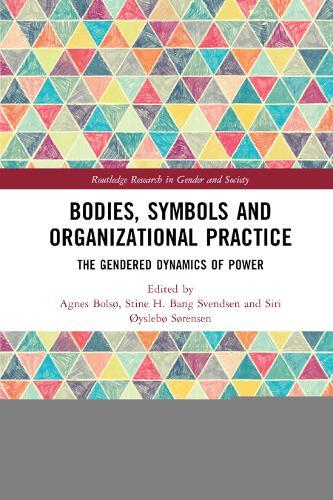
Despite all the efforts to promote change, power and authority still seem to be permanently associated with the white, the straight and the masculine, both symbolically and in the everyday world of organizations. As the intricate relationship between the symbolic and the everyday remains under-researched, this anthology proposes a transdisciplinary feminist perspective drawing on the humanities in order to explore the complex nature of the gendered politics of organizations. Indeed, analyzing how images, narratives, symbols and bodies are all part of how power and gender are constructed in organizations through a broad and international range of empirical studies, Bodies, Symbols and Organizational Practice explores issues at the interstices of the humanities and social sciences, combining theoretical and analytical perspectives from both areas. Providing a radical analysis of the gendered dynamics of power as well as petitioning for radical intervention into those dynamics, this timely volume will appeal to postgraduate students and postdoctoral researchers interested in fields such as: Organization and Management Studies, Gender studies, Feminist theory and Sociology of Work & Industry.
Full Product Details
Author: Agnes Bolsø (Norwegian University of Science and Technology, Norway) ,
Stine Svendsen (Norwegian University of Science and Technology, Norway) ,
Siri Sørensen (Norwegian University of Science and Technology, Norway)
Publisher: Taylor & Francis Ltd
Imprint: Routledge
Weight: 0.520kg
ISBN: 9780367884345
ISBN 10: 0367884348
Pages: 264
Publication Date: 12 December 2019
Audience:
College/higher education
,
Tertiary & Higher Education
Format: Paperback
Publisher's Status: Active
Availability: In Print

This item will be ordered in for you from one of our suppliers. Upon receipt, we will promptly dispatch it out to you. For in store availability, please contact us.
Reviews
This highly original book takes its readers on a journey well beyond the narrow confines of the social scientific domination of work and organization studies, providing a dazzling series of insights into what the world of the humanities has to offer. With its heady mix of empirical richness and theoretical exploration, it is an inspiring read for anyone with an interest in the gendered politics of organizational images, narratives, symbols, and embodied ways of being. One of the book's many strengths is its appeal for radical, theoretically-informed intervention into the gendered dynamics of organisational power relations. Written by challenging and original thinkers, the whole collection opens up the ways in which we write and think about organizational aesthetics, cultures and power that is both theoretically sophisticated and conceptually ground-breaking. The book deals head-on with the question of how we are to understand, and address, persistent forms of aesthetic and embodied inequalities as these are lived and experienced in a wide range of organizational contexts, and through a whole host of practices, including those that perpetuate aesthetic discrimination and embodied oppression, often whilst purporting to do precisely the opposite. Professor Melissa Tyler, Essex Business School, University of Essex This very timely book covers a diverse range of topics, industries and approaches to develop understanding gendered/gendering bodies as symbols of organizational practices. Like all good feminist work the book is avowedly political: one of its aims is to 'forestall women's complicity with a neoliberal climate that is so harmful for the majority of women'. But it does far more than this. Each chapter contains a particularly valuable, thought-provoking or mind-expanding nugget that insists on worming its way into one's thought-processes and writing. The chapters exemplify the advantages of social scientists and colleagues from the Arts and Humanities working together: something truly new and insightful emerges from such collaborations. The book is a delight to read, from start to finish. Nancy Harding, prof. Bradford University School of Management, UK. Here is an edited book about gender and organization that is distinctive in demonstrating the importance of the body and its symbolic implications in interrogating the power that revolves around the hegemonic masculinities of our contemporary neo-liberal social order. The editors draw together a broad range of chapters that make a significant contribution to understanding the dynamics of the visual as well as the discursive aspects of gendered power. Professor David Knights, Department of Organization, Work and Technology, Lancaster University Management School. The authors in this anthology turn a collective eye on a present beckoning urgently for feminist scrutiny. Their various theoretical engagements offer insightful accounts of the production and reproduction of organization under neoliberal limits while advancing possibilities for imagining different worlds to subvert such limits. Creatively conceived, this collection delivers a highly readable feminist encounter with the contemporary conditions of organization. Professors Marta B. Calas and Linda Smircich, University of Massachusetts - Amherst The book speaks about gender as a social practice, the coexistence of space and things, of bodies and discourses, and also the fortunate optimism of science that launches a transdisciplinary feminist turn in opposition to dominant cultural hegemony. What this book does is to show how organizational practices are wrapped up in a profoundly aesthetic yet politicized sphere of images, narratives, symbols, and bodies. Silvia Gherardi, prof. Research Unit on Communication, Organizational Learning, and Aesthetics, University of Trento, Italy.
This highly original book takes its readers on a journey well beyond the narrow confines of the social scientific domination of work and organization studies, providing a dazzling series of insights into what the world of the humanities has to offer. With its heady mix of empirical richness and theoretical exploration, it is an inspiring read for anyone with an interest in the gendered politics of organizational images, narratives, symbols, and embodied ways of being. One of the book's many strengths is its appeal for radical, theoretically-informed intervention into the gendered dynamics of organisational power relations. Written by challenging and original thinkers, the whole collection opens up the ways in which we write and think about organizational aesthetics, cultures and power that is both theoretically sophisticated and conceptually ground-breaking. The book deals head-on with the question of how we are to understand, and address, persistent forms of aesthetic and embodied inequalities as these are lived and experienced in a wide range of organizational contexts, and through a whole host of practices, including those that perpetuate aesthetic discrimination and embodied oppression, often whilst purporting to do precisely the opposite. Professor Melissa Tyler, Essex Business School, University of Essex This very timely book covers a diverse range of topics, industries and approaches to develop understanding gendered/gendering bodies as symbols of organizational practices. Like all good feminist work the book is avowedly political: one of its aims is to 'forestall women's complicity with a neoliberal climate that is so harmful for the majority of women'. But it does far more than this. Each chapter contains a particularly valuable, thought-provoking or mind-expanding nugget that insists on worming its way into one's thought-processes and writing. The chapters exemplify the advantages of social scientists and colleagues from the Arts
Author Information
Agnes Bolsø is a Professor within the Department of Interdisciplinary Studies of Culture at Norwegian University of Science and Technology, Norway Stine H. Bang Svendsen is Associate Professor of Pedagogy at The Norwegian University of Science and Technology, Norway Siri Øyslebø Sørensen is a researcher at the Department of Interdisciplinary Studies of Culture, The Norwegian University of Science and Technology, Norway